
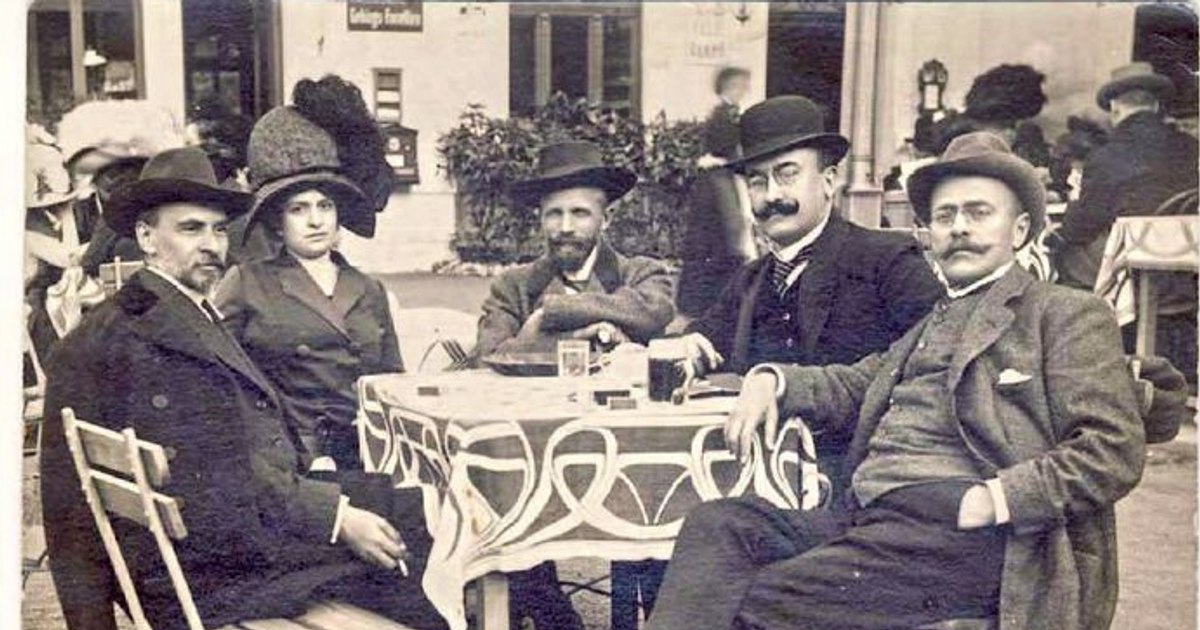
In the afternoon of June 9/22, 1912, more than seven years after he went into exile in Berlin, Ion Luca Caragiale is found dead by his wife. With the repatriation of the lifeless body to Romania, the playwright becomes the main character of a story that has become a legend: the wandering of the hearse.
Caragiale's elite entourage: Delavrancea, Vlahuţă, Coșbuc and Macedonski. PHOTO archive
Sunday, June 9, on the day of local and European parliamentary elections 2024, the question of the tormented citizen from the play “A lost letter” of the great playwright who died exactly 112 years ago.
“One morning, Caragiale never appeared in the salon again to listen to a Bach fugue. I worked alone, I started studying Schumann's great sonata in F sharp minor, a dramatic and difficult piece. Suddenly, a scream tore through the melodic thrill. I got up in fear and ran towards Caragiale's bedroom. The door was open. He, slumped on the floor, next to the bed, with his left hand clenched on the sheet, his head thrown back, his face white, his eyes fixed. Terrified, his wife looked at him. He had seen that he had not appeared as usual, he had dared to knock on the door at 11 am. The silence had worried her. He opened, saw, screamed. How to make room for pain, like that, unexpectedly? On the eve, in the evening, at the table, he charmed us with stories, projects and good cheer. He had no longer teased us about our tendencies towards poetry with absurd metaphors, he had laughed at the verve with which Luki recited pastiches composed by him… Death had reached him quickly, without hesitation, as of course he had wanted it, essence in space, verb without adjective “, write, in the volume “From a Century of Life”Cella Delavrancea, who was at that time visiting the Caragiale family.
The cause of the playwright's death is atherosclerosis, corroborated with the heart disease from which almost the entire Caragiale family perished, according to the details in the volume “Caragiale, the tragic destiny of a writer”, written by biographers B. Jordan and Lucian Predescu.
Take Ionescu: “I can't describe the grief”
Alexandrina Burelly, the writer's wife, sends a short telegram to Take Ionescu: “Caragiale is dead!“, to which the politician replies sorrowfully: “I cannot describe my grief for the death of my dear friend, your beloved husband and the greatest Romanian playwright. In the general grief may you find the courage to bear such a loss”as noted by the writer Constantin Bacalbaşa in “Bucuresti of another time”.
The newspapers of the time report on the death of the writer for three days, showing that “all the breath of Bucharest youth” is emotionally affected by such news.
Arghezi: “Caragiale does not exist for any of the fifty”
However, Tudor Arghezi describes a lack of reaction from those around him upon learning of Caragiale's death:
“However, I was expecting a general startle of my tram companions; I wanted to see them take part as well, at least as much as the gypsies selling newspapers, to our thoughts, of those who, excessively much or excessively little, value Caragiale's extinguished life. Caragiale did not exist for any of the fifty. Not even in the most lost of memories. He who descended into all these, who smothered them in detail, who dipped his pen into their mouths and into their brains, who mocked them with so much love as to make them all laugh“.
Vlahuță and Barbu Ștefănescu Delavrancea leave for Germany to be with Caragiale's widow
Upon hearing the news of the playwright's death, two of his friends, Alexandru Vlahuță and Barbu Ștefănescu Delavrancea, leave the country to be with the grieving family and especially the writer's wife. In Berlin, he talks with several close relatives of Caragiale, including Constantin Dobrogeanu-Gherea, Panait Cerna and Dimitrie Gusti, about how the repatriation of the lifeless body and the funeral will be done.
His lifeless body “Herr Director”as Caragiale was called in the last period of his life, is embalmed and deposited in the chapel of the Erster Schöneberg Friedhof cemetery, and on June 27 he is lowered into the vault of the chapel, in the presence of Vlahuță, Delavrancea and Dobrogeanu-Gherea.
But Caragiale's remains remain in the crypt of the chapel in Germany until the fall of the same year.
The alleged incident with the hearse
The lifeless body of the playwright is transported from Berlin to Romania.
The newspaper “Universul”, one of the most popular publications of the time, stands out (reported by all the others) reporting an alleged incident: the wandering of the hearse.
The article on the so-called incident is not even signed with a pseudonym.
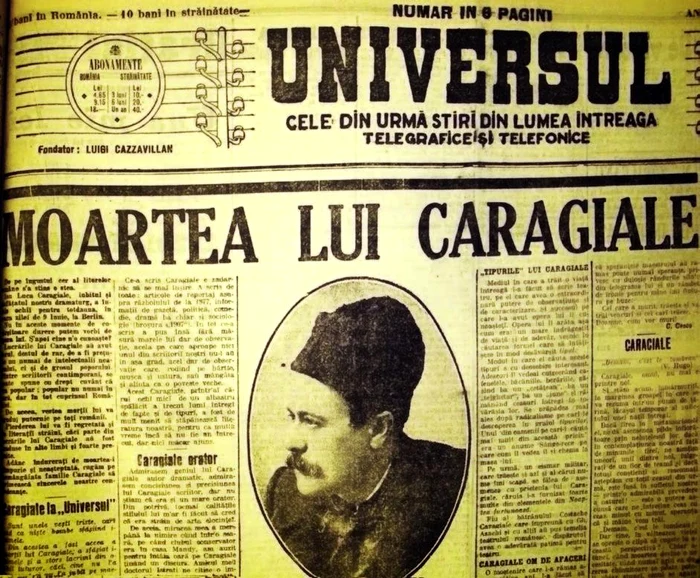
“The Universe”, the only publication in which it is mentioned that the hearse went astray. PHOTO archive
The text claims that the hearse was a freight car, that it left Berlin “without waybill”and that he got lost on the road, being discovered only in Bucharest, when the station master was surprised by the presence of a sealed wagon, about whose contents he knew nothing, because “fexpedition sheep” would have been lost. According to the article, in the end, the carriage is opened and it is confirmed that the casket with Caragiale's body is in it, and the head of the station alerts the authorities, including Take Ionescu, who became Minister of the Interior, but also those close to the playwright, Mateiu Caragiale, Vlahuță and Delavrancea.
None of those close to the playwright left any testimony about the so-called wandering of the morrow wagon
In reality, things were not like that.
In fact, on November 18, several Romanian intellectuals and journalists waited for the arrival of the casket in the Capital, which was later deposited at the “St. Gheorghe”, says the historian Șerban Cioculescu, who devoted extensive studies to Caragiale. Neither the family nor the relatives recorded the alleged episode of the loss of the wagon, which, according to the Universul newspaper, would have been on an unused line in Vienna for a day or two.
On November 22, 1912, the funeral cortege left from the “St. Gheorghe” to the “Şerban Vodă” Cemetery (Bellu), crossing “Strada Colţei, Bulevard Carol, Strada Academiei Regale, Calea Victoriei, Strada Carol, Calea Rahovei and Strada 11 Iunie to Bellu”, also passing in front of the National Theatre, which he had ruled it in the previous century.
