
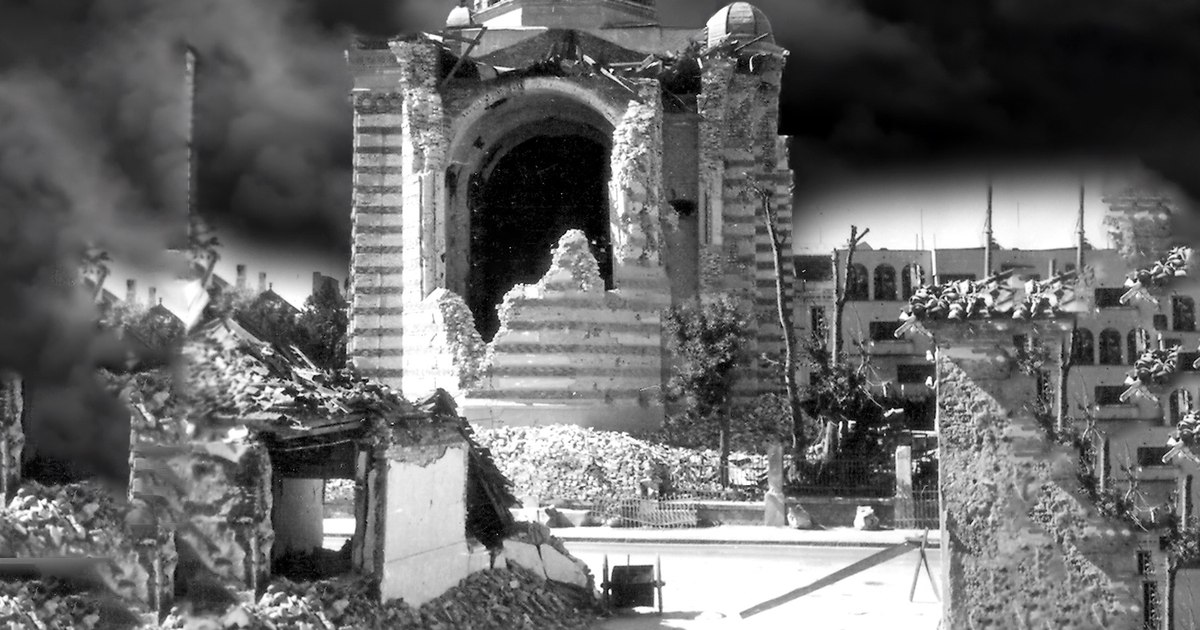
Wanting to weaken the Axis, the Allies, specifically the US, bombed in April 1944 the strategic points in Romania that were helping Germany, punctuating the blackest day in the history of Bucharest: heritage buildings destroyed and approximately 3,000 dead in just half an hour .
The American bombs destroyed several heritage buildings in the Capital. PHOTO: ANR
In the spring of 1944, Romania was still on the side of Germany, but only Marshal Antonescu still supported this alliance. On the other hand, the negotiations started in the fall of 1943 in Ankara and in Stockholm, regarding the armistice and Romania's withdrawal from the war against the United Nations, were ongoing. Prince Barbu Știrbey, the representative of King Michael and the opposition, had gone to Cairo at the end of February for negotiations with officials of the United Nations – Great Britain, the USA and the USSR – with a view to concluding an armistice. The Allied Powers, however, had no patience with the indecisive attitude of the Romanians, they wanted to act, therefore, to weaken the power of the Germans. The plan was well made: the Americans started from Africa where they had landed in November 1942, then chased the Italians and Germans into Tunisia, and occupied southern Italy in August 1943, where they began to build airfields. The US 15th Air Force was based there, from where it began the destruction of the “soft belly of the crocodile”, as Winston Churchill liked to call southern Europe. All the infrastructure put in the service of Hitler was systematically destroyed by the Americans, so Romania knew (or should have known) that it was next on the list – the Axis' own gas station.
“The Advances of Civilization Darkening the Blue of the Sky”
In Bucharest, defense drills had become a habit – when the alarms started going off, people had to hide in air raid shelters. On April 4, 1944, at 11:00 a.m., such an exercise had just taken place. So, at 1:30 p.m., when the first bombers entered the Capital's airspace and the alarms started ringing, the world ignored them, thinking it was another exercise. No one noticed when the clear spring sky darkened and at precisely 1:45 p.m. it began to rain bombs. “I was at lunch, towards the end, when the sirens started wailing. At first I thought it was a continuation of the passive defense exercise that had taken place in the morning. After 15 minutes, the cannons started going off, and we realized it was no joke. And then the dance began, which lasted an hour or so… Three times I thought the house was falling on my back; the walls and objects also shook like an earthquake… but I only got away with a few broken windows. A formidable explosion, in the neighbors towards Lascăr Catargiu Boulevard and the whole block where my daughter had her apartment (the Băicoianu building) collapsed! Lucky that my daughter had breakfast at my place (it was her birthday and it was nice, but God sent her!)… The bomb went through her dining room, if she was at home, it was ready… And also lucky that she evacuated the little girls them eight days before at Breasta… It is easy to understand the state we were in at my place, listening to the booming of the cannons and the crackling of the bombs, waiting every moment for it to end with us too”, noted in his memoirs the politician Constantin Argetoianu, former prime minister of Romania.
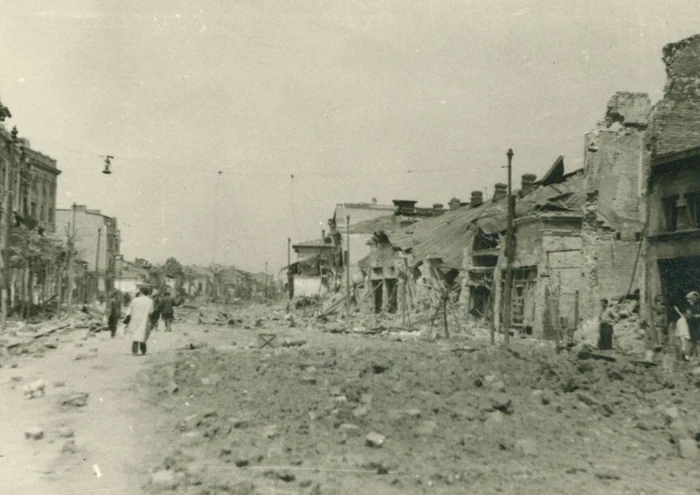
The ruins of the Basarab neighborhood PHOTO ANR
On the other hand, General Constantin Sănătescu, head of the Royal Military House, wrote with surprise in his diary: “At 1:40 p.m. the alarm sounds. 250 Anglo-American planes arrived, which bombed the capital for an hour and a half, causing considerable damage in the Cotroceni, Grivița and Gara de Nord neighborhoods. This bombing was a big surprise for us, because we had gotten used to the idea that Bucharest would not be bombed”. Maruca Cantacuzino, who was at home (on Calea Victoriei, in Casa cu Lei), also wrote about the 30 minutes with the smell of death later, together with her husband, the composer George Enescu: “On the clear spring sky, stormy , unexpected artillery salvos, explosions that tear our doors off their hinges, formidable detonations shattering the windows in the place where George Enescu composed his quartet in E flat major. Another earthquake, this time caused by the murderous madness of men, overturns and collapses all around us the houses upon their occupants, the pigeons fly madly in the metallic glare of the light flares. The last roar of the technical genius of the century… the progress of civilization! Which darkens the blue of the sky, covers the sun”.
Immobilized Bucharest
The Americans clearly knew what they wanted to achieve with the 313 bombers escorted by 119 fighter planes: the destruction of the railways. But, in half an hour, they did more destruction than (perhaps) they had planned: they were hit frontally by a “carpet of tactical bombs” the neighborhoods of Filantropia, Grivița, Parcul Domenii, the Biserica din Nicolae Titulescu Boulevard, Dinicu Golescu Boulevard , Calea Griviței, Calea Plevnei, Calea Victoriei, Cotroceni District, Sfânta Vineri Cemetery, North Railway Station, Ambassador Hotel, Splendid Hotel and Athenee Palace, Argentine Legation, Royal Palace, Matache Măcelaru Square and Jules Michelet Street. Also, next to the North Station, the Grivița Workshops of the CFR were also destroyed, collapsing on all the people inside.
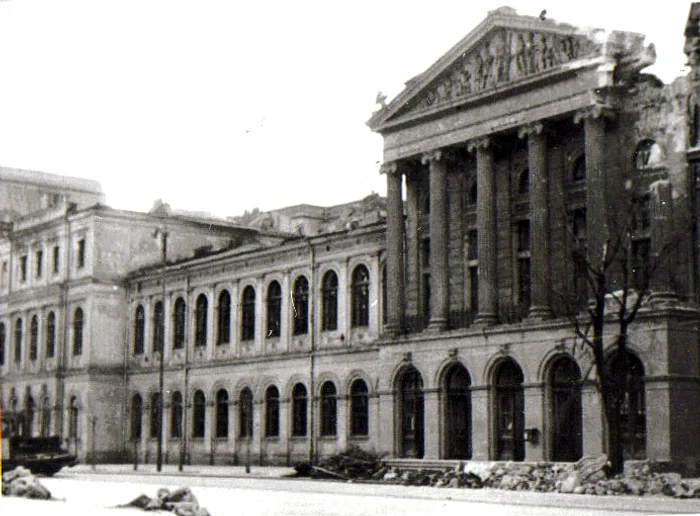
The University building, among the most affected. PHOTO NO
Public transport stopped working in the capital for a few days – cars could not find their way through the piles of rubble, and trams stopped working because the Grozăvesti power plant had also been damaged. A day later after the bombings, Sănătescu described the situation in the Capital: “So far, 900 dead and 1,200 wounded have been registered. There is a lack of water in the city, the water pipes and the Grozăvesti Plant being damaged. The trams are no longer running. Luckily the electric light works. After the meal the alarm went off again. About 300 planes approached Bucharest, but then headed towards Ploiești, where they heavily bombarded the Gării de Sud district. There is a lot of damage, especially in the center and at the oil refineries. There is a lack of food in Bucharest, because those in the vicinity of the city are afraid to come with the usual supplies”.
“Three women mourned a charred corpse”
Although the Americans had only targeted strategic points, their aim being to affect the Nazi machine and not to destroy Bucharest, the bombs launched – more than 2,500 explosive bombs, plus many incendiary ones – destroyed whole neighborhoods, being buried under the rubble more than 5,000 people, of whom nearly 3,000 died. “When I went out into the courtyard, I saw countless colored papers floating (probably manifests) and I thought that the planes had really dropped nothing but manifests… The first rumors coming from the city (a bomb on Brezoianu, one on Strada Carol) – they seemed like fabrications. When I went out to the center, a strange nervous agitation enlivened the streets, as if more out of curiosity than terror. Only later did we realize the extent of the disaster (…) Yesterday afternoon I was in the Grivița neighborhood. From the North Station to the Basarab Boulevard, not a single house – not a single one – escaped untouched. The sight is heartbreaking. The dead are still being dug up, wails are still heard from under the rubble. At a street corner three women were wailing—with shrill screams, tearing their hair, tearing their clothes—a charred corpse just then pulled out from under the rubble. It had rained a little in the morning and the smell of mud, soot, burnt wood hung over the whole slum. Atrocious, nightmarish vision. I was no longer able to go beyond Basarab and I returned home with a feeling of force, horror and helplessness”, Mihail Sebastian described the situation in his diary.
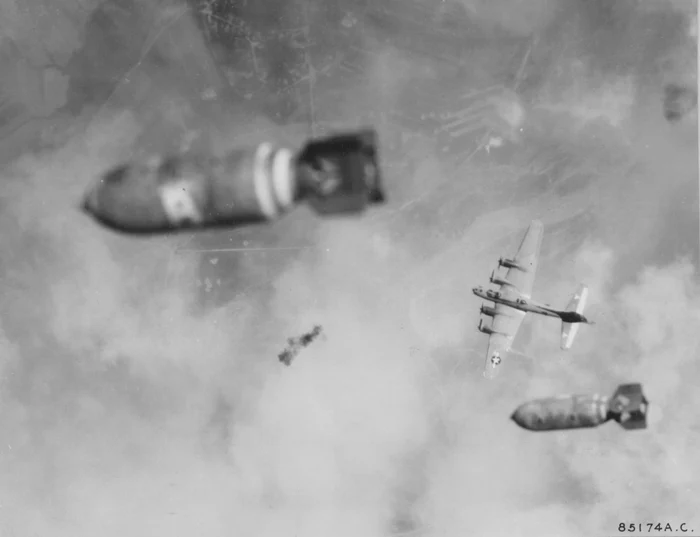
Death came from the sky – so said the people who caught the fateful day. PHOTO NO
The picture was completed, among others, in pages of diaries and memoirs, also by the diplomat and professor Ion Hudiță: “I saw on Pake Boulevard, close to Calea Moşilor, both sidewalks full of broken windows, and the street sergeants trying to prevent the passage of pedestrians, for fear of collapsing the walls of the buildings. I saw Taşca's house; it had all the windows broken and a collapsed balcony. I got home around three o'clock. My parents had watched from the living room window, along with my mother-in-law, the hundreds of planes shining in the sun. From Calea Moşilor to Vatra Luminoasa, not a single bomb fell. By 4 o'clock I found out on the phone the disaster in the city, especially the Griviţa neighborhood and the North Station. At 5 o'clock Mielu Mihăiescu comes by car to visit the workshops and garages of the Society to see what damage the bombing caused. In Cobălcescu, the building suffered nothing except for the windows, all of which were broken. At the Ambassador Hotel, a bomb fell right on the sidewalk, breaking all the windows of the facade, as well as of our Central.”
“Flames were coming out of every window”
Historian and economist Gheorghe Zane, who was at the time of the bombing at the North Railway Station, waiting for his luggage from Iași, notes: “Suddenly, a rain of bombs began to fall from the Railway Station advancing in the famous “carpet” towards the center. We took refuge in the basement of the Union Hotel where we lived, not realizing the danger of this kind of shelter. The bombs were falling around us, continuously… Outside it seemed that an inferno had broken out. In the shelter, children began to cry and some women screamed. Slowly, slowly, the rumblings became rarer, until, after about an hour, they were no longer heard. (…) Athénée Palace could be seen burning, smoke was rising from other parts of the city. Lena and I left the hotel and with a sense of horror we headed towards the Athénée Palace which was still burning, flames coming out of every window; a little higher, on Calea Victoriei, I saw the Splendid Hotel smoking, almost completely demolished, on the sidewalks only shattered glass from the shop windows destroyed by the bombs. Behind the devastated Athenaeum, the exhibition site of the Patronage Committee was still smoking. Up Calea Victoriei, on the left and on the right, from place to place, demolished buildings. Up to Frumoasa Street, all the windows were broken; I tread carefully and avoid the piles. From St. Voievozi Street towards the North Station, the bombardment had caused terrible havoc. I saw a streetcar caught in motion; the dead leader lay slumped with his chest pressed against the controls. I didn't go any further”.
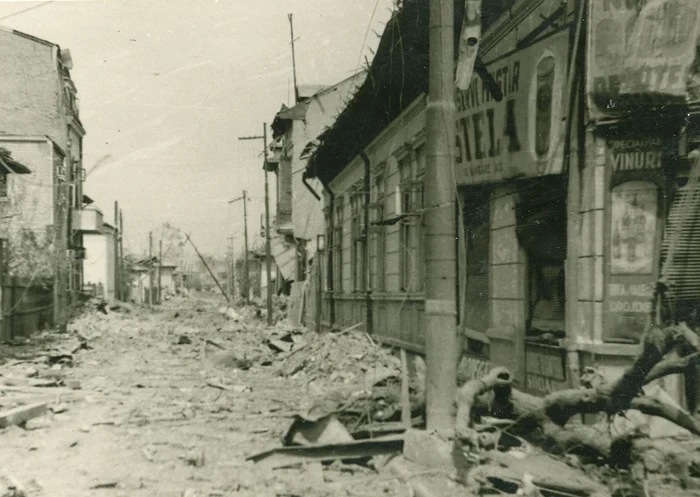
The ruins of Grivița neighborhood PHOTO ANR
The Allies had achieved their objective and the most affected was the North Station: “We visit the neighborhood of the North Station and Calea Griviţei. Ruined houses, uprooted trees, streets full of rubble, where we can't even drive through. Lines of soldiers and street sergeants try to direct traffic. Ambulances and doctors run to transport the wounded. Groups of soldiers and citizens seek to remove the bodies of the dead and those who may still be alive from under the rubble. We walk along Calea Griviţei to the room that Mircea and Lizeta had rented. We find, instead of the house, a huge pit with water. The bomb had fallen right on the house. I later found out that they were in the city, during the bombing, because otherwise they would have been pulverized, like all the 7 people in the other rooms, who were all horribly mutilated. (…) Woe to the poor refugees from Moldova, who, after leaving their homes, now see the few things they were able to save lost in the North Station”, wrote Ion Hudiță.
