
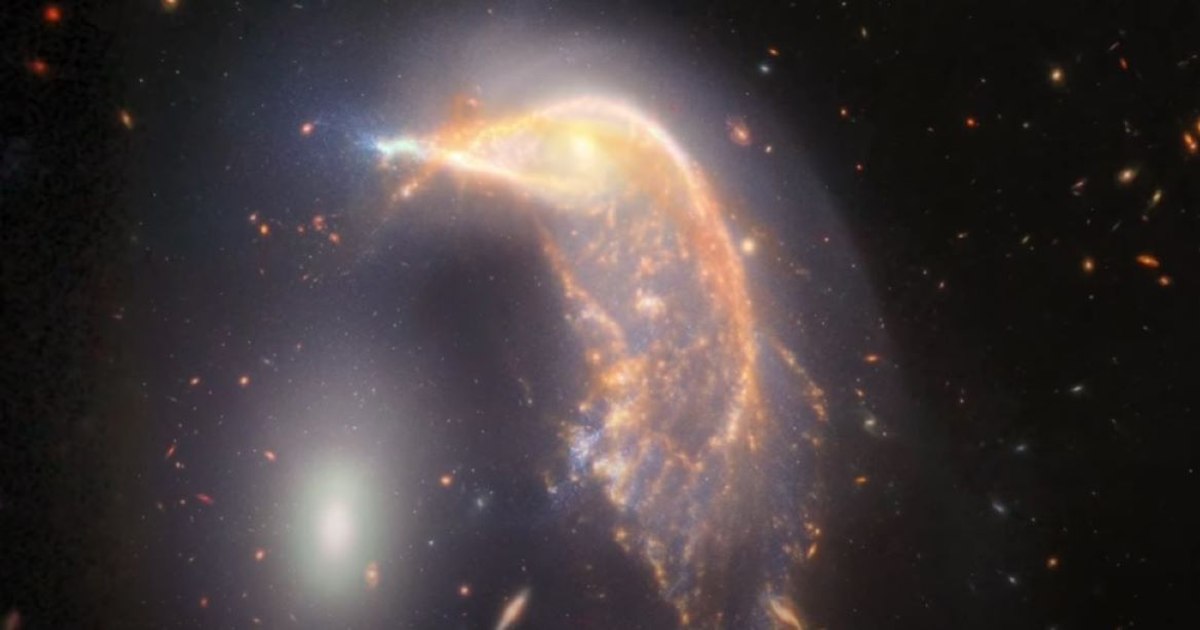
Two galaxies, nicknamed the Penguin and the Egg, were captured by the James Webb Space Telescope. Launched on December 25, 2021, the Webb telescope provided its first scientific observations of the Universe on July 12, 2022, according to CNN.
“With remarkable images from all corners of the Cosmos, going back almost to the beginning of time, Webb’s capabilities shed new light on our celestial environment and inspire future generations of scientists, astronomers and explorers.”said Bill Nelson, NASA administrator.
Webb used his scientific instruments to create a detailed portrait of the Penguin and Egg galaxies, collectively called Arp 142. The galaxies, named for their resemblance to a penguin guarding an egg, are 326 million light-years from Earth , in the constellation Hydra.
And the Hubble Space Telescope took an image of this duo in 2013. Photo YouTube video capture
The two galaxies are about 100,000 light-years apart, which is astronomically close. For reference, the Milky Way galaxy’s nearest neighbor is the Andromeda galaxy, 2.5 million light-years away, and the two are expected to meet in about 4 billion years. A light-year, the distance light travels in one year, is 9.46 trillion kilometers.
According to astronomers’ estimates, the Penguin and Egg galaxies first interacted between 25 and 75 million years ago. From that moment on, their celestial dance continued, spinning around each other. In millions of years, they will merge into a single galaxy.
In addition, the Hubble Space Telescope also captured an image of this galactic duo in 2013.
At first, the Penguin looked like a spiral, but over time, its appearance changed due to interactions with the Egg galaxy. Currently, the center of the galaxy serves as the Penguin’s eye, and its arms resemble a beak, head, or spine.
“Webb Offers Insights into Old Mysteries”
The dance between the two galaxies resulted in a gravitational pull on parts of Penguin, causing some of the gas and dust filling the galaxy to collide and lead to waves of star formation.
Meanwhile, the oval-shaped Egg Galaxy remains about the same. Filled with aging stars, the galaxy contains less gas and dust than Penguin, so its structure has not been affected. And since both galaxies have about the same mass, the Penguin did not overtake the Egg.
Astronomers believe the Webb telescope will operate for at least two decades, providing a unique way to study the Universe and solve some of its many mysteries.
“In just two years, Webb transformed our view of the Universe, enabling the kind of world-class science that led NASA to make this mission a reality.” said Mark Clampin, director of NASA’s Astrophysics Division.
“Webb offers insights into long-standing mysteries about the early Universe and ushers in a new era of studying distant worlds, while providing images that inspire people around the world and pose exciting new questions to be answered. It has never been more possible to explore every facet of the Universe.”
