
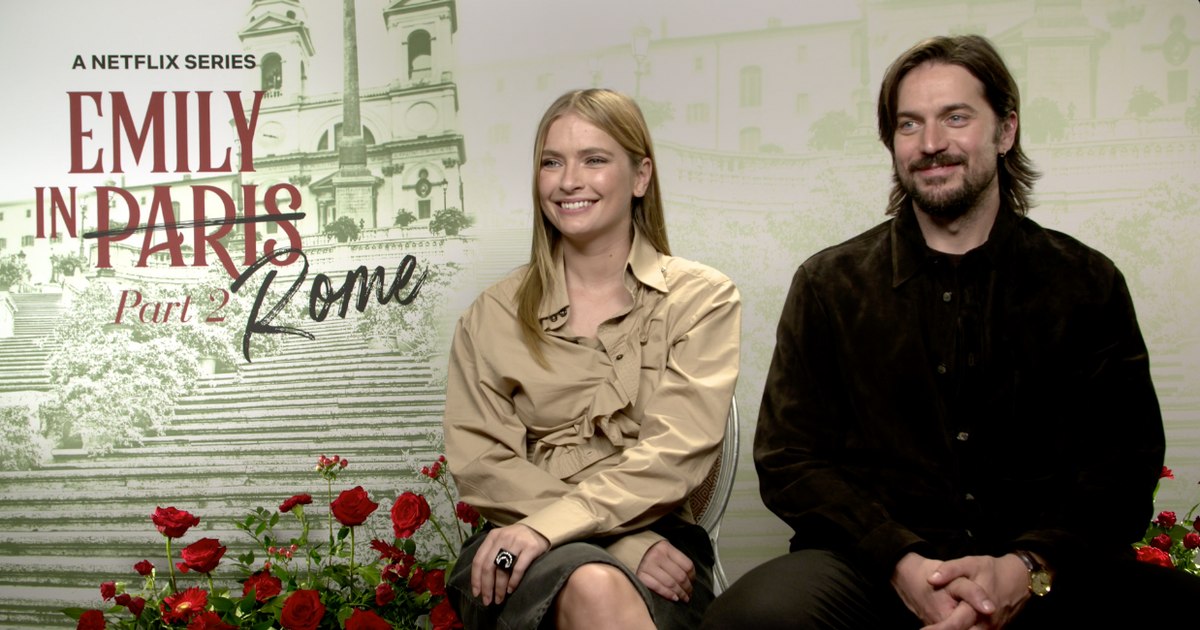
In an exclusive interview for “Weekend Adevărul”, the actors from the series “Emily in Paris”, Samuel Arnold (Julien), Bruno Gouery (Luc), Camille Razat (Camille) and Lucas Bravo (Gabriel), talk about the role of fashion and gastronomy as a bridge between worlds and reveals details behind the scenes of the Netflix production. French actors also debunk the myth of clichés, saying that they are starting points in the discovery of a culture.
Camille Razat and Lucas Bravo, during the interview for “Weekend Adevărul”
At first glance, the series “Emily in Paris” seems like a romantic comedy, which presents the adventures of a young woman from Chicago who came to Paris for her dream job. But once you get the hang of it, you can discover many layers, just like a mille feuille cake. Emily Cooper, played by the beautiful Lilly Collins, crossed the Ocean for more than eating croissants and visiting the capital of France. She is the bridge between two worlds: between Europe and America, between the latest fashion and haute couture – through her creative and energetic nature, she manages to befriend the conservative vision of promoting luxury brands with non-conformist marketing and the trends offered by social media.
Cliché, je t’aime!
At the Grateau agency, run with an iron fist by Sylvie Grateau (played by Philippine Leroy-Beaulieu, who impresses with her refined, classic, impeccable style), things take shape with the help of the experience of two of Emily’s charismatic colleagues: Julien ( who is brought to life by Samuel Arnold) and Luc (played by Bruno Gouery). The three basic people of the agency bring, each a little, something from the classic portrait of the Frenchman, but on a light, funny, sympathetic background. In the end, it turns out that the French are not so tough either – the hermetically sealed shell, wrapped in a thin layer of arrogance and well-lined with many tricks can be cracked with charm and empathy, with curiosity about their culture .
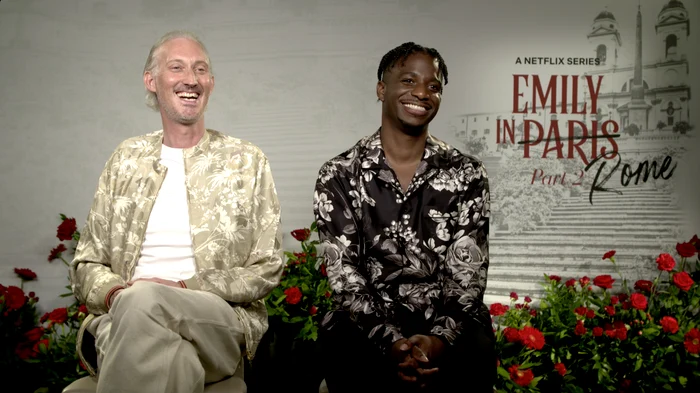
Bruno Gouery and Samuel Arnold, interview for “Weekend Adevărul”
Beyond the characters, many who watched the first three seasons of the series – of course, most of them being French – remained trapped in the first cinematic line, represented by, as many called it, an ostentatious display of French clichés : the numerous and ample frames of the tourist attractions, the food with an emphasis on fine dining and pastry, the extravagant clothing. Samuel Arnold and Bruno Gouery, French actors by the way, told exclusively for “Weekend Adevărul” that a cliché, although the word itself has acquired this negative connotation, is by no means something bad, but on the contrary, even a way of conveying to as many people as possible more about their country. “The cliché comes from somewhere, it is not an invention. When you live in a certain place, you have your own way of doing things, everything seems normal. But from the outside, it all seems like a cliché – and that’s for everyone. Yes, Emily in Paris is built around those clichés, but there are funny stories being told, that’s how I see it“, says Samuel Arnold.
Bruno Gouery, also a French get-beget, reinforces this perspective of embracing clichés as something normal, even something to be proud of: “The cliché is just something small, a part of the truth about something – about Paris, about France – that can make the whole world understand and seek, discover the complete truth. It is a starting point. That’s why, sometimes, we need clichés”.
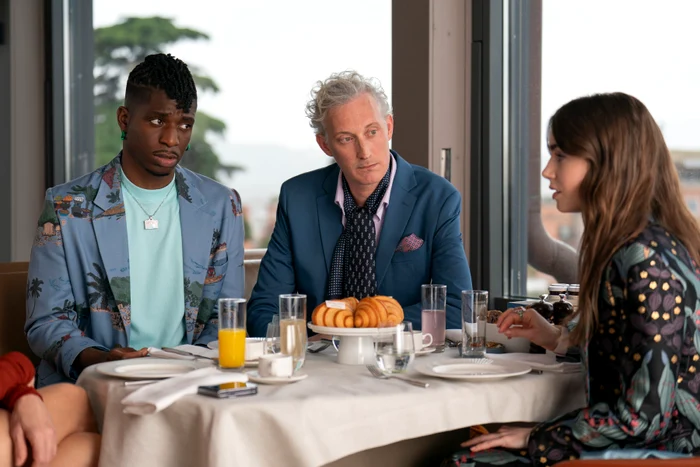
Luc, Julien and Emily, colleagues at the Grateau agency. PHOTO: Netflix
The world of clichés is even better defined for “Weekend Adevărul” by Camille Razat and Lucas Bravo, the two actors who give life to the characters Camille and Gabriel – she, a sophisticated girl, who comes from the class of the small French aristocracy, he, a young chef charming, who wants the restaurant he owns and works at to receive a Michelin star (which he will go the last hundred meters for in the new season). “We can say that we juggle clichés. We started with the classic ones – the French who smoke after leaving the gym – but season after season, they started to become more nuanced and thus, to clarify more things that people thought they knew about Paris. I think it’s a smart approach: you start from a safe place and then they allow you to explore and learn more about French culture”Bravo scored.
La mode et le monde
Leaving aside the conclusion that, after all, clichés are a good thing, they are just a starting point to get to know a new civilization, “Emily in Paris” brings back to the viewers’ attention that food and fashion are undoubtedly a link between worlds, centuries old – in fact, we could easily say that fashion is one of the main characters. Bruno Gouery says that through his character he rediscovered how important the fashion industry is to society: “Clothes are important to everyone: from society to our show, characters, even for us as actors – a costume sets the tone for the direction you create your character in.”. “In addition, we have Fashion Week in Paris, Milan, New York and wherever you go, you meet the same people who come from all over the world. So fashion is something universal, just like film – it’s art and everyone understands it”Arnold added.

The relationship between Camille and Gabriel, in the foreground in season 4. PHOTO: Netflix
Emily’s attire remained, even into season 4, a topic of intense debate. The bright colors, as well as the tributes to French cinema and famous actresses, such as Audrey Hepburn, stole the show in the first three seasons. This time, Emily’s maturation, as well as the refinement of her tastes after a state period in Paris, are reflected in the new outfits: inspired by the British model of the 60s, Twiggy, but also by films such as “American Pshycho” or “Charade” , another tribute to Hepburn. “Emily’s style evolves and becomes more French, impeccable. Embrace French style more – it’s clear how fashion is a link between two such different countries“, said Camille Razat. “Food is also a form of art and expression. You can always start a discussion about food. Feeding people is an art form. Every mother or grandmother in the world who has faced food shortages will tell you to eat more – it’s the language of loveBravo added.
The pastel part of the series
After four seasons of “Emily in Paris”, the actors say that the masks they wore, the characters they took on, can help them in real life, as well as those who watch the series. For example, Samuel Arnold recounted his own experience: “I helped my older sister, for three or four months, at her marketing company, and I really managed, I even did Julien’s work (laughs)“. Camille confesses that she had to learn from her character how to be vulnerable in front of people, an aspect that she has been working on for a long time with her, on a personal level. On the other hand, Bruno Gouery has not only learned to appreciate more what clothing means to an actor, but says that his character offers many landmarks for those who want to know France: “Luc talks about Balzac, about the films of François Truffaut, but also about Antonioni. I have many things to share in the series. And I would be very happy if people from all over the world discovered a little bit of French culture in this way”.

Season 4 scene shot at Monet’s memorial house. PHOTO: Netflix
Ever since the last seasons, the action of the series has been more than Paris. Several scenarios took place in picturesque places in France, in small family restaurants, next to a lavender field or in a vineyard guarded by a manor house. This time, art prevails, and the viewer is taken, along with Camille, to Monet’s home, to Giverny, among green and blue, among water lilies and pastels. “It was incredible, especially since we thought we were going to shoot in the studio. Monet’s house is an hour and a half from Paris, it is an extremely poetic and magical place. It is a must-see for anyone coming to FranceCamille confessed.
Now, all you have to do is watch the series and discover France through the eyes of an American woman, through the eyes of French women, through your own eyes, peeling away layer by layer – and as quickly as possible, because Emily is about to say “Au revoir, Paris! Bye, Rome!”.
