
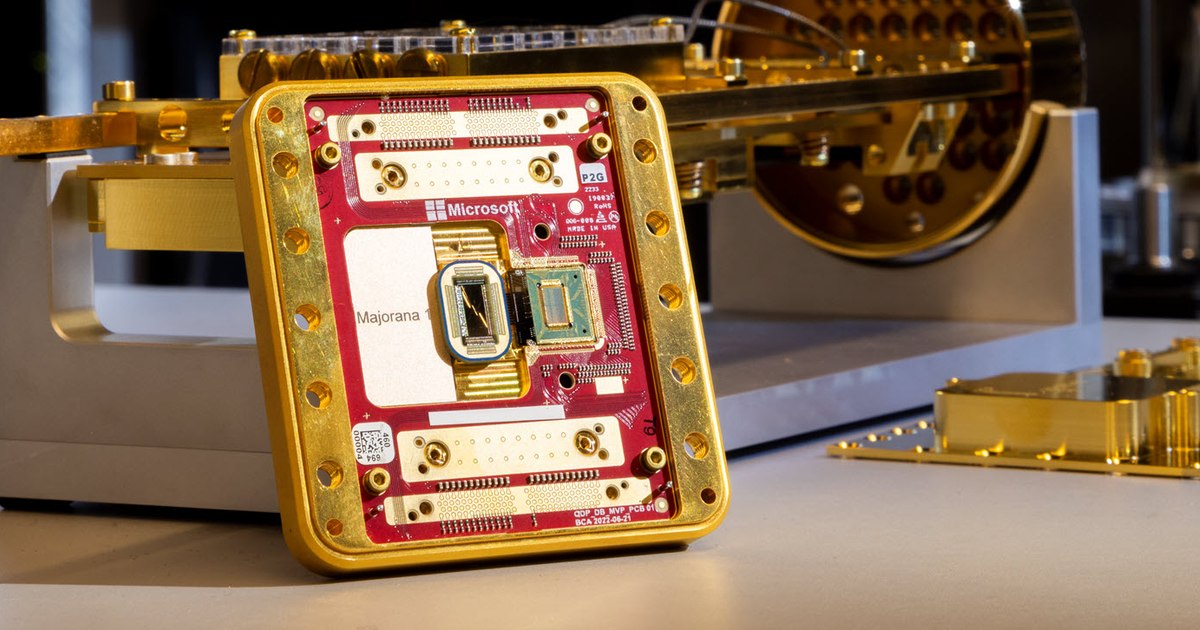
Quantum computers could be built in just a few years, according to Microsoft, which has revealed a new chip that could accelerate their development.
Quantum computers could be developed within a few years with the help of new Microsoft photo chip
The technological giant has created a CIP which claims to represent a leap comparable to the invention of semiconductors, which have made possible smartphones, computers and electronics by diminishing the dimension and increased processing power, The Guardian reports.
The chip is powered by the first topoconductor in the world, capable of creating a new state of matter that is not solid, liquid or gaseous. This innovation allows the design of quantum systems that fit in a single chip smaller than the palm of a hand and provide a more reliable hardware.
The race for quantum computers
Paul Stevenson, professor of physics at the University of Surrey, believes that Microsoft might become “A very serious competitor” In the race for the construction of the first reliable quantum computers, if you manage to advance in this direction.
“These works are an important step, but as in the case of many promising innovations in the field of quantum calculation, the following steps are difficult. Until they are realized, it’s too early to be more than optimistic prudent ”Stevenson said.
George Booth, professor of theoretical physics at King’s College London, described research as on “An impressive technical achievement”although its real value could become obvious only in retrospect.
“It remains to be seen whether Microsoft estimation that this progress will lead to significant developments in just a few years.”he said.
What could such a computer do
Microsoft claims that its topoconductor could allow the development of quantum systems capable of reaching one million quubites – fundamental units of quantum calculation, the equivalents of the current computers.
These extremely powerful computers, based on quantum mechanics instead of classical physics, could solve complex industrial and social problems. Possible applications include:
- Disintegration of microplastics in harmless products;
- Creation of self-healing materials for construction, production or health;
- Optimization of complex supply chains;
- Breaking the encryption codes.
This month, the Agency for Advanced Defense Research Projects (DARPA) has selected Microsoft Topoconductor as one of the two directions it explores to determine if it is possible to build a useful quantum computer on an industrial scale by 2033 – much May – early than current estimates.
The other approach is developed by Psiquantum, which uses silicon-based photon, a light-based technology, to create a quantum computer made up of a photon qued network.
From failures to a new direction
Microsoft has previously claimed that he created topological quubes, but a study was withdrawn from scientific errors.
Although the company’s progress was slower compared to other rivals, it focused on “Long -term game”working on a more resistant noise and interference system than fragile quantum computers built by competitors, explains Booth.
“These topological quubes protect the information they carry using the properties of a new emerging particle, the Majorana farm, which makes the information harder to lose during processing. However, this technology is more complex than other competing architects ”he said.
These major particles have never been observed or created previously. Microsoft explained that they had “Coaxate in existence” Using magnetic fields and superconductors, which is why most research in the quantum field has chosen other directions.
Booth believes that this progress could be a solid basis for a technology “Capable to compete with the most advanced solutions developed by companies such as Google”. However, there is a long road until it is shown that this system can be scaled at the industrial level.
