
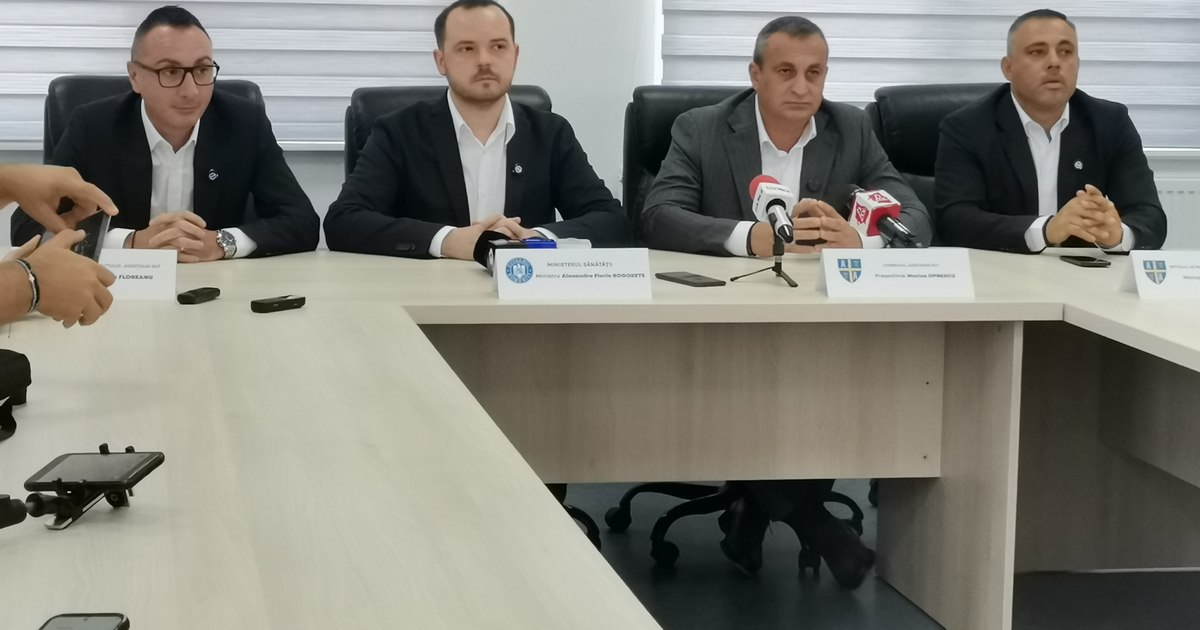
Present in Olt County to inaugurate a section of treatment of post-currency addictions, the Minister of Health, Alexandru Rogobete, said that next week an emergency ordinance will be adopted that substantially changes the normation of the staff in hospitals.
The Minister of Health made a visit to a hospital in Olt Photo: Alian Mitran
Asked how the problem of personnel deficit in public hospitals can be solved, the crisis of doctors in certain specialties being almost generalized, the Minister of Health said that other European countries are facing the lack of doctors, in return the problem of distribution of specialists is added to the Romanian system. Next week an emergency ordinance will be adopted that will produce substantial changes, the minister announced.
“It’s a reality. Unfortunately, it is not the reality of this country, in many European countries there is a lack of staff on certain specialties. For example, Germany is experiencing lack of anesthetists, Romania is facing several specialties. (…) As a number of doctors per 100,000 inhabitants we are not well below the EU average. We are with 0.6 points below average, our problem is their distribution at national level, in the sense that in certain sanitary units there is an unequal, reduced distribution, and in many large centers, for example, they are overcrowded. It is an overcrowding, on certain specialties, of medical personnel ”, said the minister.
“Romania is in the first place in the number of continuous hospitalization beds at European level”
This situation came into this situation, Minister Rogobete believes, because “The hospitals have not been reset for over 20 years ”, and the legislation regarding the personnel norm is unchanged for so long.
“At the moment, Romania is in the first place in the number of continuous hospitalization beds at European level, only that those continuous hospitalization beds are empty. In many places the degree of occupancy in certain sections does not exceed 5% per year. The complexity of the cases, the related services are not taken into account, the auxiliary staff is not taken into account ”the minister drew attention.
Things would be corrected by an emergency ordinance that “will change the way of calculating the personnel regulations to 180 degrees ”. In establishing the personnel need, to a lesser extent the number of beds will be taken into account, an essential indicator, instead other indicators will be taken into account, such as the rolling of patients, the number of patients who are stationary, the number of days of stationing. “One is to have patients who stay on average two days and the other is to have patients who stay 20-30 days, one month, two and so on. The complexity of the cases will be taken into account ”said the minister, giving example the neurosurgical interventions, which are complex services that require more medical personnel, the patient requiring recovery, interdisciplinary consultations, etc.
“C.Red that with the rethinking of the organization of the health units, with the rethink of the normation according to the historian and the addressability of the health unit, things will change ”, added the minister.
Changes in the future and for the ambulance system
Changes would take place, although the minister did not grant a term, and in the ambulance system, which will be reorganized, reaching the conclusion that “A territorial administrative organization is much more efficient than a local one.”
The county ambulance stations remain, the minister said, instead there will be changes in the coordination. “Next in Olt will remain the ambulance station, with all its staff, except the manager, is true, because when you combine the coordination on several counties, the coordination will be done at one point”, He commented on Rogobete, later stating that this is not what things will be regarding the Olt County Ambulance Service, but that analyzes are still done.
“We have not yet established how many counties, which and how it will be done, we do not know that. At the moment the analysis is done on the figures, the population served is calculated, the number of crews are calculated, including geographically, access, roads and so on, and depending on this reorganization it will be thought about how the administrative coordination will be established. Again, no ambulance service from any county is abolished, only that certain ambulance services will be territorially coordinated from a single point, this is all that is happening ”, said the minister.
“It will certainly reach quite a lot of places to terminate the employment contract”
The Minister of Health also referred to the possibility that the doctors in the public system continue to carry out activity in the private environment. The minister said that he does not intend to prohibit the state -owned doctors to activate in private, instead, through legislative changes, more autonomy to hospital managers will act in certain situations.
“I am not in principle that the doctor has to choose between the public or private, but, as I said firmly and I say it now – including an important legislative change will appear next week in this field – I asked my medical colleagues to respect their work schedule. After the work schedule in the public system, obviously, each one is free to carry out their doctor’s activity, or to provide medical services, where he wants. (…) By the legislative modification that will appear next week, the manager of the sanitary unit will have many more administrative tools than he has now and will certainly reach quite a lot of places to terminate the employment contract for non -observance of the legislation in force. I do not ask for no more, I do not ask for anything atypical, I do not ask for anything strange, I only ask to respect the work schedule in the public system for which that doctor is paid ”, concluded Rogobete.
