
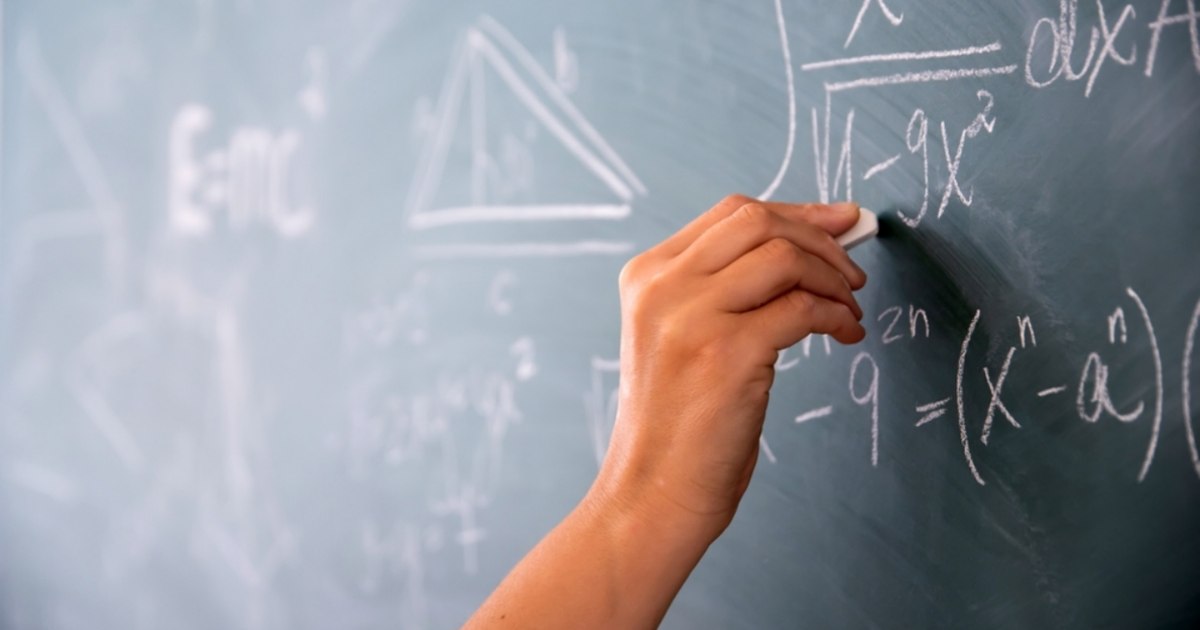
The deficit of teachers in mathematics, physics and chemistry has become one of the serious vulnerabilities of the Romanian school. The phenomenon is not a short -term one, warns the education expert Marian Stas, but the result of decades of erosion of the quality of education and the lack of real reforms in the training of teachers.
Romania is facing a deficit of the Mathematics Photo Mathematics Teachers
A crisis that can no longer be ignored
Romania faces in 2025 a crisis of teachers, especially in the fields of STEM (science, technology, engineering, mathematics). The vacancies remain unoccupied, and the young graduates are increasingly oriented towards the teaching career.
According to the OECD report “Education at a Glance 2024”, Romania is among the 18 of 21 countries with a deficit of qualified teachers. The biggest lack of teachers, is observed in the chairs of mathematics and exact sciences.
No other European countries are better at this chapter.
“All countries are facing a lack of mathematics teachers, which highlights the global challenge of attracting and retaining teachers in this essential subject. Similarly, all, with the exception of France, do not have an adequate number of science teachers. (…)is shown in OCDE analysis.
Starting from the global problem, we turn our attention to our country. Education expert, Marian Stas, explained punctually for Adevărul, who were the factors that brought Romania in this situation and how much it has to be related or could be accentuated by the current crisis in education.
“The theme of the small number of teachers or the diminution of the number of teachers in the stem area is the deep evil. We are not talking about a short -term situation, but one that has reached in time. It has 10% related to what is happening now. It is unrelenting and insignificant for what this metastasis of human resources means” “warns Marian Stas.
He emphasizes that the problem is not only the present, but the way in which both the Romanian school and the universities worked for decades.
“Mathematics, physics, chemistry fields, require serious effort and training. That very deep evil is related to the way both the pre -university public system works – how children are prepared for further – as well as the way the university system works which, in fact, does not prepare teachers ”added the expert.
Proposed Solution: License for teaching profession
One of the main causes, according to Stas, is that “universities do not train teachers”. Specifically, it is about the lack of a clear chain of didactic training. Currently, graduates become teachers after giving a few pedagogy courses, but there is no specific license for the didactic profession.
“My pleading for many years has been for a license for the teaching profession. In other words, if Florina wants to become a mathematician, and Marian wants to become a mathematics teacher, we go to the first year at the Faculty of Mathematics with two totally different programs. Because being a mathematician, to be a professor of mathematics. teachers.says Stas.
A concrete first step in the direction of reforming the training of teachers is made by the University of Craiova, which launches, in the national premiere, from the academic year 2025-2026, two teaching programs with dual specialization: chemistry-biology and history-philosophy.
These programs start from a rigorous planning: it takes four years and were included in the educational offer following a draft Government Decision, which modifies the study nomenclature, adopted this fall by the Ministry of Education.
“Finally, there is a first university that begins to train teachers from the first year, not chemists and biologists, through a bachelor’s degree for the teaching profession. The master’s degree, as they were invented, are not bad, but they do not solve the problem. It is difficult to make young teachers after having gone through the license years.”points out the expert.
Moreover, the admitted students will also benefit from a substantial financial incentive: a monthly scholarship of approximately 2,165 lei, the equivalent of the net salary of a beginner teacher, as provided in the norms of the Ministry of Education for double specialization teaching programs.
The effects of degradation of the quality of education
The teachers’ crisis is also fed by the constant decrease in school standards, which discouraged young people to choose the “heavy” disciplines.
“The problem is that, with the deterioration over the decades of quality and decreasing the degree of rigor for what this area means, many things have failed, including the appetite of young people for those didactic professions that require more work than communication and public relations.”states Stas.
The expert emphasized the idea that all the evil has accumulated and amplified with the passage of years. During which no measures were taken in the pre -university system, nor in the university system. Thus, more and more young people preferred to choose the so-called “easy path” and to turn their attention to studying human profile subjects.
“Fewer young people are interested in the faculties of mate, physics, chemistry. Why? Because it is difficult and the job is serious, and their high school exercise, in an overwhelming proportion of the number of students, is a very weak one ”adds the specialist.
Three directions to follow: rigor, teaching licenses and professional recognition
Marian Stas identifies three major directions of action.
1.
Return to rigor in the system
UNIVERSITY:
“The one in pre -university and high school and high school is the return to what it means to rigor, demand, seriousness in preparation for mathematics, physics, chemistry, all that means sciences. Matters that, by their nature, cannot be memorized. It requires serious work and solving hundreds of thousands.,
he says.
2.
Creating license programs for teaching profession:
“In the university area it is mandatory to mobilize all the universities on what means the construction of the license programs for the teaching profession. Our young people do not go out of literature, physics, mathematics, history, etc., philologists with pedagogy loans, mathematicians with pedagogy loans, historians with pedagogy credits”,
emphasizes the idea of the education expert.
3. The recognition of the status and pay
appropriate:
“The third large component, the one of human resources, the recognition of the status of teaching profession, the meritocratic pay, with an honest financial package, correct for those who are performing”concludes the specialist.
Holding is the poisonous ingredient
Stash criticizes hard and the current degree mechanism, which they consider to be one of the causes of mediocrity.
“From this point of view, the degree is the poisonous ingredient of the first rank for the quality of education and the quality of the teachers’ performance in Romania. It is an epitome for mediocrity in a pure state. The enemy once won leads to mediocrity. What incentive I would have to behave professionally if I know that I am in the post until I go out”he says.
In the session of 2025, only 43.52% of the candidates evaluated at the written test obtained the minimum grade of 7, the threshold necessary for the indefinite period. After resolving the appeals, this rate rose to 46.66%, ie 14,532 candidates can be titled, but only if there are available positions, and at national level, only 9,180 vacancies are announced
The paradox is obvious: Romania has, on the one hand, a deficit of teachers in the Stem area, but on the other, there are qualified candidates who cannot be employed due to administrative rigidity and inefficient distribution of human resources in the system.
The appetite of young people for exact sciences stimulated by artificial intelligence
Despite the dark picture, the expert also sees a potential factor of change: technological evolutions could resist the interest of young people for science.
“I expect that with the impact of artificial intelligence and with all the things that are happening now: robotics, drones, there is a counterparty. A sufficiently relevant stimulating factor that more and more young people begin to assert themselves in the stem, and among them, more and more, to want to do and teacher.”says Marian Stas.
The future curricular reform and equality of disciplines
In the long term, Marian Stas believes that the curricular changes are now in piloting are a healthy step for the Romanian educational system, especially in high school, where the flexibility and personalization of learning can have a major impact on the training of the students.
“A healthy model from my point of view, especially in the high school area, is a curricular construction, such as this plan, the second, the option that Daniel David has adopted as a national pilot program, in which if you look, the human and real area no longer exists. All are equally important and from there the children can opt for and deepen what they want and how they want ”explains Stas.
The National Program for piloting the framework plans for high school, launched in 2025 under the coordination of the Minister of Education Daniel David, represents a significant approach in the educational reform in Romania. It would be tested from school year 2026–2027 and allows schools to build more flexible framework plans, balance the hours between disciplines and to offer students the opportunity to choose their deepening route and skills.
