
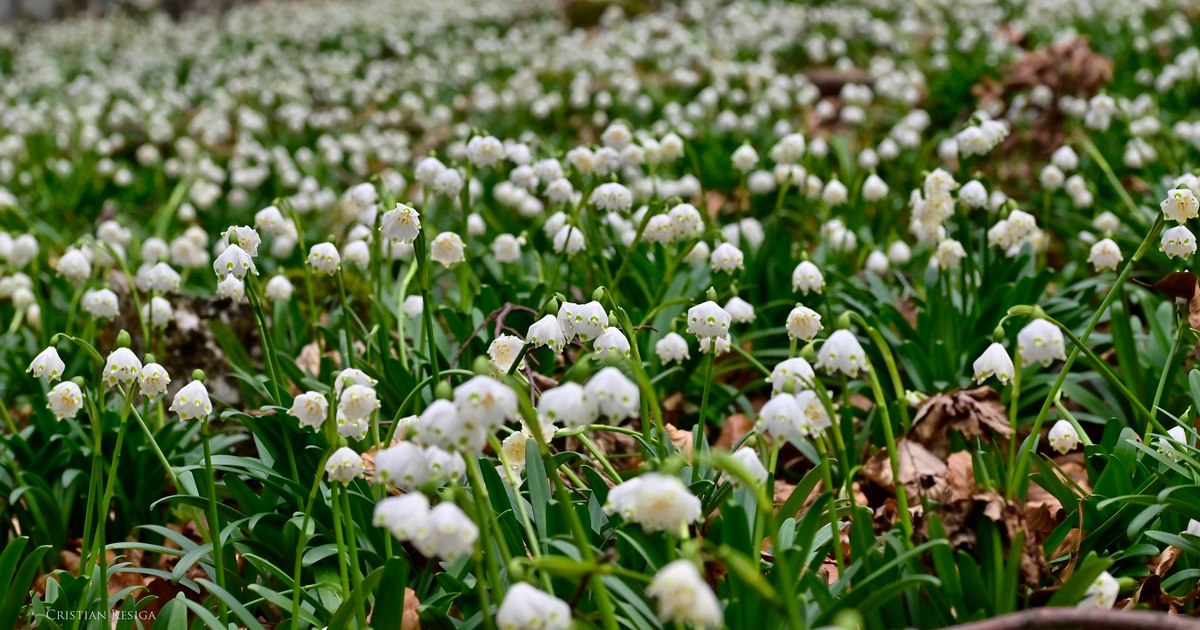
Several glades and forests in the Land of Dacian Fortresses are enlivened by carpets of wild snowdrops that bloom in early spring, offering a spectacular sight. In the past, places like the Whirlpool Plateau were almost unknown to tourists, and people attributed strange legends to them.
Located in the Orăștiei Mountains, less than ten kilometers from the Dacian capital, Sarmizegetusa Regia, the Vârtoapelor Plateau from Grădiștea de Munte (Hunedoara county) has long been regarded as a place of legends with ancient origins.
The smooth summit, at an altitude of 900–1,000 meters and bordered by a series of precipitous rocks, rises above the Rea Valley, the stream that divides the hills covered in the past by centuries-old forests, running through the sites of ancient settlements.
Ranisstorum
At “Sub Cununi”, a place so named because of the crown of rocks that surrounds it, you can see the traces of ancient terraces on which Dacian and Roman vestiges were discovered.
“On the first of the terraces here, the westernmost, the ruins of a Roman construction are preserved, consisting of walls with mortar, tiles and bricks. Since the middle of the 19th century, several inscriptions have been discovered here, as well as over 500 Roman republican denarii. It is the Roman settlement closest to the walls of Sarmizegetusa Regia, whose name has not been preserved, but which was assumed to be the ancient Ranisstorum”, informs archaeologist Ioan Glodariu.
Ranisstorum, the name of an unknown Dacian settlement that became the headquarters of the Roman troops, is mentioned on the funerary monument at Philippi (Greece) of the Roman general Tiberius Claudius Maximus.
Here the head of King Decebalus would have been brought, before being sent as a trophy to Rome and thrown on the Gemonia steps, where the bodies of the emperor’s enemies were exposed, and finally it would have been thrown into the waters of the Tiber. Vârtoapelor Plateau, Craivii Stone and Man’s Glade have become part of the legends of the mysterious Ranisstorum.
Decebal’s Treasures
The Whirlwind Plateau did not only preserve the legend of the death of King Decebalus. Caves have been identified under its crown of rocks, which the locals reported were the places where ancient treasures were discovered, which the Dacian king would have hidden during the years of war.
Some galleries go deep into the mountain and communicate into the unknown, emerging through other mouths many kilometers away. The locals reported that they had noticed in the past how strange flames came out of the mountain during some nights, a sign that the caves were hiding treasures. Other testimonies speak of the monks taking refuge in the hard-to-reach cells carved into the rock.
“The entire summit of Vârtoapelor, rocky, calcareous, is studded with small grottoes, which sometimes have the appearance of smaller caves. Dacian ceramic fragments have been discovered on the small plateaus at the mouth of some of them. Above the source of the Bodii stream, in the rock called Piatra Bodii, there is a rather spacious cave, with two exits and a side gangway to the south, still unexplored by archaeologists”historian Ioan Glodariu pointed out.
“Alea Frumoase” by “Under crowns”
The Vârtoapelor Plateau is decorated at the beginning of spring with carpets of wild snowdrops, called luste, to which the locals attributed some special legends in the past. It is said that their appearance is due to the fairies who protect the settlement in the mountains and decorate it with flowers. People call them “Beautiful Alleys” and say that supernatural beings can be heard singing or vibrating at night around the rocks, the mouths of streams and in the clearings surrounded by old trees.
“The ancient myths also have an ancient hearth here, on the hills around the Dacian fortresses. The female deities changed their names and sometimes their attributes, but their meaning remained. The old Bendis of the Thracians also lived in the Artemis of the Greeks, and later Diana of the Romans became Sânziana in the Romanian language, which the Romanian people celebrated by the plural of the name, Sânzienele, perhaps summing up several deities among which so naturally they could also find their place in Alea Frumoase”, wrote ethnologist Lucia Apolzan, in the work “Aspects of spiritual culture”, in 1981. Sometimes those who approach Alea Frumoase are punished: “their face changes, oblivion is displaced”local people recounted, quoted by Lucia Apolzan.
The wild snowdrops (Leucojum vernum) from the Vârtoapelor Plateau, also called lustes, are plants with bulbs and 3-5 linear, obtuse leaves, from the Amaryllidaceae family. The flowers are large, white and pleasantly scented and are found in forests, thickets and wet meadows. Although they are confused with snowdrops, the flower of the snowdrops is larger than the snowdrops, and their stem can measure between 15 and 25 centimeters.
Tourists attracted by snowdrop glades
The beauty of wild flowers has attracted more and more travelers to the Whirlpool Plateau in recent years. However, tourism proved to be unfavorable for nature. Many visitors make their trip to the plateau easier by riding their ATVs and all-terrain vehicles, which they park in sagebrush glades, crushing them under the weight of their wheels. Others pluck them to make bouquets or leave trash behind.
“We invite people to admire these flowers and the places where they are found, in the Grădiștea Muncelului–Cioclovina Natural Park, but they must know that it is forbidden to tear or pluck wild flowers. It is also not allowed to leave public roads with cars, motorcycles or ATVs. These can cause other destruction to nature, as well as the waste left behind by tourists”. informed the representatives of the administration of the Grădiștea Muncelului–Cioclovina Natural Park (APNGMC), on the territory of which Vârtoapelor Plateau is located.
According to the regulations of the natural park, the following are prohibited: breaking or uprooting species from the spontaneous flora, capturing or killing specimens from the spontaneous fauna without the necessary authorizations or by illegal means, collecting specimens from the spontaneous flora or fauna without the approval of APNGMC, disturbing nests and harvesting eggs, producing noises that may disturb the local population and spontaneous fauna.
