
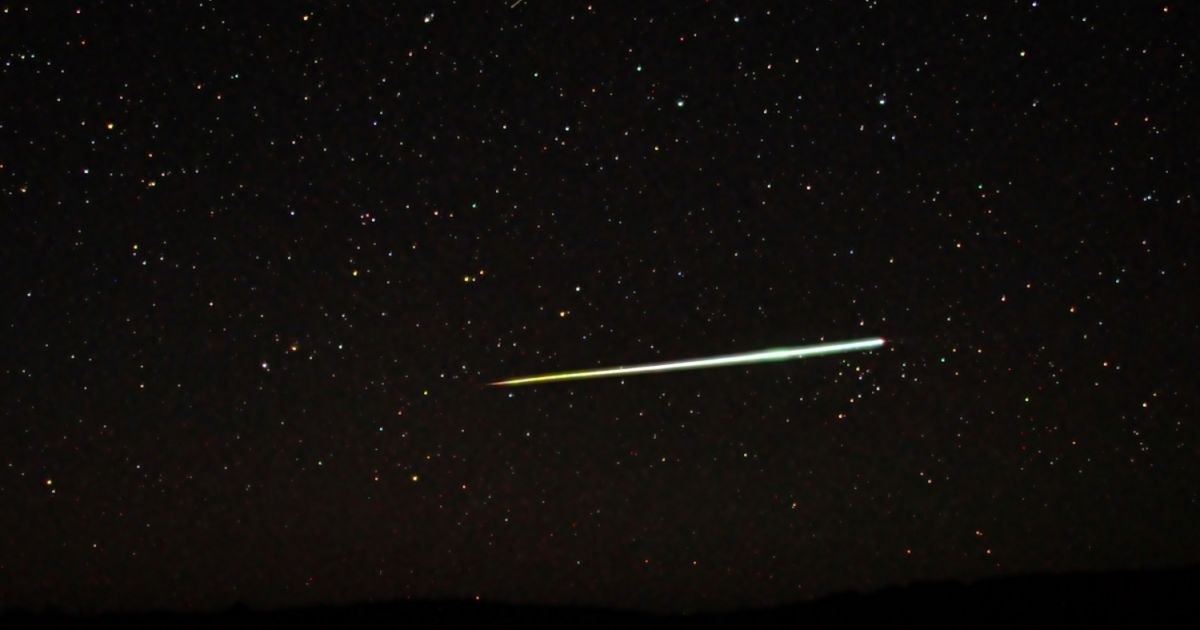
The meteor shower known as the Lyrides returns in 2026 as one of the oldest and most beautiful astronomical phenomena observable with the naked eye.
This event occurs annually in April, when Earth passes through a comet’s debris field, and cosmic fragments entering the atmosphere ignite and create streaks of light across the sky.
The night when the Lyrid star shower reaches its peak
In 2026, the peak moment of Lyride 2026 is expected on the night of April 22-23. During that time, the sky can offer between 10 and 20 meteors per hour in good visibility, and sometimes short bursts of more intense activity can occur.
The phenomenon seems to have its origin in the area of the constellation Lyra, where the name of the meteor shower comes from. However, meteorites do not physically come from that constellation, but only from the direction in which their path is projected across the sky. The best viewing conditions occur after midnight, when the sky is darker and the radiant is higher in the sky.
To best observe Lyride 2026, it is recommended to choose a place away from artificial lights, such as rural areas or the edges of cities. Sky viewing does not require a telescope or binoculars, as meteors are fast phenomena and spread over a wide area of the sky.
How the Lyrids are formed
The origin of this phenomenon is linked to Comet C/1861 G1 (Thatcher), which, during its orbit around the Sun, leaves behind a cloud of dust and small rock particles. This cosmic debris “road” remains in space for centuries.
When our planet crosses this cloud, particles enter the atmosphere at very high speeds, on the order of tens of kilometers per second. Friction with the air quickly heats them up, and they burn out completely, producing short, spectacular lights in the sky.
Although they may seem impressive, these fragments are very small and do not pose a danger to Earth. Most evaporate completely before reaching the ground.
Thus, Lyride 2026 is not only a spectacular visual event, but also an opportunity to understand the dynamics of the solar system and how our planet constantly interacts with the cosmic environment.
Where are the best places to see the Lyrids?
Those who want to watch the phenomenon in the best conditions should choose areas without strong artificial lighting. Cities greatly reduce the visibility of these discrete apparitions. Villages, plains, hills or the edges of towns offer much better perspectives for observers. An open horizon and a clear sky can completely change the experience.
The Lyrid meteor shower can be admired without special astronomical instruments and without technical training. The phenomenon is best seen with the naked eye. Binoculars are not recommended in this case, as they limit the field of view and decrease the chances of capturing rapid apparitions.
