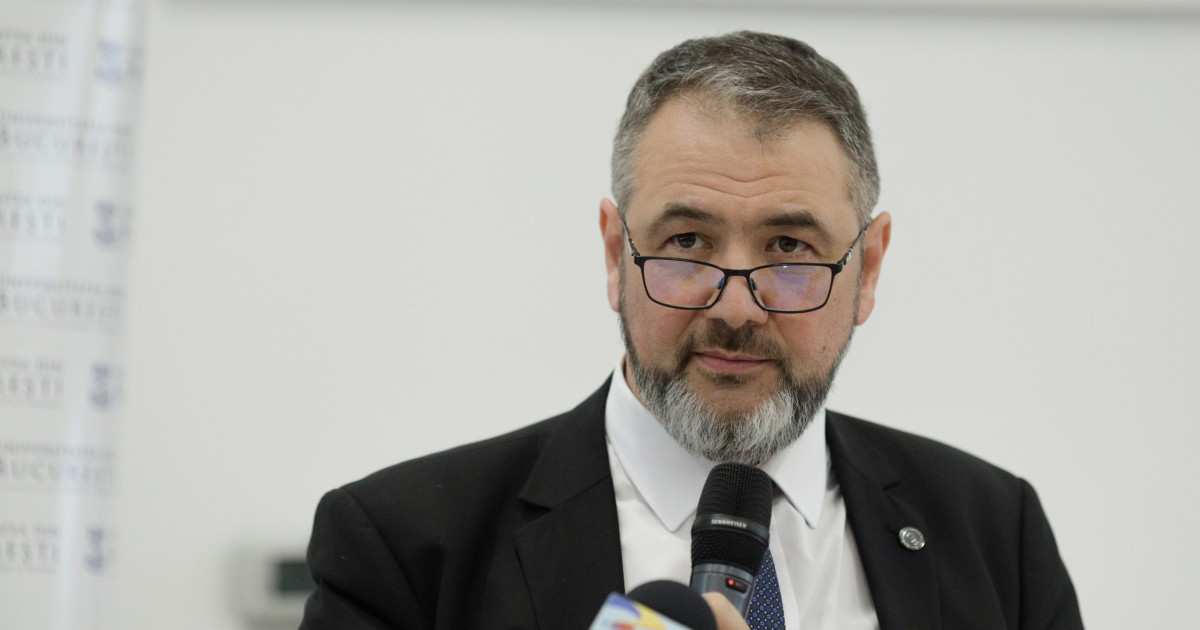
The Minister of Education, Sorin Costreie, proposes that teachers take, upon entering the profession, a “Socrates Oath”, by which they assume moral and professional responsibilities towards pupils and students. The proposed text emphasizes the development of critical thinking, respecting intellectual freedom and avoiding indoctrination in the educational process.
Sorin Costreie proposes, in a post on social networks, on the international day of philosophy, a change that involves the transition “from a predominantly memorizing education to a reflective one”.
The minister proposes to teachers a Socrates Oath, modeled on the Hippocratic Oath for doctors, “as a solemn commitment to those they train (pupils, students, etc.), to their own profession and to society”.
Sorin Costreie specifies that “it is not a historical oath formulated by Socrates, it is a historical oath for Socrates”.
“The Socratic oath for teachers and educators:
In front of those who passed on the knowledge to me, those to whom I will share it and the community I am called to serve, I freely and responsibly take this oath:
I will put the good and the dignity of each pupil and student at the center of my mission, respecting their individuality, freedom of thought and the right to learn.
I will unceasingly seek the truth and never claim to possess the absolute truth. I will have the courage to say “I don’t know”, to admit my mistakes and to continue learning, together with those I educate.
I will cultivate question before answer, argument before conviction, and understanding before memorization. I will not demand acceptance of an idea only by virtue of my authority and I will not use knowledge to dominate, humiliate or intimidate, but to open minds and stimulate knowledge.
I will encourage critical thinking, reasoned doubt and intellectual freedom, including when these challenge my own beliefs.
I will not turn education into indoctrination. I will respect the plurality of perspectives and help each student distinguish between facts, interpretations, opinions and prejudices.
I will evaluate everything with fairness and integrity, without favoritism, discrimination or prejudice, understanding that evaluation must support learning, not reduce a person’s value to a grade.
I will continue to learn and critically examine my own thinking, because no one can claim to educate without accepting to be educated in turn.
I will take care of my own health, my balance and my integrity, to be able to exercise my profession with responsibility and humanity.
I will defend academic freedom and the value of education as a public good, aware that a free society needs people able to think independently and take responsibility for their own judgments.
I will not forget that the goal of education is not to form people who think like me, but people who are able to think for themselves.
I undertake these commitments with respect to my profession, to those who were my teachers and to the generations to come and I swear not to stop asking myself, to learn and to help others to discover the power of their own thinking”, is the text of the oath proposed by the minister.
Sorin Costreie emphasizes that the text is a contemporary creation, inspired by the Socratic method, dialogue, the recognition of one’s own limits and the moral responsibility of the educator and argues that he chose the Greek philosopher because, in the Dialogues of his disciple, Plato, “education is not reduced to the transmission of knowledge, but involves the examination of beliefs through dialogue, and the search for truth is done through well-targeted questions”.
Costreie invokes the three Socratic principles that can constitute the foundation of such an oath, these being the recognition of the limits of one’s own knowledge, the critical examination of convictions and the responsibility towards the formation of the soul and character.
“In analogy with the Oath of Hippocrates, which expresses the moral obligations of the doctor towards the patient, the Oath of Socrates could express the moral obligations of the teacher towards the pupil or student, towards knowledge and towards society. If the doctor takes care of the life and health of the patient, the teacher takes care of the development of his capacity to know, to judge and to live freely. Such an oath could be taken at the graduation of pedagogical training programs or upon entering the teaching profession, as an expression of professional responsibility”, explains the Minister of Education.