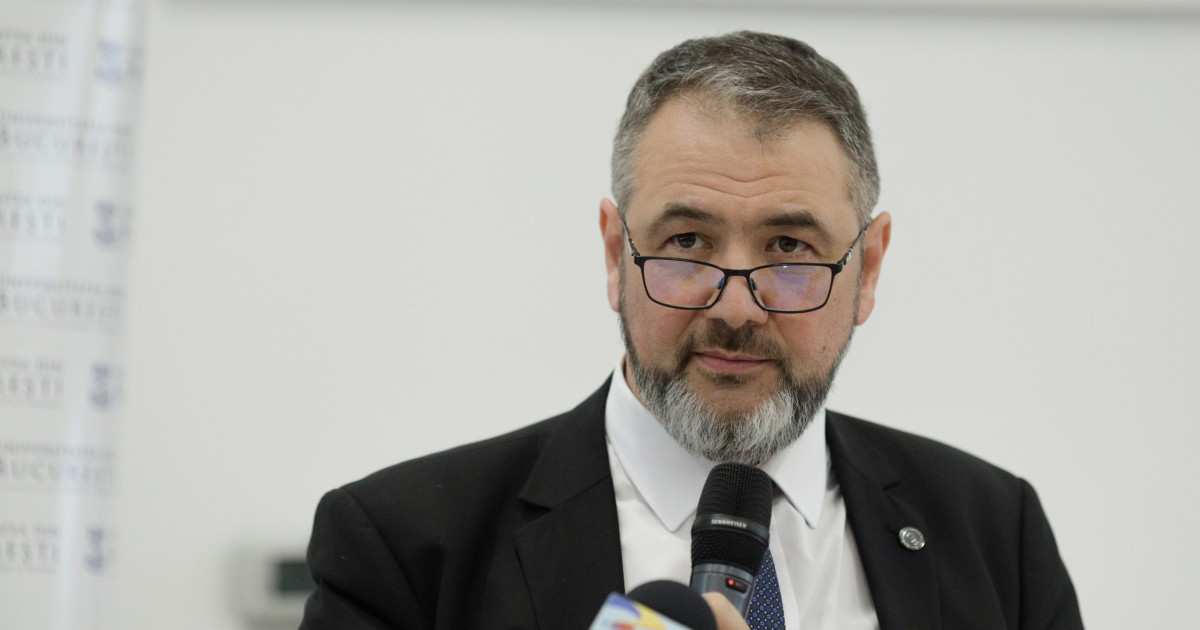
The responsibility for preventing violence in schools is common, shared especially between the family and the school, the Minister of Education, Sorin Costreie, said on Thursday.
He participated, together with the Prime Minister and the Minister of Labor, at the Victoria Palace, at the meeting of the Working Group for the prevention and combating of violence in the school environment, established at the level of the Government with the participation of representatives of organizations in the field of education.
“Today we received a report of a sociological study. And the population thinks so: 59% of Romanians believe that the responsibility for preventing violence in schools rests with parents and families, 16.6% – the Ministry of Education, 14.2% – teachers and school management, so approximately 30%, together with the ministry and school management, 7.9% – the Police, 6.9% – the students. So, it is clear that responsibility, as it is seen by society, and I think it is, is common, shared especially between the family and the school. And here there is also a problem of mentality, the moment the parents take the child to school, this does not mean that it is a total transfer of responsibility, that they are no longer interested and vice versa, in the sense that the teachers have to follow the whole process, they have to look and listen to the children, to be interested beyond the situation their school environment, so that we can talk and I think that the dome under which we must sit is ‘safe schools’, and not ‘lonely schools'”, emphasized Sorin Costreie, quoted by Agerpres.
According to him, society, the Government, the state must not leave the school alone to face this phenomenon.
“And, together with the parents, together with all the other competent entities and participating institutions, we must work together,” the Minister of Education said.
Costreie mentioned that Romania has a Strategy for combating and preventing school violence, which is already being applied.
“Today the new strategy for a more specialized form, let’s say, this radicalization, which is a form that we saw in Bistriţa and is starting to appear more and more, was made transparent, but we have to see the violence in all its aspects and for this, as I said, collaboration and cooperation are needed”, he said.
For his part, the Minister of Labor, Florin Manole, highlighted the role of solidarity in preventing and combating violence in schools.
“Because, really, school violence has to start being prevented long before it enters the school. And a whole host of factors just manifest themselves, eventually, in the school, and not only in the school, but they are born outside the school. Very often, the motivation for school violence has to do with poverty, social exclusion, domestic violence, it has to do with inequities, it has to do with racism, it has to do with all kinds of differences valued negatively. Of course there are theoretical solutions for these problems, there are also practical solutions,” he said.
Manole mentioned that the Ministry of Labor runs together with non-governmental organizations a very important program of integrated community services in over 2,000 rural communities in Romania, meaning “more than half of the Romanian countryside”.
He pointed out as important in combating the phenomenon the role of politicians and those who set the public discourse.