
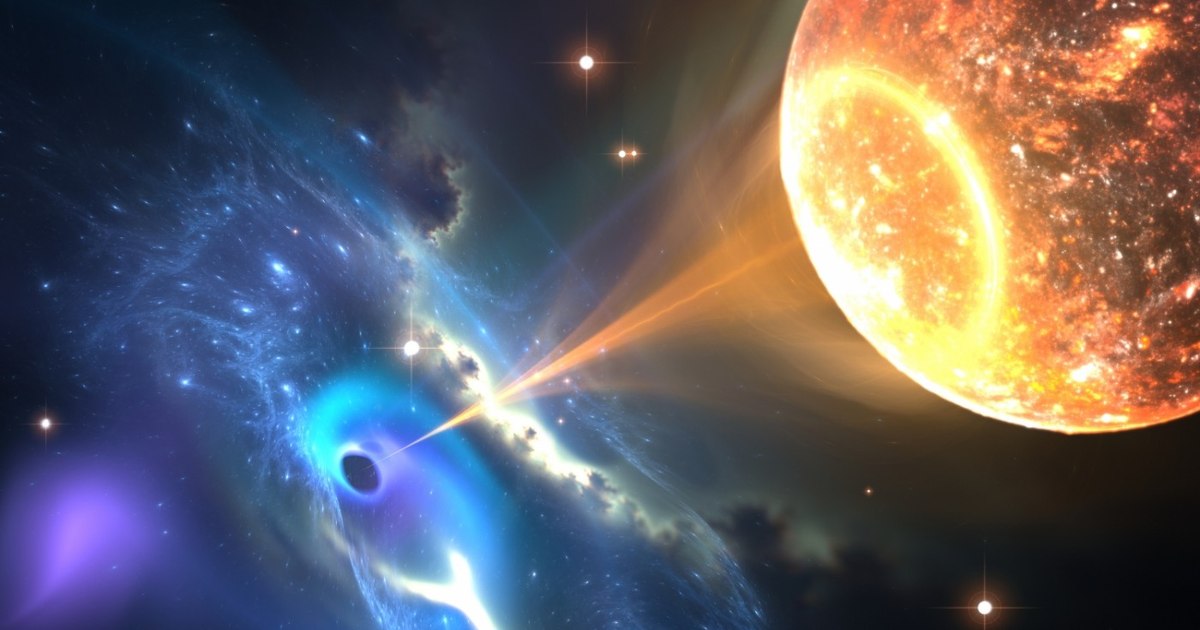
Astronomers discovered a cosmic tank of colossal water, located around the quasar APM 08279+5255, about 12 billion light years away.
Discover opens new photo research directions: Illustrative/Shutterstock
According to Ecoticias, Quasarul APM 08279+5255 has become the subject of an extraordinary discovery. Around it is a huge water tank, estimated at a volume of water equivalent to the 140 times of times the quantity of all the Earth’s oceans.
The tank extends for hundreds of light years and is fueled by the energy emitted by the quasar that has a massive black hole in its center. “The environment around this quasar (n. Red. – Active galactic nucleus, which emits enormous amounts of energy) is unique in that it produces this huge mass of water. It is another demonstration that water is ubiquitous in the universe, even in ancient times ”, said Matt Bradford, a scientist at the NASA propulsion laboratory in Pasadena, California, for Jet Propulsion Laboratory.
Quasarul offers a unique opportunity to study the extreme thermodynamic conditions in the early universe. Although the gas temperature around the quasar is approximately -63 ° F, it is much hotter and dense than similar environments in galaxies such as the lactes path, which contains 4,000 times less gas in the gaseous state.
The discovery of water vapor at a Redshift de Z = 3.9 indicates that this phenomenon took place only 1.6 billion years after the universe. This gives researchers valuable indices about the evolution of supermasive black holes and how they can grow, sometimes by six times in the current mass, depending on the availability of gas.
The discovery was possible due to the advanced technologies of millimeter and submillimetric spectroscopy, used in the Caltech sub-dimilimetric observer with the Z-Spec spectrograph. The observations were subsequently confirmed by the data obtained with the interferometer paid bure and with the carma, thus demonstrating the effectiveness of the new instruments in the study of the early universe.
This achievement opens new research directions on how black holes develop and interact with the environment, offering the possibility that some of this huge gas is used not only for nourishing the black hole, but also for the formation of new stars or to be expelled from the host galaxy.
