
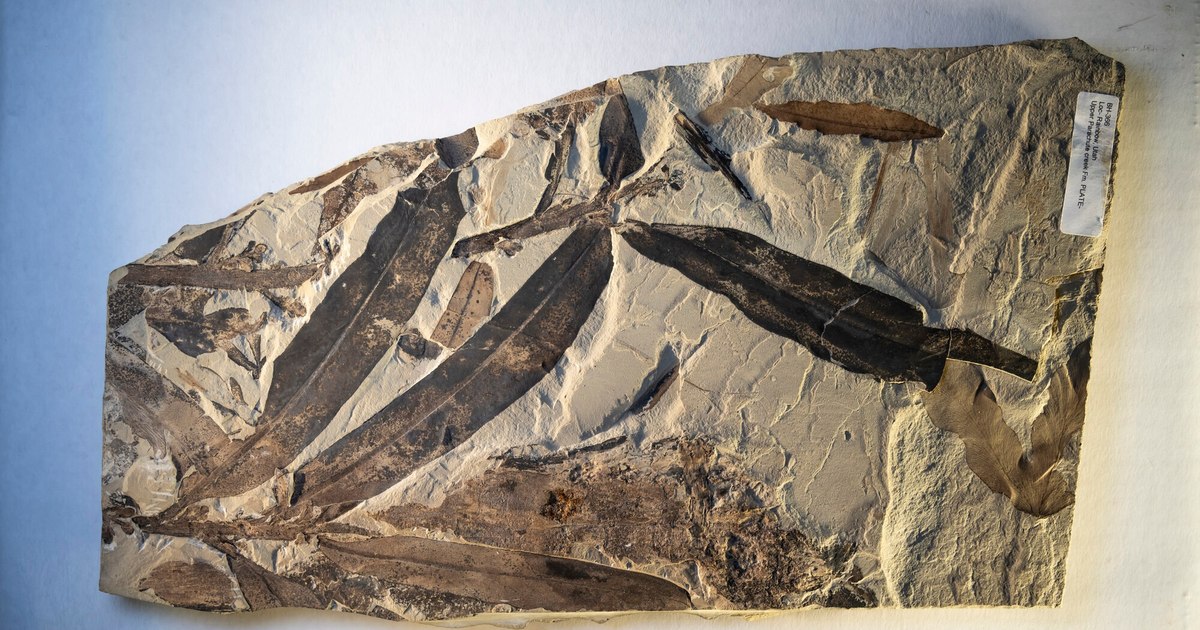
After decades of ambiguity, scientists have determined that a strange plant fossil, millions of years old, cannot be assigned to any known family, living or extinct, the Florida Museum of Natural History reports.
Strange fossil. PHOTO Florida Museum of Natural History / Jeff Gage
In 1969, in the eastern US state of Utah, some fossilized leaves of the Othniophyton elongatum species were identified – which translates as “foreign plant“.
“Initially, scientists hypothesized that the extinct species might have belonged to the ginseng family (Araliaceae). The conclusion is now revised. New fossil specimens show that Othniophyton elongatum is even stranger than scientists previously thought,” the Florida Museum of Natural History says on its official website, citing Annals of Botany | Oxford Academic.
For several years, Steven Manchester, curator of paleobotany at this museum, studied 47-million-year-old fossils from Utah. While visiting the paleobotanical collection of the University of California, Berkeley, he came across an unidentified and unusually well-preserved plant fossil collected from the same area as the leaves of Othniophyton elongatum.
“This fossil is rare because it has the branch with fruits and leaves attached. They are usually found separately”Manchester said, according to the quoted source.
The species does not belong to any living family or genus
Manchester and his colleagues showed in the study published in “Annals of Botany”, that they have thoroughly analyzed the physical characteristics of the old and new fossils, then methodically searched for any living plant families to which they might belong (over 400 extant flowering plant families), but the authors were unable to match the strange features of fossils with none of them.
Resisting the temptation to include the specimen in a living group, the team then looked for the missing families to which it might have belonged, but found nothing.
The authors say their results highlight what may be a pervasive problem in paleobotany: “often, extinct plants that existed less than 65 million years ago are placed in modern families or genera – taxonomic groups directly above the level of individual species, which can create a skewed estimate of biodiversity in ancient ecosystems.”
“There are many things for which we have good evidence to place in a modern family or genus, but you can’t always forceps them in,” Manchester stated.
The fossils were discovered in the Green River Formation near the ghost town of Rainbow in eastern Utah.
About 47 million years ago, the area was an active tectonic system of massive inland lakes, which provided the perfect conditions for fossil preservation. Oxygen-poor lake sediments and volcanic ash rains slowed the decomposition of many fish, reptiles, birds, invertebrates and plants, allowing some of them to be preserved in amazing detail.
Researchers who studied the original leaf fossils thought it might have been a single leaf made up of several smaller leaflets. This type of compound leaf is a defining characteristic of several plants in the ginseng family.
But the new fossils had leaves that were attached directly to the stems, which painted a very different picture of what the plant once looked like.
“The two branches we found show the same type of attached leaves, but they are not compound. They are simple, which eliminates the possibility of being something in that family”Manchester explained.
Fossil grains excluded families such as grasses and magnolias. The flowers resembled some modern groups, but other features ruled them out as well.
Faced with such a fossil, researchers were left with more questions than before.
The team put the fossil away for several years, and later, the Florida Museum hired an artificial intelligence curator, who created a new microscopy workstation. When looking through the digital microscope’s powerful lens and computer-enhanced shadow-effect lighting, the authors were able to spot subtle features that had escaped them during previous observations.
One of the strangest newly discovered features of the plant was the stamens, the male reproductive organs of the flower. In most plant species, once the flower is fertilized, the stamens are shed along with the petals and other parts of the flower that are no longer needed for reproduction.
After ruling out all modern families, the researchers compared the traits with those of extinct families, but no match was found either.
Julian Correa-Narvaez, the study’s lead author and a doctoral student at the University of Florida, played a major role in gathering information to identify the fossils. “It’s important because it gives us a small clue about how these organisms evolved and adapted in different places.”he said, according to the Annals of Botany | Oxford Academic.
This is not the only enigmatic species discovered in the Green River Formation. Other plant fossils identified in the locality surprised the researchers, leading to the discovery of other extinct groups.
Because they now have digital access to museum specimens through tools like iDigBio, researchers can continue to study and understand the natural history of plant evolution.
