
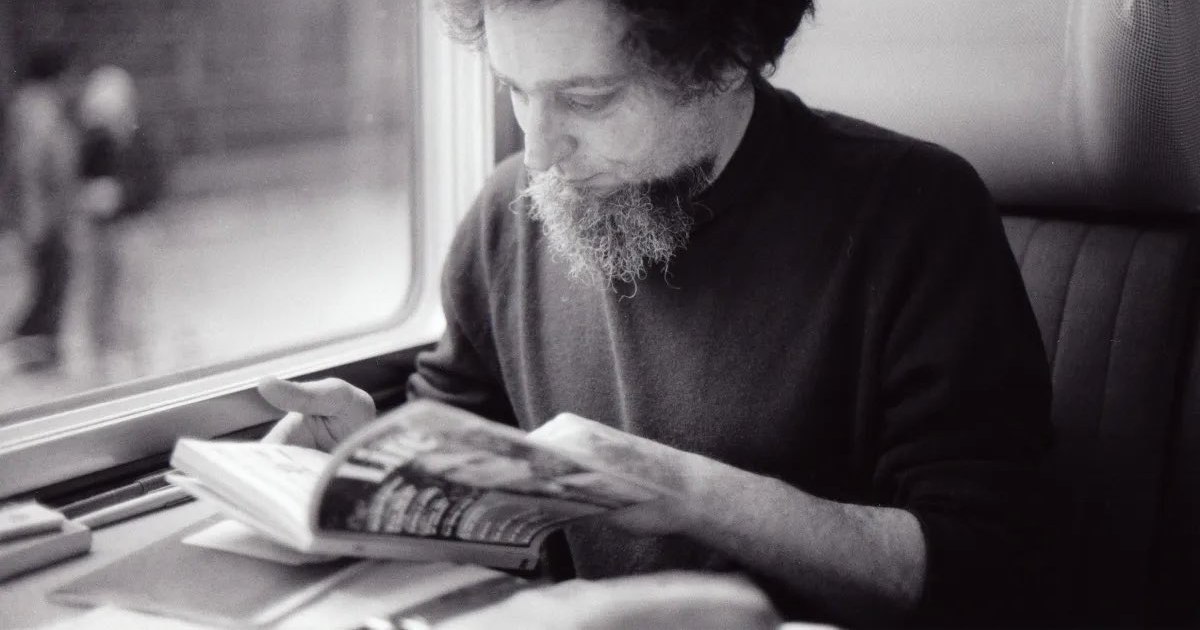
A French writer wrote a 300-page novel without the letter “e”. Georges Perec’s story is not about literary snobbery, but about what remains when something essential disappears.
“La Disparition”, a novel published in 1969, made its author, George Perec, famous.
It has 300 pages, so it’s not really a joke, and Perec has done an exercise here that could seem like an intellectual joke: a novel without the vowel “e”, the most used vowel in French?
Yes, even more important than this technical feat is why Perec chose to do this. “La Disparition” is a lipogram – a text written with the deliberate exclusion of a letter, writes Mediafax.
The missing “E” – the absence of the mother
In Perec’s case, the elimination of the “e” is all the more fascinating, as this vowel is basic in French.
The novel is a strange detective story, in which the characters disappear, are searched for, are lost, without ever being explicitly named the cause.
Over time, literary critics tried to identify the meaning of the elimination of this vowel and, at some point, they realized: the missing “e” refers to an even greater lack: the writer’s mother. Deported to Auschwitz and killed there during the Holocaust, while his father was killed at the front during WWII.
Childhood – lack and war
Here, perhaps, is how this lack takes shape and meaning, because the “e” doesn’t exist, but it’s everywhere, it’s the deaf, implacable pain, with which you have no other solution but to make peace.
Georges Perec was born in Paris, in 1936, in a family of Polish Jews.
His childhood? Loss, lack, war, silence – the moral skeleton on which he will build his writing.
These experiences return obsessively in Perec’s writing. Even when talking about mundane experiences.
Limitation doesn’t strangle, it empowers
Perec was a member of the Oulipo group (Ouvroir de litérature potentielle – Workshop of potential literature) – a community of writers and mathematicians interested in formal constraints: texts written according to strict rules, formulas, schemes, games.
The central idea of the group was that limitation does not stifle creativity, but rather enhances it.
Therefore, Perec’s novel is not just a whim, nor a vain display of good technique, but literary philosophy.
But, of course, to reduce Perec to the status of “writer of the novel without an “e” would be more than unfair.
Passionate about invention
His passions for small, seemingly insignificant objects (apartments, lists, habits, rituals, repetitive gestures) document the mundane as a constant of life (in “Les Choses” he wrote about the obsession with consumption of a young couple, and in “Je me Souviens” (I remember) – he collected hundreds of fragments of personal and collective memory and did not give them shape, simply left them like that – he was a passionate inventor and typologies).
Perec’s spectacularity lies precisely in the fact that he does not search with the candle. In a world of algorithms, rules of all kinds, constraints and political correctness, meaning can be constructed just like this: from lack.
Lack gives structure, not clutter
For just as Perec’s novel gains strength precisely from lack, so too this world can harvest its strength precisely from lack and constraint.
It is a lesson that Perec conveys to us in his own way and from which we could start in our own foray into ourselves.
Lack does not destroy, but builds. Through this, Perec remains just as surprisingly current.
In a world of noise, lack gives structure, not clutter.
Perec was only 45 years old when he died, but he left behind a work that is difficult to frame, but easy to recognize: texts that look like games, games that hide wounds.
According to Perec, the idea remains: silence says more than words.
