
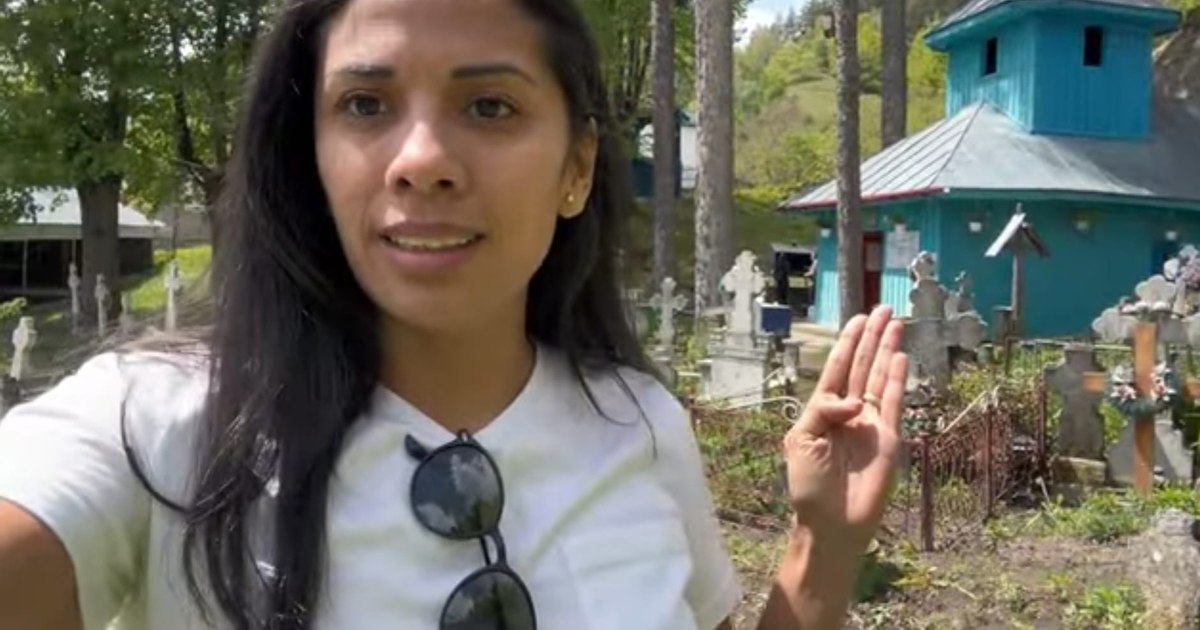
“On the way to the oldest orthodox stone church” is the title of one of the latest travel vlogs made by Micaela Gomez, an Argentinian settled in Romania. The young woman films her trips and posts the clips on the YouTube account “Donde nos despertamos hoy?” (“Where did we wake up today?”), created to promote the country of adoption among Spanish speakers.
The video dedicated to the tourist objective in the Rupestre area is almost 16 minutes long and captures, in the first part, the journey in the car driven by Micaela Gomez's husband, a young man from Prahova. The two travel a route from Ploiesti to Chiojdu, an opportunity for the two travelers to observe the Roma palaces in Calvini, with lions and horses on the eaves and on the fence posts.
In a few days, the post gathered more than 2,400 views, many from outside the country's borders. The chapter dedicated to the Aluniș Cave Church begins at minute 9:18.
“We have just arrived at our destination. The place is called Aluniș. (…) We are about to visit one of the oldest places of Orthodox worship in all of Romania, which dates back to 1274. This is one of the most mystical places in Romania. Why? Because in this place there is a very spiritual cave, a very old cave”are the words with which Micaela Gomez (photo below) begins her presentation.
Mica Gomez visited the Aluniș Church in April 2024. CAPTURE
Vloggerița presents both the cemetery, the blue, wooden church, and the entrances to the shrines, as well as the interiors of the cave complex from Aluniș.
“I have goosebumps here, I feel a special energy. Forget that stooping stone. I want to show you a detail on the wall; all the walls are covered with symbols, scratches, drawings. It's incredible! (…) Do you know how old this church is? How old is she? It is 700 years old. Now you understand why it is a mystical, spiritual and wonderful place”are some of the appreciations made by the author of the video.
Micaela Gomez is an Argentinian settled in Ploiești, after marrying a Romanian. On the Youtube account “Donde nos despertamos hoy?” (Where did we wake up today?) has published over 400 video clips, most of them made during travels in Romania. Not infrequently, Micaela Gomez had live interventions on televisions in Argentina, made from Brașov, Sibiu or Ploiesti, in which she spoke in superlative terms about her adopted country.
The vlogger from Argentina gathered several thousand followers, many Latin Americans, but also Romanians conquered by the mission assumed by the young woman who has been settled in our country for three years.
“Little one, you are a real gem of our country who sees things from a positive point of view, which many of us Romanians do not, unfortunately! Thank you for such promotion of our diverse landscape!”is the message written by Anamaria Suciu on one of the Argentine's posts.
About the Church from Aluniș
The church in Aluniş, which has been functioning for over 700 years, is one of the few stone-hewn places where services are still held. A legend says that the church was dug in a rocky massif by two shepherds, Vlad and Simion, around 1274, 1275.
The place was documented in 1351 and was a hermitage of monks until 1871, when it became the church of Aluniş village. This had and has the patron saint “Beheading of Saint John the Baptist”.
Between the years 1840 and 1850, the wooden porch was built at the entrance to the church. It is located on the outside of the rock and is perpendicular to the church dug into the rock.
The nave and the altar are dug into the rock, with a vaulted ceiling, separated by two pilasters. On one is written in Cyrillic “Ma(teio) leat 7056” (1548). On the northern wall of the altar there is another inscription, in Paleo-Slavic, from which only the names of the legendary founders Simion and Vlad, as well as the hieromonk Daniil, can be distinguished.
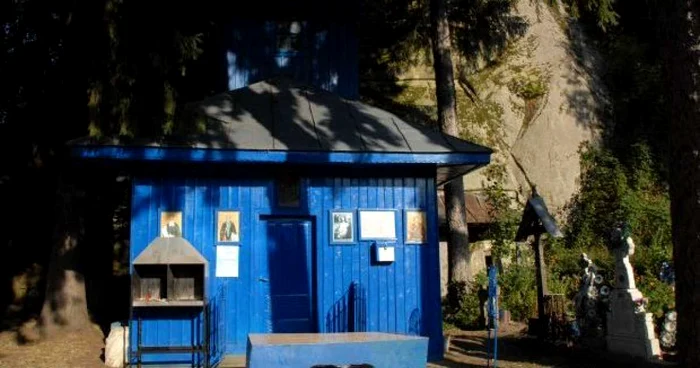
The cave church from Aluniş
The church is nave-shaped, with a vaulted ceiling. The apse of the altar is small, provided with the Holy Table, Proscomidiar, niches for cultic vessels, as well as with a window. The nave also has a window, for lighting the singer's pew and for ventilation.
In 1870, an oak pediment was installed, with zinc sheet icons, by the hieromonk Eftimie Ciolăneanu. The porch-pronaos is decorated with paintings, also on zinc sheet.
The church is part of a complex that consists of the church, two cells dug into the rock and five more undated, of which three are unfinished, one blocked with boulders and another on the ridge, for guarding. After 1871, the Christian place became a parish church, as it is today.
