
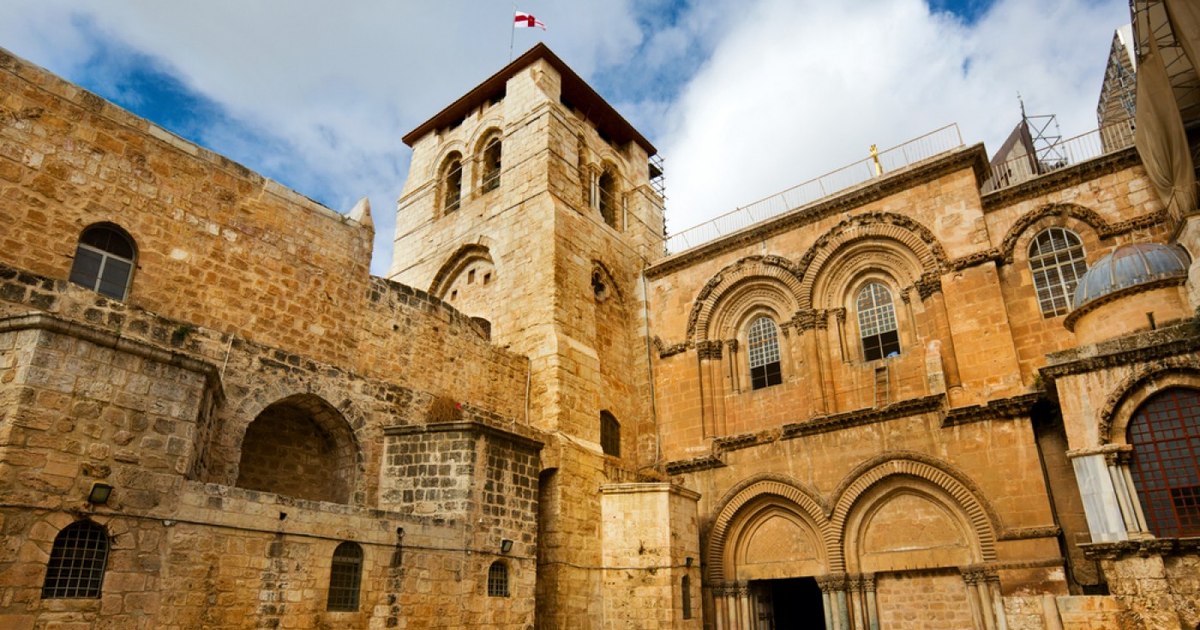
A team of researchers discovered vestiges of an ancient garden under the foundation of the Church of the Holy Sepulcher in Jerusalem, a discovery that seems to confirm the story of the Gospel after John about the place of the burial of Jesus.
The Church of the Holy Sepulcher in Jerusalem. Photo: Shutterstock
According to the Gospel after John 19:41: “In the place where he was crucified, there was a garden, and in the garden a new tomb, in which no one had been.”
A team from Sapienza University in Rome analyzed vegetable residues from the site, dating them in the pre-Christian period, approximately in the time of Crucification and funeral of Jesus, events located by historians around 33 AD, reports the Daily Mail.
Archaeologist Francesca Romana Stasolla told The Times of Israel: “The gospel mentions a green area between Golgotha and the tomb, and we identified these cultivated lands.”
This discovery feeds the debate on the true location of the tomb of Jesus. Although many historians claim that the Church of the Holy Sepulcher is the authentic place, due to the presence of graves dug in the rock of the first century, others believe that the tomb in the garden is better suited to biblical descriptions.
The excavations, initiated during the renovations of the Church of 2022, have recently brought to light the evidence of the existence of olives and vines for about 2,000 years. However, radiocarbon tests for the exact dating of the remains have not yet been completed.
Church erected on a Roman temple
The church of the Holy Sepulcher attracts about four million visitors every year. Built in 335 AD. By Emperor Constantine I, the edifice was raised on the site of a former Romanian temple dedicated to the goddess Venus. During the works, a tomb was discovered that is believed to be that of Jesus, who died almost 300 years before.
The hidden layers under the floor of the church offer new clues about the history of ancient Jerusalem.
“The church is located on a former stone quarry site, which does not surprise us, because much of the old city of Jerusalem is built on such careers. I discovered daily use objects, such as ceramics and lamps, dating from the Iron Age,” explained Stasolla.
Subsequently, the area was transformed into agricultural land, with low stone walls were raised to delimit the cultivated spaces. In addition to agriculture, the old career was also used as a cemetery, the tombs being digged directly in the rock.
Stasolla claims that Emperor Constantine would have identified the tomb of Jesus and built the Church precisely to isolate them from other funeral fences.
