
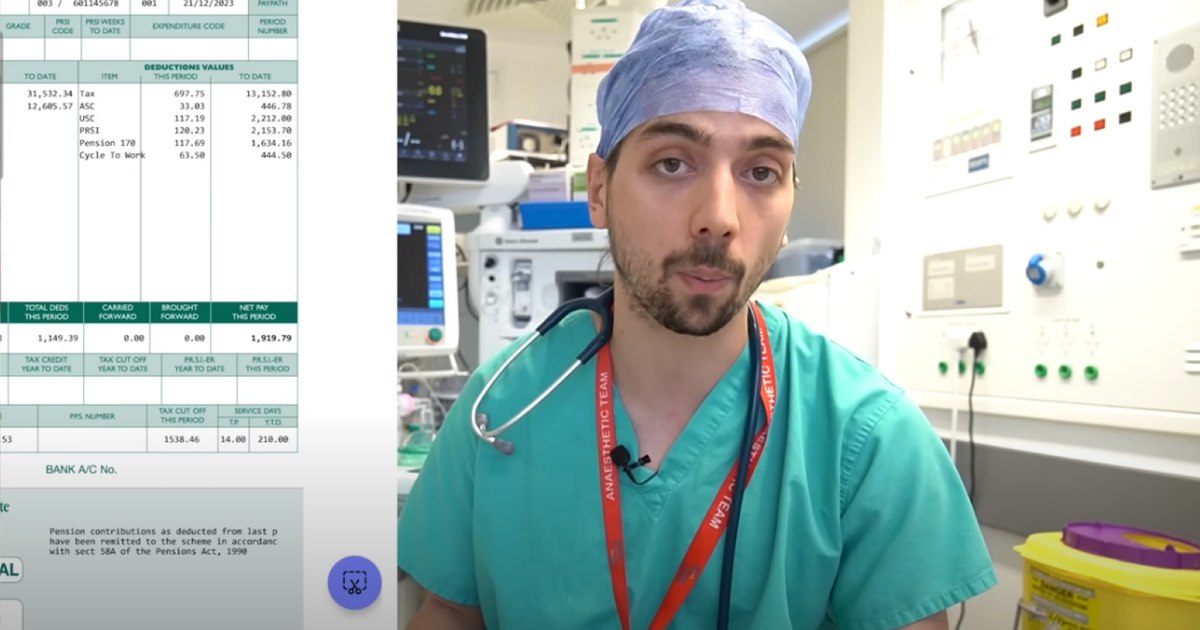
After working for three years as a resident doctor in the ATI department and a paramedic at SMURD Cluj-Napoca, Paul Oargă decided to make a change and moved to Ireland where he continued to practice, but also to study, reports Cluj News .
Paul Oargă made public his salary flyer as a doctor in Ireland, photo capture video you tube
Now he makes a comparison between the sanitary system in Romania and the one in Ireland, starting from the simple things, such as the provision of materials and the provision of hygiene conditions, and up to the salary.
“I wake up at 6am, then run or cycle to the hospital. What I like is that at the hospital there are changing rooms, there are showers. I don't have to put on my equipment from home. There are normal things here. There is soap, there is a towel, things that are not in Romania in all hospitals” – says the young doctor.
Before settling in Ireland, Paul Oargă worked at the County Clinical Hospital in Cluj-Napoca, where, he confesses in 2021, he earned 6,124 lei without guards and without other increases, because resident doctors, in the first two and a half years , their guards are not paid.
“On the hospital side, I was employed at the Regional Gastro Hepatology Institute, but I work at the County Clinical Hospital. In September 2021, I earned 6,124 lei, without guards, without Saturday-Sunday increments. Our problem as residents is that the guards don't get paid for the first two and a half years,” explained the doctor in 2021.
After almost 3 years, from over 3,000 kilometers away, he publishes his salary slip from the last month of 2023, from which it can be seen that he receives over 1,900 euros every 2 weeks, so around 4,000 euros per month.
“I now receive 30 euros per working hour. This increases, it's money that increases with experience. I was lucky that my experience as an anesthetist in Romania for three years was recognized”, says doctor Paul Oargă.
Then he also talks about the benefits that residents in Ireland have in terms of salary, starting with money for studies and ending with overtime pay.
“Leave is 30 days a year, plus 10-15 days for study leave. Here you get 1,500 euros a year to attend classes as a resident doctor. The exams are paid, they cost between 700 and 900 euros, but if you take the exam you get the money back.
I also have the payslip here, received on December 21, 2023. They pay every two weeks and you must have 72 hours worked. For these two weeks you receive 2,382 euros, but this is the gross income. Overtime is also paid, with 1.5x the basic rate, that is, I worked 15 hours and received 687 euros gross, after taxes”.
This is in contrast to the residents of Romania, whose guards have not been recognized for two years. “One thing I can't help but notice is that no matter how much experience you have, whether you're in your first month of work or your tenth year, you're paid. In Romania, during the first 2 years as a resident doctor, guards are not paid. I think we are the only category of people who work for free, just because they want to learn. It is not convenient not to take money, even if you are learning“, Paul Orgă also said.
It seems that the information provided by him gave some of the young doctors in Romania something to think about, because in the last post made on his personal Facebook page, on March 5, the doctor Paul Oargă appears with two Romanian colleagues. “Wherever you go in this world, you meet Romanians. In all corners of the world you somehow end up hearing the Romanian language. Well, today 3 of them met to work side by side in the intensive care unit of Galway University Hospital, from the West of Ireland, Andreea directly from the Capital, from Bucharest, Vlad and me from Cluj. Obviously, it was super! We greet you with the thought of the sun at home” – is the message posted by Paul Orgă.
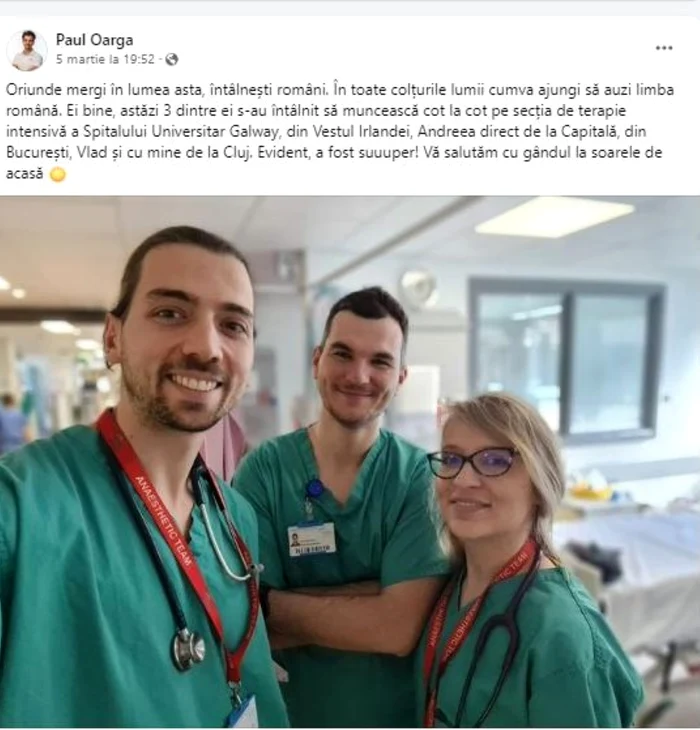
Doctor Paul Oargă's post, Facebook photo
