
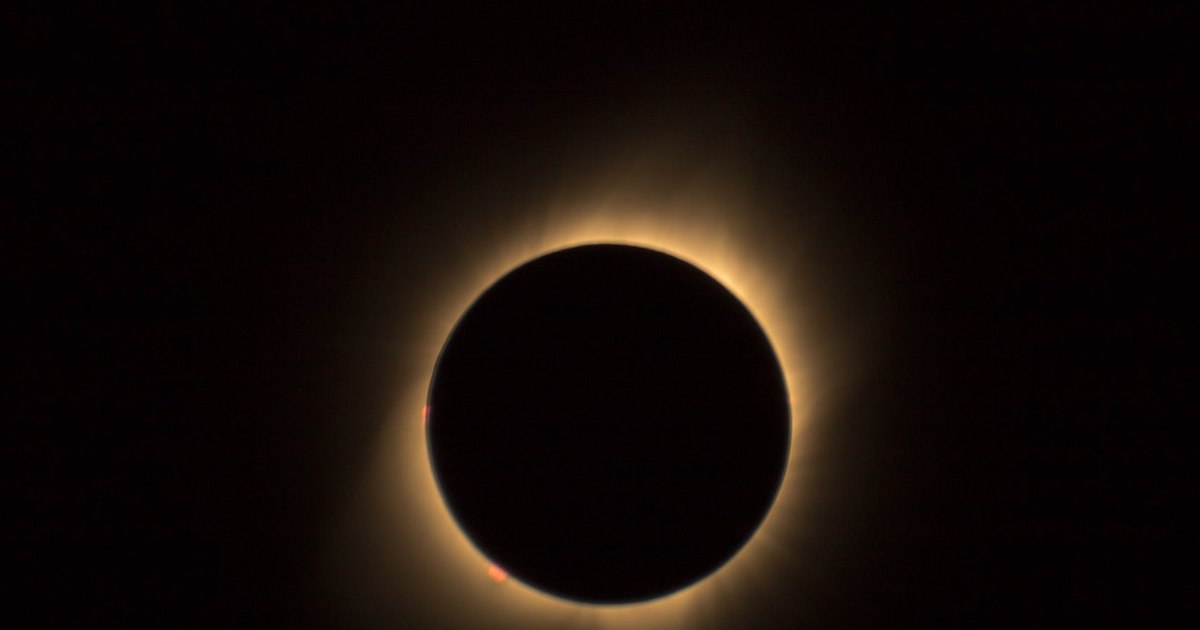
Any point on Earth's surface should experience a total solar eclipse only once every 375 years, on average. Residents of Carbondale, Illinois are about to experience such an experience for the second time in just seven years.
A total solar eclipse will occur on April 8 PHOTO Pexels
Moreover, the eclipse on April 8 is expected to be more spectacular than the one seen in 2017, notes BBC News.
Duration: 4 minutes and 9 seconds. When will she be seen
The sky will darken for 4 minutes and 9 seconds, almost double the duration of last time. Up to 200,000 people are expected to storm prime viewing spots in southern Illinois for the Great American Eclipse, Part II.
NASA PHOTO
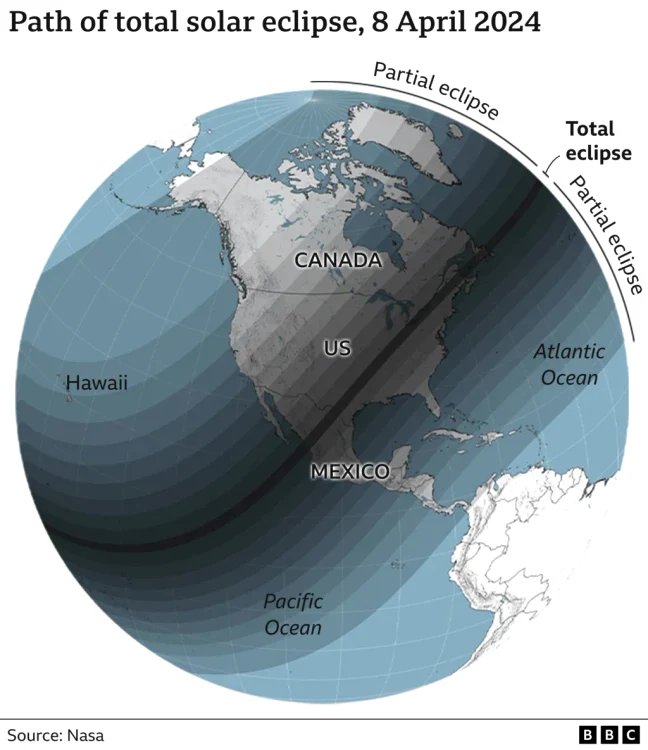
The event can be watched from the Pacific coast of Mexico to the Atlantic coast of Canada. So, it is expected to be a real blockbuster.
In 2017, the eclipse went from Oregon in the northwestern US to South Carolina in the southeast. This actually covered some sparsely populated regions, including many national parks. Instead, the 2024 event will cover some major US urban areas, such as Dallas, Indianapolis, Cleveland and Buffalo.
“This will be the most crowded eclipse in the US, with 31.5 million people able to leave their homes to experience it”Dr. Kelly Korreck, the US space agency's eclipse program manager, told BBC News.
The 2024 total solar eclipse will therefore start from the Pacific Ocean. Residents of Penrhyn Atoll, part of the Cook Islands, will be greeted by a darkened Sun at dawn at 06:40 local time (16:40 GMT).
The Moon's deep shadow will then cross Earth's surface at more than 2,500 km/h (1,500 mph), crossing the Mexican coast at 11:07 local time (18:07 GMT) and the Rio Grande border between Mexico and the US at 1:27 local time (18:27 GMT).
The journey continues through 13 US states before arriving in the Canadian provinces of New Brunswick (16:32 ADT; 19:32 GMT) and Newfoundland (16:39 ADT; 19:39 GMT).
The Moon's shadow will rise from Earth's surface into the Atlantic Ocean at 21:55 CEST (19:55 GMT), about 1,120 km west of Normandy, France.
What a total eclipse means to scientists
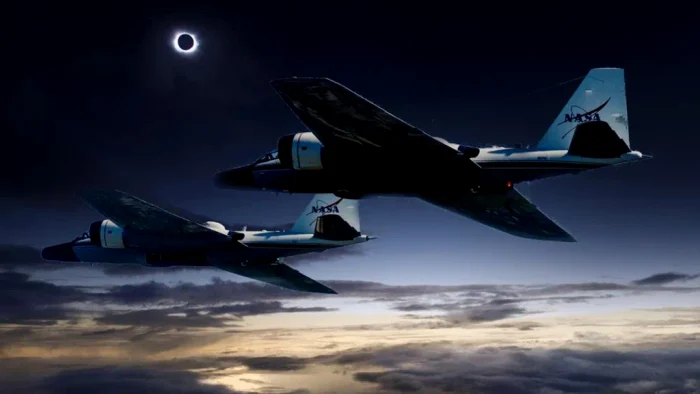
As expected, NASA will be doing experiments that day, such as launching rockets into the moon's shadow to see how it affects Earth's upper atmosphere, or ionosphere.
Instrumented jets will also follow the shadow.
NASA PHOTO
Total eclipses are special because they provide favorable conditions for studying the outer atmosphere of the Sun – its corona.
It is from this superheated, magnetized “gas” of charged particles that the solar wind originates, and from which billions of tons of matter can occasionally burst toward Earth to disrupt satellites, communications, and even power grids. The corona is eclipsed by the Sun's surface, its photosphere.
Satellites will block the glow using devices called coronagraphs, but these are usually so wide that they also block the view of the light immediately above the edge of the star. Only during an eclipse, when the disc of the Moon matches that of the Sun, do all aspects of the crown become accessible. British scientists teamed up with NASA to deploy instruments in Dallas.
They will have a polarimeter to examine the directional quality of the coronal light and a spectrometer to observe the behavior of iron atoms.
“During an eclipse, nature gives us a unique opportunity to measure this region with relative ease and see the connections between the Sun and the solar wind”explained Dr Huw Morgan from Aberystwyth University.
But you don't have to be a professional scientist to study the eclipse. There are also numerous citizen research projects. E.g:
Sunsketcher – for measuring the exact shape of the Sun.
Eclipse Soundscapes – will record how the natural world, especially animals, react when the planet is plunged into darkness. Apparently the bees don't fly anymore at that point.
Globe Observer – aims to record changes in temperature and cloud behavior.
Eclipse Megamovie – will again use an army of DSLR cameras to capture an expansive view of the event.
