
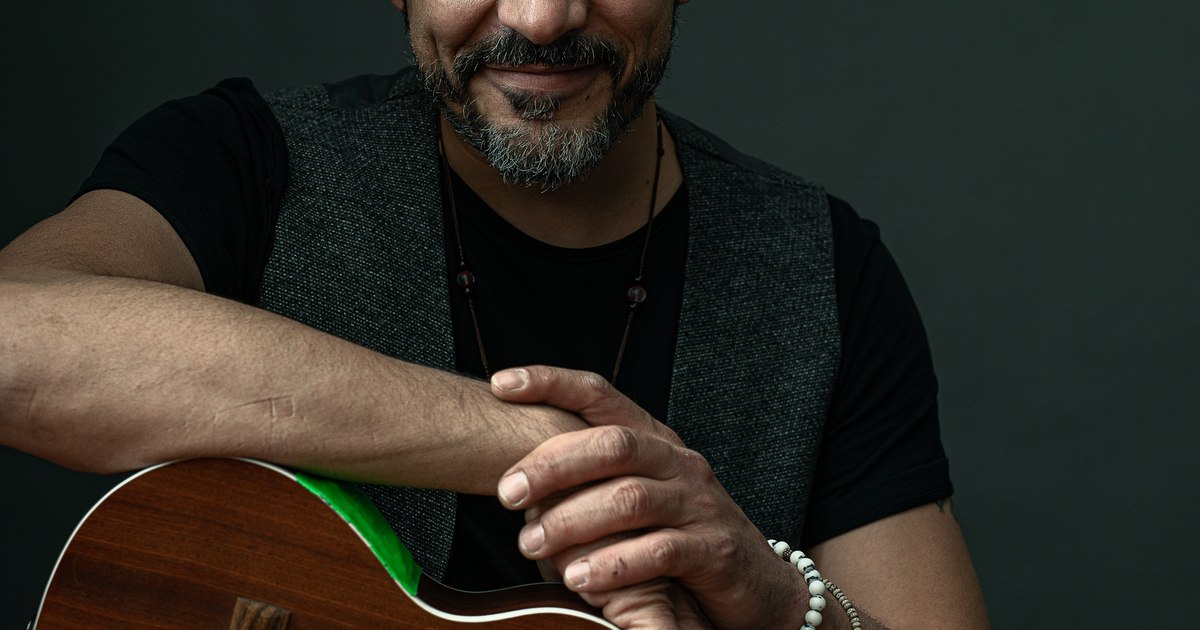
Adrian Despot, the soloist of the Vița de Vie band and one of the most talented and appreciated artists in Romanian music, confesses in an interview for Weekend Adevărul, that the creative act is his safety belt, and the new album, which was released on April 10 2024 is a difficult message.
Adrian Despot, the soloist of the Vița de Vie band, an exceptional artist PHOTO Matei Buta
Founded in 1996 and having ten albums under their belt, Vița de Vie is one of the best known and most loved alternative rock bands in Romania.
Characterized by a unique mixture of professionalism, sincerity and emotion, Vița de Vie is one of the most awarded Romanian bands, being rewarded throughout their career with numerous awards from the specialty industry.
From “Rahova”, the debut album released in 1997, to “Lacrimă și Fier”, the album that was released on April 10, Vița de Vie remained in the top of those who love rock music.
In an interview for “Weekend Adevărul”, the soloist and leader of the Vița de Vie band, Adi Despot (48 years old), takes the depressed teenager from childhood by the hand, brings him to the microphone and talks about fear, anxiety and fragility, experiences that have returned with the pandemic.
He also dissects Romanian society, from the music industry to the political class, pragmatically pointing out that nothing should surprise us, because politicians come from the ranks of the people, and art is only the satisfaction of a need.
A graduate of the Pedagogy department of the National University of Music in Bucharest and a graduate of the SAE Institute (School of Audio Engineering) – Cologne (Germany), Adrian Despot is a sharp interlocutor with a brilliant and very mobile mind. He is superlative, just as he is when he composes lyrics and music.
In the exclusive interview given to Weekend Adevărul, Adrian Despot was honest, open, with humor and many memorable lines. He spoke openly about both his relationship as an artist with sounds, as well as his evolving relationship with turmoil and how often music triggers his retroactive memory. A different kind of interview with an accomplished artist.
WEEKEND TRUTH: On April 10 YOU
launcht
albumthe
“Tear and Iron”. How was the creative process for this album compared to previous albums?
ADRIAN DESPOT:
If we start from the premise that each album is an entry in a personal diary, “Lacrima si Fier” is about the strange period 2020-2023, in which the world seems to have turned upside down – pandemic, lockdown, online school, show business closed, then war and all the economic implications derived from this whole complex of events. It's a heavy album, message-wise, and it's the kind of album that I had to take out once to get it off my shoulders and soul. It's gorgeous and terrifying at the same time, it was vital to do it, but it hurt like hell. “Tear and Iron” was the bag of stones that I carried around with me during this whole period. The time has come to put it down and move on.
– How did the pandemic and the war influence the creative process of the Vita de Vie band for this album?
Bizarre. Although I need isolation when I write, this form of enforced isolation has virtually annihilated my desire to write or even pick up an instrument. Then, when things calmed down a bit and we started to get some news about the virus, the government decided that the entertainment industry could be a danger to public health, so they shut us down.
In 2020, after 24 years of singing to people weekly, I was faced with the situation of not being allowed to sing. Without a logical explanation and without any trace of even a coherent estimate of a return to normalcy. “And now what do we do?” was the question we had to carry throughout this period.
The first song composed and released was “Butterflies” late in 2022. It took two years to settle with myself and my thoughts at the table. Inevitably, “Butterflies” is a song about fragility and destiny. Then came “Nobody, Nothing”, an almost biographical song that tells the story of loneliness accompanied only by a guitar and a notebook of lyrics. “Between the waves” is the third song already released in single format and, together with “Lacrimă și Fier”, the song that opens and gives the title of this album, the four make up the basis and essence of the new Vita de Vie material. It might as well have stopped there, but we chose to water it down by adding three more songs.
“I'm trying to make order in the chaos inside me and I'm getting better at it”
– How would you describe the relationship cA
sound artist?
Crime and Punishment (zboth). I realized how much time I waste searching for the perfect sound and how counterproductive it is. I collected six lifetimes worth of gear, thinking it would fertilize my creation. However, my six square meter childhood room and my first guitar, Reghin, are and have remained the mental creative temple of my life. I needed very little to make music back then, and that's what I try to remind myself of every time I think about buying a new guitar to spark my inspiration. The answer is in the soul, not in the sound, that's what a song needs.
– When did the effervescence of depression help you the most creatively?
This is how I was formed from a creative point of view, on a teenage background of depression, this is the reason why I felt the need to put my hand on the guitar and with its help remove all the fog that surrounded my mind and soul. Curious, maybe that's why, in musical jargon, we say “shovel” for “guitar”, I never thought about that.
It's true that sadness gives me wings, creatively speaking, that's where I feel at home. That's why it's also hard for me to make happy songs, it's like they're not mine… I don't know how to say, I don't recognize myself. But I treat myself, I began to get tired of eternal deep philosophies and this perpetual metaphysical torment. It's like I'm always trying to sew my heart with a needle without a thread, I don't solve anything.
Leafing through Vita de Vie's discography, I found that, although I've been doing it for almost a lifetime, I'm still trying to heal the teenager in that room I was talking about. I forced myself to argue, I started to tell myself that I am too easy and that I have to get over it. This is also the reason why I added three pieces over the “Tear and Iron” square.
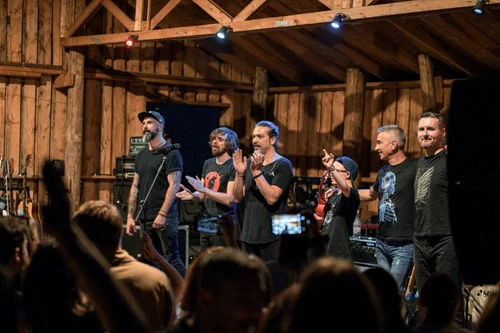
Image 1/11:
Vita de Vie in concert at Marcea Winery photo Catalin Neacsu jpg
– How often does music trigger your retroactive memory?
As a listener, it takes me to places and periods. States, less often, because the analytical part of me is always activated and I am careful to discover new things in old songs. We haven't gotten to the smells yet – please remind me to get professional help if it gets there
(zboth). At the same time, I'm looking for new music rather than revering old music. 90% of the time this is what I do: I listen to everything that moves, regardless of genre or period. I listen to so much music that I rarely remember the name of the author. I only retain it if I intend to return to it for further study. But I usually retain all the details of a satisfactory first audition. The time of day, the light outside, the place and my general mood.
Music, “the red thread of maturation”
– “Everything bothers you / Slow and sad”, you say in the song “Towards Paradise” from “Rahova”, the band's first album. How the relationship evolved with the turmoil between “Rahova” and “Tear and Iron”?
I'm trying to bring order to the chaos inside me, and I'm getting better at it. I always keep an eye open for the risk of self-plagiarism and always try, with each song, to take a step forward, compositionally, lyrically and production-wise.
– The songs of the Vița de Vie band arouse many emotions. Which artists evoke the most emotions in you?
Most of the time, the acoustic moments, unpopulated, where there is no orchestral thicket to block direct access to the soul of the song. Emotion is born from emotion, that's what I'm looking for and that's what I'm trying to pass on.
– How much has the creative musical act matured?
It is the very red thread of my maturation. Because the world as I originally saw it seemed crooked and meaningless, I tried to make sense of it through creative lenses. Over time, I chose not to take them off, and now they are already part of me. It's my safety belt that makes the things around me acceptable.
A natural change
– Say at a given time
that “The way I make my art is not directly, but through metaphors and other suggestions”
– iar Vița de Vie really makes different music in the best sense, without anything prosaic. How you managed to pervert your unmistakable musical style in your 28-year career,
in a Romania where the superficial in music is growing,
Unfortunately?
It's a decision I made a long time ago: to make music according to my head and not according to the likeness of her eventual “customers”. My music describes the way I see the world, inside and out. It is primarily about me, and its purpose is primarily therapeutic, not financial. The superficiality you speak of always starts from financial premises. If culture were in vogue and reading a mega-commodity, puppeteers would sing from Dostoevsky. They don't care what they sing, as long as they get paid and the “customer” buys their merchandise. This is also the reason why handcuffs, in particular, and superficial music, in general, cannot be blamed – as in any business, it only covers a need.
“Instrument people are gone from TV, replaced by people with turntables”
– I lived a long time in a rock culture. Why, for several years in Romania, do we live in a DJ culture?
People with instruments disappeared from TV, and in their place they put people with turntables. There is no tragedy, it is just a spinning wheel, both literally and figuratively.
– “I suffer horribly when I see people treat music exactly the way you treat a whore”, you declared 12 years ago in an interview. How would you characterize,
in the
OVERVIEW,
the way in which Romanians behave with music at the present time?
By no means uniform, people have different degrees of capitalizing on things that make them feel good, music, art in general, being one of them. Some don't listen to music at all. Others, only at parties. Others go to concerts. Others learn to play an instrument and start making their own music. I could say that, penetrating the miracle of the music and being touched by the power of it and the words that sometimes accompany it, I am sometimes disappointed by the shallow use of this potentially extraordinary blend. At the same time, people put water in wine to drink more, giving up taste for quantity. I prefer it dry.
– Although you have been repeatedly disappointed by the elected, you stated three years ago that you go to vote every time and you do not want to appearSyour country How irritating the question is “Who am I voting with?” in this year's elections?
I stay away from the subject so my heart rate doesn't go up. I will make the decision with the stamp in hand, in the voting booth. It's true that I'm tired of having my hopes trampled, but I'm not giving up.
– How much does the selfish amateurism in Romanian politics bother you? Has this amateurism sharpened?
The political class can only be an exponent of the society in which we live. Politicians don't come from space, they come from among us. Drawing the line, this is us.
