
Mercury may have a thick layer of diamonds several hundred kilometers deep, according to a new study published last month in the journal Nature Communications, which may provide answers to questions about the planet’s internal composition and its bizarre magnetic field. magnetic, Live Science reports Thursday.
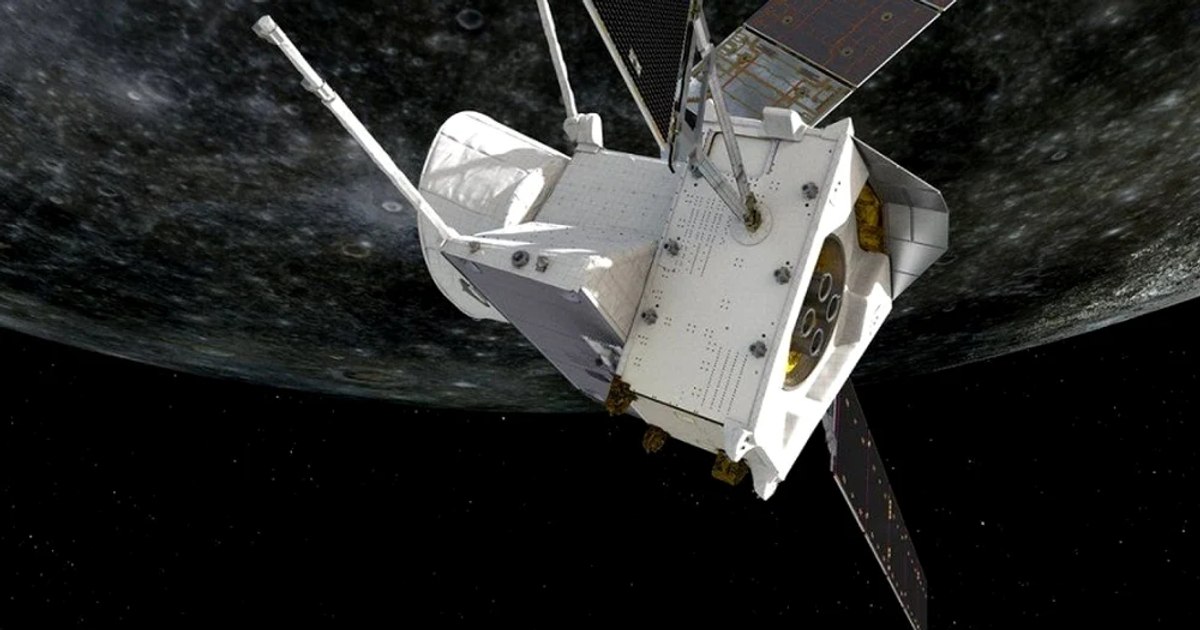
Planet Mercury Photo: ESA/ATG MEDIALAB
Mercury is a mysterious planet. For example, it has a magnetic field, which, although much weaker than Earth’s, is surprising because the planet that generates it is very small and apparently geologically inactive. Mercury also has unusually dark regions on the surface, which were identified by NASA’s Messenger mission as graphite, a form of carbon.
The existence of these graphite-covered regions on the surface of the planet attracted the curiosity of Yanhao Lin, researcher at the Center for High Pressure Science and Technology Advanced Research in Beijing and co-author of the study. The extremely high carbon content of the planet Mercury “made me understand that something very special must have happened inside him”according to a statement released by the Chinese researcher.
Despite this planet’s oddities, scientists believe that Mercury formed in a similar way to the other telluric planets in the Solar System: from the cooling of an ocean of magma. In the case of Mercury, this ocean was probably rich in carbon and silicates. First, metals coagulated within this magma ocean, forming a core, while the remaining magma crystallized to form the planet’s mantle and crust.
For many years scientists assumed that the temperature and pressure of the mantle were high enough to transform the carbon into graphite, which, being lighter than the rest of the mantle, rose to the surface. But a 2019 study suggests that Mercury’s mantle may be 50 kilometers deeper than previously thought. Thus, the pressure and temperature conditions in the boundary zone between the core and the mantle could be high enough for the transition of carbon into diamond.
To study this possibility, a team of Belgian and Chinese researchers, including Yanhao Lin, created a chemical “soup” containing iron, silicate and carbon. Such mixtures, similar in composition to certain types of meteorites, are considered to reproduce the initial chemical conditions in the magma ocean that covered the planet Mercury. The researchers also added different amounts of iron sulfide to this mixture. because the magma ocean could have contained large amounts of sulphides, given that the crust of this planet is rich in sulphides.
The team then subjected these mixtures to a pressure of 7 gigapascals – about 70,000 times greater than the pressure on Earth at sea level – and a temperature of 1,970 degrees Celsius – conditions intended to reproduce those in the depths of Mercury.
In addition, the researchers used computer simulations to obtain more precise measurements of the pressure and temperature in the boundary zone between the mantle and the planet’s core. Such computer models are used to learn more about the fundamental structure of the planet’s interior.
The experiments showed that minerals such as olivine probably formed in the mantle – a finding that matches the results of other studies. But the team found that adding sulfides to the chemical mixture made solidification possible only at very high temperatures. Such conditions are favorable for the production of diamonds. These diamonds would have crystallized during the solidification of the inner core of the planet and then migrated to the border zone between the core and the mantle. Calculations show that these diamonds would form a layer with an average thickness of about 15 kilometers.
Extracting these diamonds is impossible with current or near-future technologies because they are too deep (about 485 kilometers deep), but their existence is important from another point of view. This layer of diamonds could be the origin of Mercury’s magnetic field. Diamonds could have a role in the transfer of heat between the core and the mantle, and the temperature differences could produce currents inside the liquid iron, which would thus generate the planet’s magnetic field.
The conclusions of this study can also be used to explain the formation and evolution of other carbon-rich planets. “The process that led to the formation of a layer of diamonds in the basement of Mercury could also be found on other planets, leaving behind similar signatures”according to Lin.
More data will be collected by the BepiColombo mission, a collaboration between the European Space Agency (ESA) and the Japanese Space Agency (JAXA). Launched in 2018, the BepiColombo probe is scheduled to reach Mercury’s orbit in 2025.
