
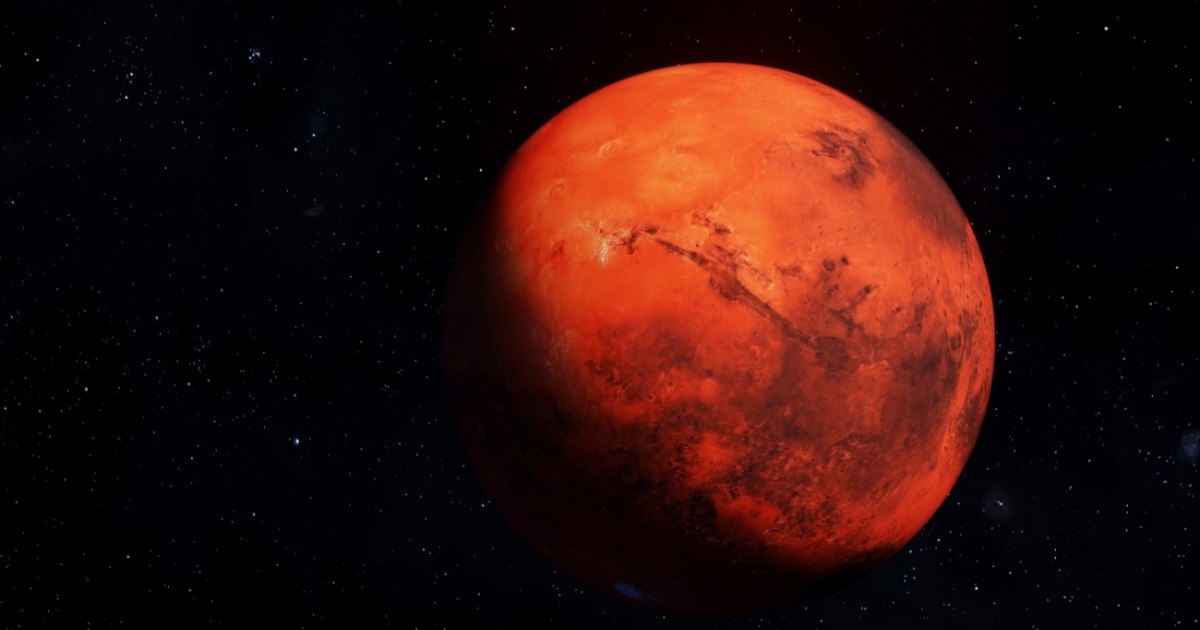
The planet Mars has revealed a new secret: ice has been discovered at the top of its giant volcanoes, an unexpected discovery that will help scientists better understand the water cycle on “Red Planet”essential for future exploration missions, informs AFP.
More information has been discovered about the Red Planet PHOTO: Shutterstock
This surprising discovery was made by chance by the European Space Agency's (ESA) Trace Gas Orbiter (TGO) probe in the Tharsis dome region near the Martian equator, according to a study published Monday in the journal Nature Geosciences.
The Tharsis region is vast and high, about 5,000 kilometers in diameter, and home to huge volcanoes that went extinct millions of years ago. Among them is Olympus Mons, the largest volcano in the Solar System, with an altitude of 22 kilometers, three times higher than Everest.
No one expected to find a grain in this area. “I thought it was impossible around the equator of Mars,” said Adomas Valantinas, lead author of the study and the researcher who made the discovery.
Strong sunshine and very low atmospheric pressure”they maintain temperatures quite high on the tops of volcanoes, similar to those on the surface of the planet”, explained this researcher from Brown University in the United States, quoted in an ESA press release.
In the Tharsis region, temperatures can drop drastically to -130°C at night, but this does not depend on altitude, “unlike Terra, where the peaks are frozen“, he added.
Also, the atmosphere at the Martian equator has a very low water content, making condensation difficult. “Other soundings have observed snowdrops in wetter regions, particularly in the northern plains”, said Frederic Schmidt, professor at Paris-Sarclay University and co-author of the study.
The discovery was made by chance. The TGO probe, which has been orbiting Mars since 2018, can observe the planet's surface at all hours of the day, explained this planetary scientist who specializes in studying ice in the Solar System.
The probe captured images at the moment of the first rays of the sun. “I saw a bright blue deposit with a special texture, visible only in the early hours of the morning and in cold seasons”he explained.
This deposit of ice, very thin – the thickness of a hair – is a transient phenomenon. But the amount of ash present at the summits of four volcanoes (Olympus Mons, Ascraeus Mons, Arsia Mons and Ceraunius Tholus) represents “150,000 tonnes of water circulating between the surface and the atmosphere daily, the equivalent of 60 Olympic swimming pools“, detailed ESA.
The authors of the study suggest the existence of a microclimate in the calderas of volcanoes, their vast circular craters. The winds would climb the mountain slopes, “bringing the relatively moist air near the planet's surface to higher altitudes, where it condenses and settles as drizzle”, said Nicolas Thomas, another co-author of the study.
“We observe this phenomenon on Earth and in other regions on Mars”added Nicolas Thomas, lead coordinator of the Color and Stereoscopic Surface Imaging System (CaSSIS) on the TGO probe.
Computer modeling of the formation of the plume should allow a better understanding of the water cycle – its dynamics between the surface, atmosphere, equator and poles – “one of the best kept secrets” of the “Red Planet”, according to ESA.
This cycle is essential for future human and robotic exploration. “We could recover water from the bean for human consumption and launch rockets from Mars by separating oxygen and hydrogen molecules“, predicts Professor Schmidt.
Mapping the water on the Martian surface – which currently exists only as vapor and ice – is also crucial to the discovery of traces of life, the appearance of which would have been possible due to the presence of liquid water on Mars 3 – 3 .5 billion years.
