
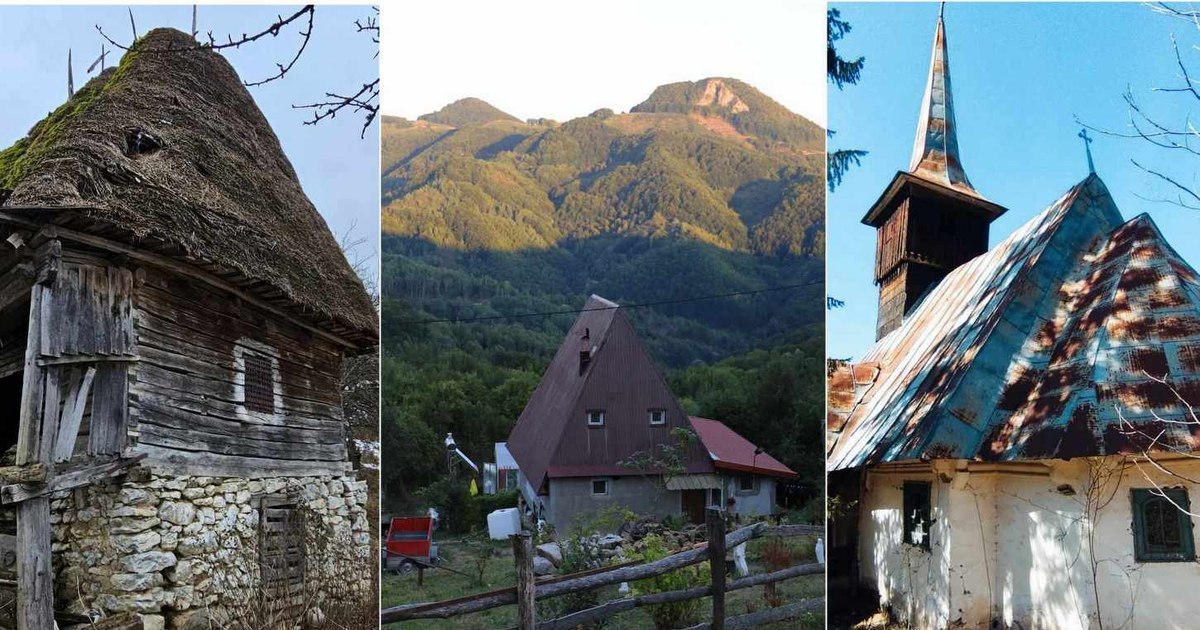
Located in the Apuseni Mountains, in an isolated land on the border of Hunedoara and Alba counties crossed by the “Iancului Road” – impassable by cars, the village of Tomnatec in Hunedoara could be reborn. Several young families moved here to start a new life.
Tomnatec and its surroundings. Photo: Daniel Guță. Church. Photo: Daniel Stanc.
The silence that had engulfed the old village of Tomnatec in Apuseni (video), attested since around the year 1500, but remained almost deserted for several years, it was further dissipated.
Several young families moved here, in the isolated land of the forests on the border of Hunedoara and Alba counties, impressed by the beauty of the place, the clean air and the fertile land on the hills.
“My family and my sister’s came and we settled here at Tomnatec. It is a place where we can raise our children, in the middle of nature. The soil is good because any vegetables can be grown here, we don’t have to buy them from supermarkets. It’s a signal, we’ve drawn water, and the road to Bulzestii de Sus has been repaired in recent years, so it’s somewhat accessible.” says Cristina, a young woman who moved with her family, from Teleorman county.
A small Adventist church was established on a hill of the village, for the community that seems to be consolidating in the village of Tomnatec.
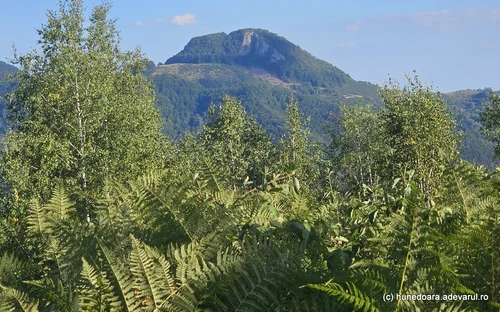
Image 1/13:
Tomnatec village in Hunedoara Photo Daniel Guță THE TRUTH (4) jpg
And other families bought old households, uninhabited for several years, in Tomnatec and in the surrounding hamlets (Străuți and Grohot – video) with some picturesque houses with thatched roofs, with the intention of restoring them.
People usually come here during the summer, but some of the new tenants are increasingly tempted to stay in the village permanently. The old residents of Tomnatec can be counted on the fingers. Only a former forester and his elderly wife never left the village.
The hamlets in the surroundings of Tomnatec, connected by mountain roads that are difficult to access by cars, are also kept alive by several families, some by elderly people, who live in them permanently, and others who take care of them but live in the municipality of Brad or in the villages close to Tomnatec, but accessible by paved roads.
At Tomnatecul de Jos, left deserted, travelers arrive on the forest road that crosses Cheile Ribicioarei, from Ribița commune in Hunedoara, a place with a spectacular relief, where there are several caves inhabited in ancient times.
In the village, tourists discover several households abandoned for several years, hidden by the wild forest or lined up on the side of the forest road, damaged by machinery and wood trucks.
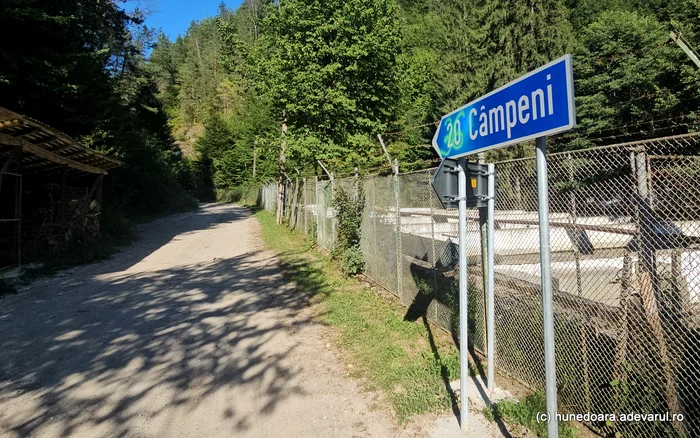
The Iancului road, difficult to reach from the edge of the village of Bulzestii de Sus. Photo: Daniel Guță. TRUTH
The road between the villages Tomnatecul de Jos and Tomnatecul de sus is inaccessible to cars, say the locals.
On the other hand, the hills of Tomnatec can be reached from Bulzești from above, on two dirt roads, 10 – 15 kilometers long.
Other forest roads, paved or partially asphalted, climb through the dense forests of the commune of Bulzești de Sus, up to the gentle ridges of the Apuseni Mountains, where a few inhabited households animate the hamlets of Grohot, Străuți, Giurgești, Păulești, Rusești, Stănculești and Ticera.
Iancu’s Road
Of the two hard-to-reach roads to Tomnatec, one is partially asphalted, up to the village of Grohot, but the last seven kilometers remain inaccessible to cars during the winter and after the rains.
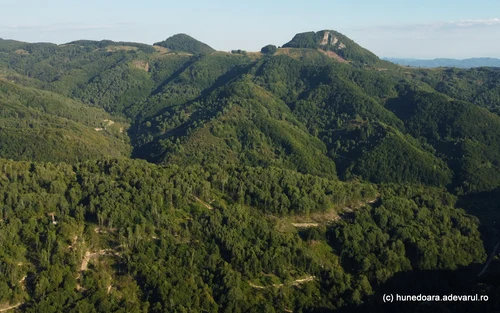
Image 1/12:
The village of Tomnatec in Hunedoara Photo Daniel Guță THE TRUTH (18) JPG
The second road that goes up to the edge of Tomnatec village is called “Drumul Iancului”. The road that connects the north of Hunedoara county with the mountain settlements in Alba county crosses the commune of Bulzeștii de Sus in Hunedoara, located 30 kilometers from Brad municipality, in the Apuseni Mountains. In the entire commune, to which the village of Tomnatec also belongs, about 300 people remained, ten times less than its population in the middle of the 20th century.
From the end of the village of Bulzeștii de Sus, the road to Avram Iancu and Câmpeni communes, located about 30 kilometers over the hills, is continued with a stone road, impassable by cars, that passes at the foot of the hill on which the village of Tomnatec is located.
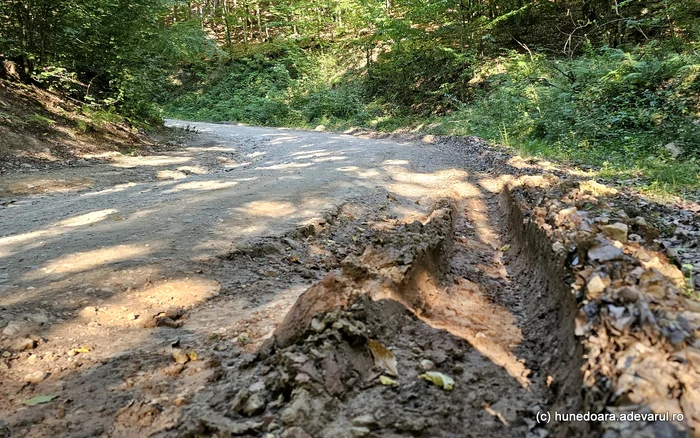
Iancu’s Road. Photo: Daniel Guță THE TRUTH
This road was called “Drumul Iancului”, being the route that connects Vidra de Sus, the place where Avram Iancu was born, and Țebea, where Crăișorului Munților’s grave is located. Several locals asked the Hunedoara authorities that, at least in 2024, when the 200th anniversary of the birth of Avram Iancu, this road be rehabilitated.
“It is about County Road 762 that connects Bulzești de Sus to Avram Iancu commune and that has been in a precarious state for many years. For those who do not know or pretend not to know, this road is the pride of the Apuseni people, it is the road that connects the seven wonderful valleys that lead to the heart of the Apuseni people. It is the road on which, until recently, the bus traveled to Câmpeni, where the locals used to go to the fair. It is the road that leads to Mount Găina, it is the road that Avram Iancu walked on, it is a road that, once modernized, would bring an unprecedented development of tourism in the entire area. We consider it a duty of honor, a tribute and a holy duty that this road be brought to the stage of normality”, it is stated in a petition sent recently by several locals from Bulzeștii de Sus, to the Hunedoara County Council.
The old church in Tomnatec, cared for by the locals
Not only the roads, but also the old church of the village of Tomnatec, is in a precarious state. Built in the 18th century, only this year, the church in Tomnatec was cared for for the first time (video – Daniel Stanc), after decades in which it was almost abandoned.
In the last decades, it had been abandoned and left to its fate, just like most of the former households of the moti in the settlement crossed by the Ian’s Road.
In April, a group of volunteers worked to bring her back to life. People trudged up the mountain path to the abandoned church and set to work.
They swept away the thick dust that settled on the floors and furniture of the church, cleaned the books and its odors, and freed the old settlement from the vegetation that invaded it.
“Iancului’s road brought the young people from Bucharest, Giurgiu, Timișoara and Arad county together again to the wooden church in Tomnatecul de Sus (Bulzeștii de Sus Commune), where with God’s help they managed to clean both the inside and the near the church, they also improvised temporary solutions to stop the rain from penetrating inside the church. We want to save and restore the value of this wonderful church and we will do everything necessary to succeed, so we invite everyone who wants to get involved to come with us”. informed Daniel Stanc, initiator of the action.
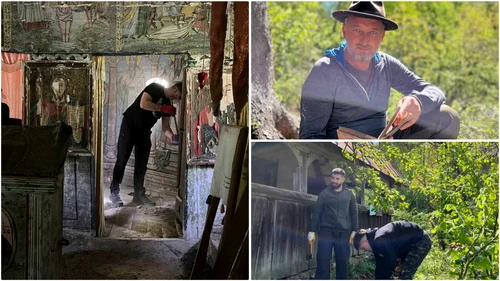
Image 1/8:
The church in Tomnatec Photo Daniel Stanc (9) jpg
The church in the village of Tomnatec, however, needs extensive repairs, in order to be fully safe – says Daniel Stanc, initiator of the “Drumul Iancului” project, which aims to bring back to the attention of Romanians the land of the Apuseni and the places where lived Avram Iancu.
The village of Tomnatec, remained almost deserted in recent years
At the beginning of the 20th century, the village of Tomnatec in the Apuseni Mountains, located on the border of Hunedoara and Alba counties, had over 800 inhabitants.
The mountain village spread over the valley of Ribiciora from Hunedoara (video) and on the ridges traversed by the “Drumul Iancului”, a cobbled road on which the locals from the lands of Zarand went up to the fairs in Câmpeni, Abrud and Muntele Găina.
It included many hamlets, the most populated being Tomnatecul de Sus and Tomnatecul de Jos, each with a picturesque wooden church from the 18th century.
The moti settlements were watched from afar by the Bulzestii de Sus bulzu (video) on one side and the Tomnatec ridge, on the other – two massifs with the appearance of huge gray pyramids covered by wild forests, remnants of extinct volcanoes.
Since the 1930s, numerous families from the Apuseni Mountains were displaced to Arad county, so that the villages on the western borders of Romania would be more intensively populated with Romanians.
The mountaineers from Apuseni were then offered more fertile land than in the mountains, to build their houses, and the promise of a higher standard of living.
After the Second World War, other families migrated to the industrial centers of Apuseni and Hunedoara, the people being able to be employed in the mines and factories in the Bradului area or over the mountains, in the mining centers of Abrud and Zlatna.
The village of Tomnatec seemed doomed to disappear since the 90s, when its churches were abandoned, and the village of Tomnatecul de Jos turned into a pile of rotting wood. The forest engulfed her and swallowed her forgotten cemetery.
The other church, in Tomnatecul de Sus, remained until a few years ago somewhat protected by the line of towering fir trees that rose around it, hiding it even better in the dense forest.
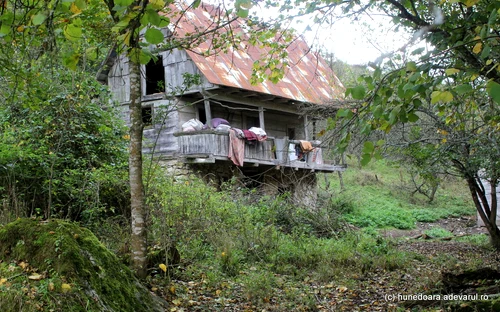
Image 1/13:
Tomnatec Village Photo Daniel Guță THE TRUTH (7) jpg
The trees were cut down and the church, difficult to find in the absence of a road, was also left to decay. The bells and several other valuables were taken from him, to the displeasure of the few locals left in the area.
