
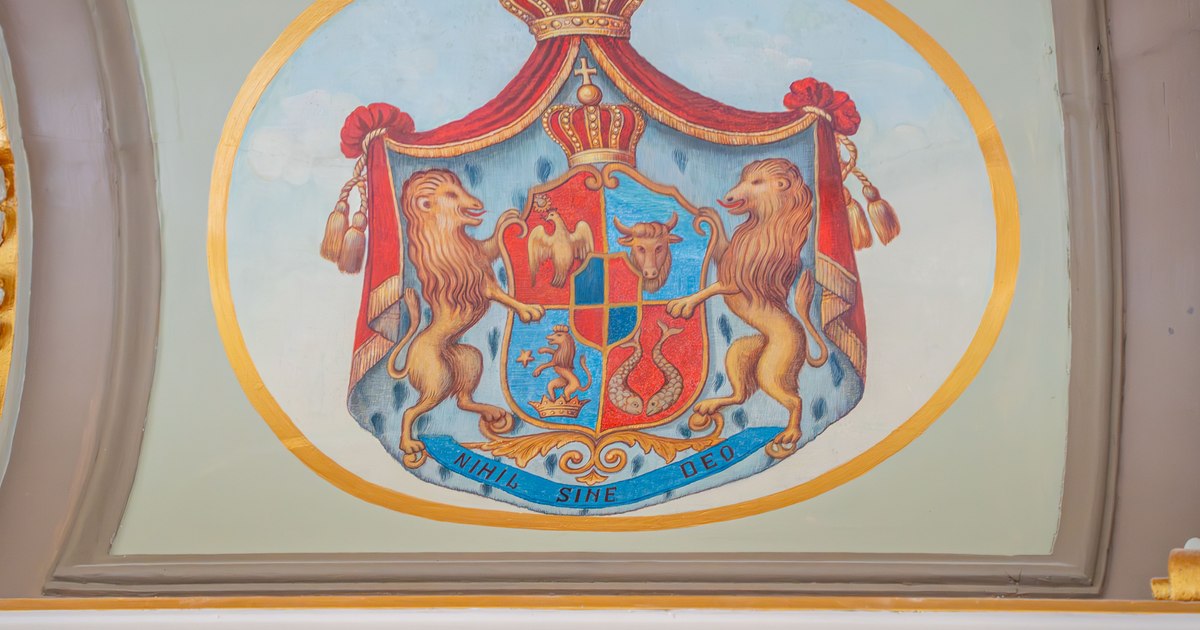
After five years of restoration, the “Rudolf Schweitzer – Cumpăna” Art Gallery in Pitesti will regain its former glory. This is one of the most beautiful art galleries in Romania and Eastern Europe.
The painting with the royal coat of arms of Romania was hidden for 75 years PHOTO Argeș County Council
The building was built in 1886, in an eclectic classicizing style, based on the project of the architect Ion Socolescu, with the initial destination as the seat of the Pitesti City Hall.
Mihail Kogălniceanu was the one who made an essential contribution to the construction of the building, a real architectural gem.
The building was completed in just one year, being inaugurated on October 30, 1886 and functioning as the headquarters of the Pitesti City Hall until 1968. From 1968, the building became the headquarters of the Pitesti Art Gallery, a gallery renamed in the early 2000s “Rudolf Schweitzer-Cumpăna “, in honor of the great painter originally from Pitesti and who decided to donate numerous paintings and graphics to his hometown. And – a sign of destiny? – Rudolf Schweitzer-Cumpăna was born in 1886, the year of the inauguration of the building that would later house a large part of his paintings.
After 1990, the Pitesti Art Gallery reached an advanced state of decay step by step. But thanks to an extensive project of 19.9 million lei, of which European funds of 19.5 million lei and co-financing from the Argeș County Council of 426,603 lei, five years ago the restoration of the Pitesti Art Gallery began from the ground up.
“Adevărul” was on the site of the Art Gallery in Pitesti, the restoration being more than 99% completed, and spoke with some of those involved in this major cultural project.
“Part of the interior walls of the building that houses the Pitesti Art Gallery have become works of art in their turn, because during the restoration works, valuable paintings were discovered that were initially unknown, they had been covered by several layers of plaster and lime, and now they have been brought to light. Original paintings made in the period 1885 – 1886 were found, there are even two rectangular plaques, in the hallway leading to the first floor, where the members of the Royal Family (King Carol I and Queen Elisabeta), of the Government headed by Ion C. Brătianu and of the City Council from that period. During the restoration works, a coat of arms of Royal Romania was also discovered, a very rare one, which had originally been covered by the coat of arms of Romania from the communist period”declared for “Adevărul” Ion Mînzînă, the president of the Argeș County Council.
Uncovering the unique paintings, an extremely laborious job
Uncovering the special paintings and restoring them required a lot of work, with more than 40 people involved in total.
“The whole process started, basically, with some stratigraphic surveys done on each individual surface, in the areas where it was possible, because there were large areas where the painting was completely exfoliated. The atmosphere here was more than desolate, and following the stratigraphic surveys carried out by the entire team, it was possible to highlight the fact that there is an original painting that is special for the entire Romanian heritage. It was worked square centimeter by square centimeter, as each layer was successively removed until we reached the original version. The royal coat of arms of Romania, discovered during the restorations, had originally been covered with a layer of light green painting, a worker’s green applied very tightly to the entire surface during the communist period”explains expert restaurateur Maria Cătălina Tuică.
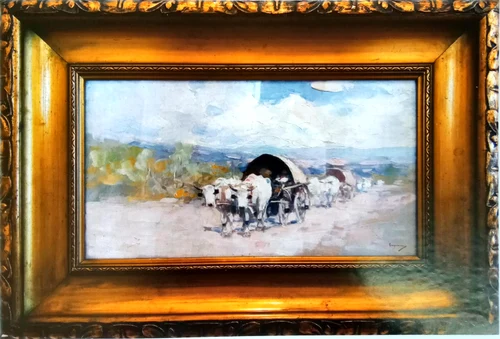
Image 1/11:
Nicolae Grigorescu painting Pitesti Art Gallery photo CJ Arges jpeg
Later, the removals began and the restoration of the paintings discovered using different methods, including the velatura technique, so that, as Maria Cătălina Tuică says, “the areas that were missing were consolidated and reconstructed, everything related to the original was consolidated, so that at the end we have a complex image where a clear unity of the original prevails, not of the intervention of the restorer, because the restorer does nothing but to value the past. The mural pictorial ensemble has a particular uniqueness, thanks to this ornamental and chromatic richness and extraordinarily well mastered”.
How the communists hid symbols of royalty
The communists completely masked the two rectangular plaques where the members of the Royal Family (King Carol I and Queen Elizabeth), of the Government led by Ion C. Brătianu and of the Local Council from the year the building was inaugurated, were passed.
“In addition to the layer of paint, they had a very adherent layer of plaster, an attempt was made to mask them completely, so that no detail could be seen, so that there would be no access to these two testimonies. Only history has come out”says expert restaurateur Maria Cătălina Tuică.
Among those who worked with passion and dedication on the restoration of the paintings were also several graduates of the Sacred Art section of the University of Pitesti.
“I greatly appreciate the young people who worked on the restoration of the Pitesti Art Gallery. Consider that the restoration of a small painting took at least three days. These young people dedicated themselves body and soul to the restoration, with a lot of patience, attention and talent. After the completion of the restoration, the Pitesti Art Gallery will be one of the most beautiful museums in Romania. It is essential to get involved with the deed in supporting culture and rehabilitating special buildings, such as the Art Gallery”says Ion Mînzînă, the president of CJ Argeș.
The reception of the building will be in the fall of this year.
As for the many high-value paintings, about 1,400 in number, it will be some time before they can be seen again. During the restoration works, the paintings were moved to the Argeș County Museum. And they will be returned to the Pitesti Art Gallery, section of the Argeș County Museum, only after the necessary microclimate is ensured.
“We own, among other things, the largest collection of Rudolf Schweitzer-Cumpăna paintings in Romania, almost 300 paintings. The paintings will be moved again to the Pitesti Art Gallery after we have ensured the necessary microclimate. Studies will be done for several months to see what temperature is needed in the rooms for the paintings, we need to see the microclimate, the simes will be set up. I have already installed several devices, including fan coil units. After the necessary microclimate will be ensured, we will also choose which paintings will be exhibited. There will also be two free rooms for temporary exhibitions”says Cornel Popescu, director of the Argeș County Museum.
Among the modern and contemporary works of art that will be brought back to the attention of art lovers from 2025 are representative works of Romanian painting, included in the National Cultural Heritage, with national and international value, signed by great painters such as: Nicolae Grigorescu, Nicolae Tonitza, Stefan Luchian, Ion Tuculescu, Octav Băncilă, Theodor Pallady, Rudolf Schweitzer-Cumpăna, Camil Ressu, Nicolae Darăscu.
