
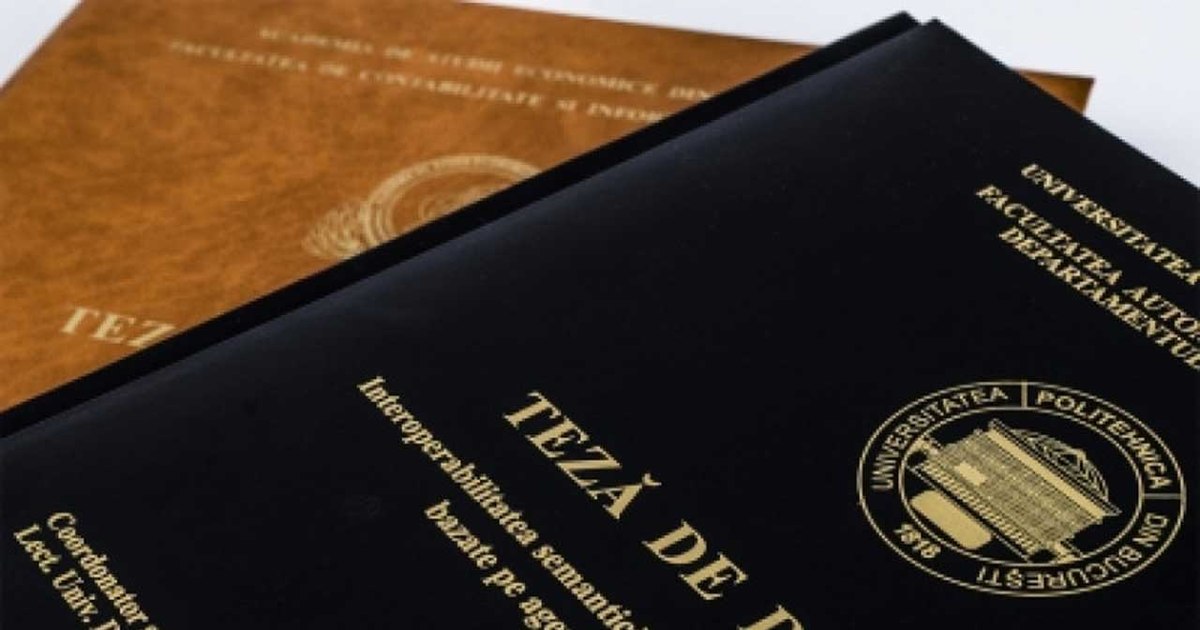
The upcoming halving of the doctoral allowance is creating controversy in society. On the one hand, there are those who say that the money obtained in this way is a privilege and point the finger at plagiarism scandals and the way in which such a title can be obtained in Romania. The latest available data, from 2022, showed that in Romania there are over 80,000 people with the title of doctor. On the other hand, those who worked for such recognition feel discouraged and wronged. “It is not the responsibility of the prime minister to check who did their doctorates honestly and who didn’t. So – as always – the honest ones pay for the pots broken by the resourceful ones”says university professor Mihai Maci.
What measure is being prepared
According to a draft emergency ordinance on administrative measures, made public by the Ministry of Development, the doctoral allowance will be capped in 2026 at 500 gross monthly lei. Currently, the amount can reach up to 950 lei gross monthly. That is 580 lei net. If the measure will be applied, those who hold the title of doctor will receive at most 293 per month. The difference is almost 50%.
The decision is not singular, but is part of a package to reduce budget expenses. “Through the draft normative act, a series of measures are established, so as to ensure compliance with the commitments assumed by Romania in terms of falling within the budget deficit target, by reducing some operating expenses of the central and local public institutions and authorities, and respectively, by increasing the budget revenues of the administrative-territorial units”the Executive justifies the measures introduced in the ordinance.
After the announcement, political scientist Cristian Preda tore up his doctoral degree live on television. While sociologist Gelu Duminică came up with a different reaction and wrote that it seems natural not to ask for preferential treatment.
In the document put up for public debate, no detailed analyzes are presented related to the beneficiaries of this allowance, and no clear number of the persons concerned appears. The latest available data, made public by the Ministry of Education, are from January 2022. Until then, 80,144 doctorates had been awarded in Romania. For decades, the situation looks like this:
- Between 1990 and 1999 – 9,517 PhD titles
- Between 2000 and 2009 – 28,226 PhD titles
- Between 2010 and 2019 – 37,969 PhD titles
The year with the most such appointments was 2012 (6,259 doctorates).
The stigma of plagiarism
Over the years, the academic environment in Romania has been marked by numerous high-profile plagiarism scandals: Prime Minister Victor Ponta and Deputy Prime Minister Gabriel Oprea are among the most famous names accused, following investigations by journalist Emilia Șercan, of having copied in scientific works. However, they remained with the title of doctor, even if their diploma had initially been withdrawn. And Marinei Pirtea, the rector of the Western University in Timișoara, who was in the books for the position of Minister of Education, was targeted by such accusations. But also the Minister of Justice, Radu Marinescu.
“Always, we only see public figures, the ones that, because of their visibility, Mrs. Emilia Șercan has her sights set on. However, there are thousands of military and civil servants with doctor’s degrees. How many of them got them through honest work? We had the “Academy” of Mr. Oprea, which was a kind of lodge that was entered by “blessing” a doctorate “in the family”. What happened to their commissions? Has anyone suffered anything? As they say in the army: these people are “in reserve”; waiting for the moment of his return.”, says Professor Mihai Maci, lecturer at the Department of International Relations and European Studies of the University of Oradea.
Mihai Maci: “The measure affects all those who live from study and research”
However, the professor believes that the allowance reduction measure will affect precisely those who honestly obtained the title:
“I don’t know how the measure is seen where it was decided; in this case what budgetary increase is obtained by applying it. Down where I am, it doesn’t affect at all those who got their Ph.D. just for (yet) a buttonhole ribbon, but it hits everyone who makes a living from study and research and who (we can assume) did their dissertations for real. However, unfortunately, only piecemeal measures can be taken here. It is not the prime minister’s job to check who has honestly earned their doctorates and who has not. So – as always – the honest ones pay for the pots broken by the resourceful ones”.
Raluca Ailincăi, school counselor teacher and doctor of sociology, says for his part:
,,It affects exactly the people who have worked for years for a title properly obtained through real research. Instead of solving specific problems in the system, it is cut for everyone, en masse. It’s a quick fix, but deeply unfair to those who have actually invested time, energy and competence in their academic training.”
Privilege or right?
The allowance for the scientific title of doctor exists since 2017, for staff paid from public funds. The amount was set at 50% of the minimum gross salary per country and granted only to those working in the field in which they obtained their doctorate. Before 2017, there were increases for the doctorate in the budgetary sector.
Romania is the only country in the European Union that offers such an allowance, which has led many to say that it is a benefit and a financial advantage, not a right.
Professor Mihai Maci says that it is neither a privilege nor a right, but a compensatory measure for incomes that are not commensurate with academic training.
“The doctoral allowance is a compensatory measure. In reality, those with third-level education (as they say after Bologna) should have had a completely different fixed remuneration at work, intended to confirm their training. Of course, this is also about the fields for which doctoral studies are a necessary stage of professional validation. We, on the other hand, have done doctorates in all kinds of “sciences” unique in the world, and we have given doctorates, as well as bachelor’s and master’s degrees to anyone. If we raised everyone’s salary, it would be even more chaotic. The paradox is that the doctor’s degree and the related income have ceased to be a privilege and have become democratized. And I think the real problem is that they don’t go to everyone!” the university professor thinks.
Even Raluca Ailincăi does not see the allowance as a privilege:
“A privilege is something you get without effort. You don’t get a doctorate like that. Compensation is a form of recognition of consistent intellectual work. Years of study, research, giving up, professional responsibility. If we want to encourage academic achievement, we must respect it. Otherwise, we send the message that effort doesn’t matter.”
How could the academic system be cleansed of imposture
I asked professor Mihai Maci what he thinks should be done so that the title of doctor is granted only to those with high academic training and is no longer associated with imposture.
“The only way to ensure the quality of doctoral theses is the honesty of the examination committees. Or, what did we do? We have created verification mechanisms, both within universities and on a national scale (CNATDCU). It didn’t work, because the works with problems did not decrease. Then we went to court, where it is never clear what and how. People with obvious integrity issues won on some procedural nonsense. Honestly, I think there is nothing to do here. We are multiplying skills and – honestly – every skill is counting on clients to add something to their salary.”
Furthermore, complete this: “Perhaps this measure of the prime minister is, in its own way, rational: only by restricting the need for doctorates can a relative cleanliness be achieved. It should go further: the career advancement of those who do not teach or do research (doctors, soldiers, policemen, people from the judiciary, administration, etc.) should no longer be conditional on a doctorate or the doctorate should no longer represent any kind of advantage for them”he answered.
Raluca Ailincăi also recognizes the problem of fake diplomas and draws attention to some necessary measures:
“When you have more than 80,000 doctors, but not all of them have produced real knowledge or are not active in fields where the title is relevant, it is clear that the procedures need to be reviewed. I think the solution is simple but firm: clear criteria, independent commissions, real evaluation of scientific contribution and total transparency. The doctorate must return to what it should be — a title awarded to those with solid academic training and genuine results, not a formality.”
Protest in Education
Grievances related to the reduction in allowance add to another string. In Bucharest, trade unionists from education announced a protest against the fiscal-budgetary measures aimed at this segment. The demonstration is organized by the Federation of Free Trade Unions in Education, the Federation of Trade Unions in Education “Spiru Haret” and the National Trade Union Federation “Alma Mater”, but they were also joined by the Representatives of the National Alliance of Student Organizations from Romania (ANOSR).
