
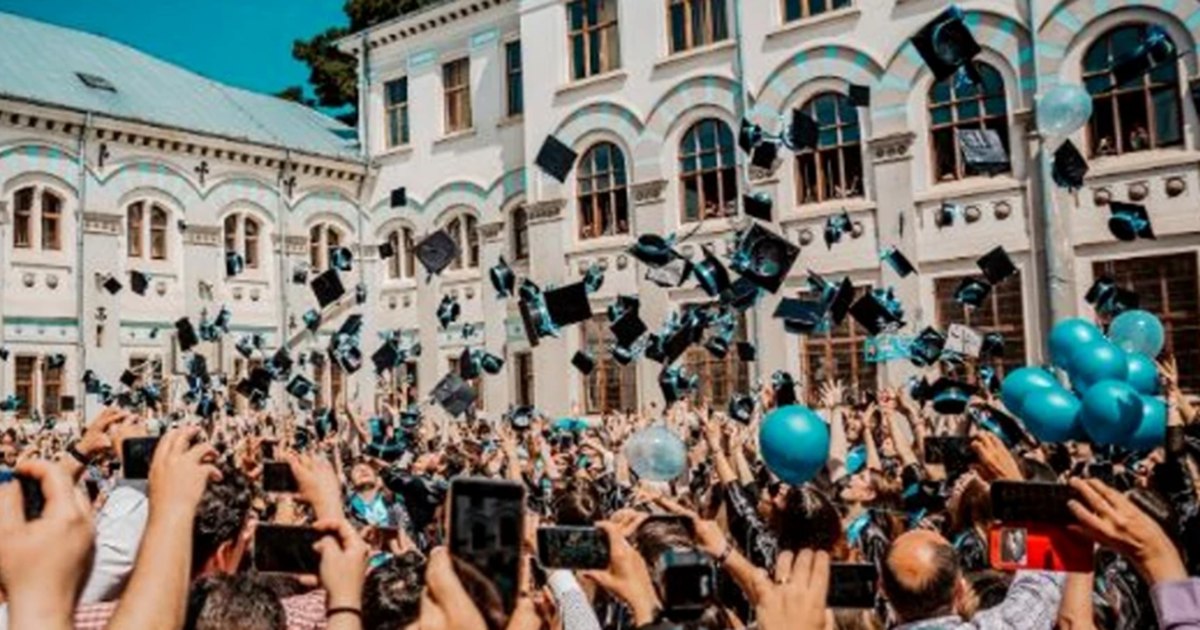
In a Romania already coda in terms of higher education, with the fewest Faculty graduates in the EU, the austerity measures strike again in students. The massive scholarship cuts, recently announced, do not seem to be only a budgetary measure, but rather a systemic strategy of discourage higher education.
Fewer scholarships, fewer graduates of higher study photo archive
Professor Mihai Maci formulates hard and clear: “We need many people to work with their hands and few to work with their heads ” What this decision means, who loses and who wins – a painful analysis of the sacrifice of education on the altar of austerity.
Scholarship reform: an “optimization” with devastating effects
Romania is facing one of the most drastic restructuring of the student scholarship system in recent decades. As part of the application of Law 141/2025 (“Bolojan Law”), the Ministry of Education approved a 40% reduction in the total scholarship fund, with severe changes regarding the granting criteria.
Among the hardest measures are: the complete elimination of the exchanges of excellence, the decrease of the scholarships for the future teachers with 1,500 lei, the exclusion of the students with tax from any type of scholarship, the granting of scholarships only during the teaching activities, not on holidays.
The changes are likely to affect not only the academic path of young people, but also the entire concept of fair access to higher education. Professor Mihai Maci, lecturer in the Department of International Relations and European Studies of the University of Oradea is of the opinion that other solutions could be found.
“A
It was the great discussion about the fact that, in the last two years, the scholarships have exploded. There were several ways to act: the first, was it to see what those scholarships were – social scholarships? The merit scholarships, according to my science, have been kept within decent limits. Social scholarships could be redefined, granted on the basis of clear criteria, transformed into vouchers that allow students to buy books, go to conferences, things like this“he claims.
“There will be less and less prepared” – Mihai Maci explains the effects in the waterfall
Maci is of the opinion that the current measures are the symptom of a dangerous, intentional and deeply regressive direction.
“What I can tell you, from the experience I have with the students is that most of them are in the situation where, inevitably, they are also deprived of this small subsidy, they will have to work. If the student works, his ability to prepare for the courses and, especially, for the seminars, it seems to me that they will not decrease. Sad, from my point of view, it will be this.he says for the truth.
The problem is even deeper, and the students, trapped in a vicious circle: with the employment, they risk exceeding the income ceiling that allows them to benefit from the scholarship, thus losing essential long-term support.
“Students are facing similar subsistence problems in holiday weeks, scholarships representing constant and necessary support for them. The fact that students will no longer benefit from scholarships during these periods can cause them to temporarily engage in order to cover their expenses, and the additional income they have to have could subsequently endanger their chances of benefiting from social scholarships in the next academic year, due to the possibility of registering income over the ceiling of scholarships ”,”, ”
stresses the National Alliance of Student Organizations of Romania (ANOSR), in a statement.
Eurostat: Romania, in the last place in the EU at graduates of higher education
Mihai Maci’s statements gain even greater weight in the context of European data. According to Eurostat, Romania is in the last place in the European Union at the percentage of higher education graduates, among young people.
Only 23% of Romanians between the ages of 25 and 34 have a university degree. The European average is 42%, and 13 Member States have already exceeded the 45% target for 2030.
In Ireland, the percentage reaches 63%, in Cyprus – 62%, in France – 52%, and in Poland – 46%. In this context, the recent measures of the Romanian government risk not only maintain, but to deepen this gap.
“It is a sad thing. We behave as if studies would not count at all. We live in a world where all these measures let us understand that we have internalized the idea that from an intellectual point of view, of research, of new cultural performance we have nothing to wait. Thus, we can sacrifice them. ”,
says the university reader, Mihai Maci.
Hard scenario: a tiny elite, a mass of workers
University studies would become a luxury, for those who allow it, while the state seems to withdraw from the mission to support the academic training of young people.
“The idea is that if you want to study, you do the money for the mother and my father. And ready! If not, he has another idea behind them, namely to turn young people into workers. Because we do not need people with diploma – there are, and so on the possibilities of the country,” points out the education expert.
Mihai Maci’s statements reach an ignored reality: Romania produces more graduates for the public sector (law, economy, psychology) and almost none for industry and agriculture – two sectors left in comparison.
“We need to understand that this thing has its reason. The fact that we have demanded the big industries, we put them to the ground, because we did not know, we did not know how to find markets. In us, agriculture is either export or subsistence. Primitive, which does not involve specialized personnel.continued the specialist.
Faculty graduates, in a percentage of 2%
A dark forecast for the future would be for Romania to have even ten times fewer graduates than at present.
“My vague suspicion is that, at the level of planning, it is considered that Romania could work very well with a tenth of the current graduates. This is trying to do it. To avoid brushing things, because, obviously, everyone would jump: Deculturalization of the country, Government abuse, if this is what to do. The head, ”says Maci.
“We sacrifice more than we earn”
Once disassembled, a system such as education can no longer be rebuilt at acceptable costs – neither financial nor human. The question is: is it worth the sacrifice of a generation only for a budget balance of the moment?
“From my point of view there are some measures that are made extremely fast, they are made and, almost without realizing it, is that we sacrifice more than we win.
It will also happen at the level of higher education, probably at the level of primary education, in the rural area, about what happened with the industry. Put on big facts, we destroy these things and after, when we have to recreate them, it will cost us thousands of times more expensive than to maintain them, at the level of subsistence, at the present time. Obviously, then we will have no money to recreate them.
I understand that it is a reason behind these things, I understand that it cannot be displayed, but on the other hand, it seems to me that the measures are sudden, paușale and messchine“,
stress Mihai Maci.
Students, excluded and ignored: “an unfair and discriminatory measure”
The National Alliance of Student Organizations of Romania (ANOSR) has expressed “deep disappointment and concern” to the restriction of access to scholarships.
“This practice of the Ministry of Education and Research ignores the principles of transparency and involvement of the actors interested in making decisions, expressing a lack of respect of the institution and a challenge of the regulations existing in this regard.Dememaging is the fact that this case is not a singular one, the Ministry of Education and Research practicing in recent months this way of adopting normative acts“,
The ANOSR statement is specified.
Students also talk about a non -transparent approach, no public consultation, lack of real debates and accentuation of discrimination. Moreover, ANOSR considers the new “unfair and discriminatory” measures, especially the elimination of scholarships for students from the tax, a decision that “emphasizes inequities” and reduces the chances of those without financial resources to continue their studies.
The reverse direction to Europe
While Europe aims to have almost half of young people between 25 and 34 years old to have higher education by 2030, Romania seems to assume the exact opposite: a minimalist educational model, in which higher studies are intended only for privileged.
How much about the rest? “It is not clear if we enter the platoon of European countries or, in fact, we are an exception. We have too many with universities, especially in the administrative environment. Instead, we have too few in the actual industry, where doors are made for cars and I do not know what LEDs for TVs.”is the conclusion of Mihai Maci.
