
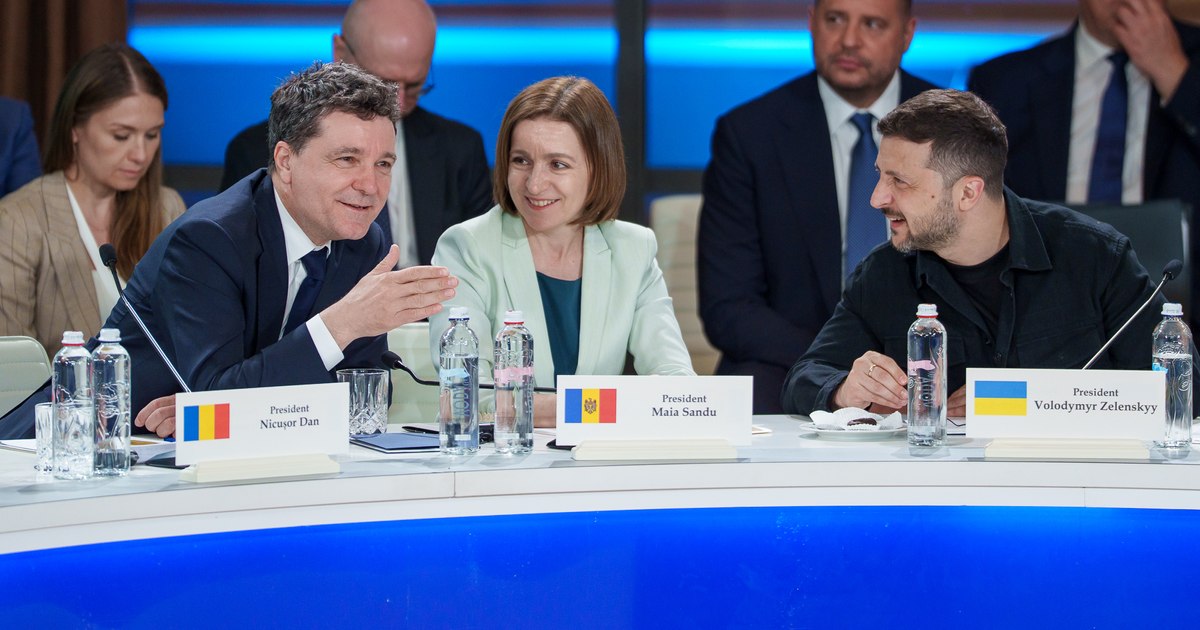
An alliance between Romania, Ukraine and the Republic of Moldova in the field of cyber security will not only contribute to the objective assumed by Romania, to position itself as an active and relevant actor in the region, but can also represent a support for the Republic of Moldova, under the hybrid assault in the context of the autumn elections.
PHOTO Presidential Administration
Romania, Ukraine and the Republic of Moldova announced the establishment of a coalition in the field of cyber security, which can play an important role, “In accordance with the goal of Romania to position itself as an active and relevant actor in the region ”mentions the head of the National Cyber Security Directorate (DNSC), Dan Cîmpean.
The discussions in this regard have been held recently, during a meeting in Cernăuți, in Ukraine, and the cooperation aims to capitalize on the experience accumulated in recent years by Ukraine, as well as to strengthen a common operational framework for the prevention, detection and reaction to cyber threats.
Important role in support of elections in the Republic of Moldova
Iulian Chifu, an expert in security and international relations, explains for the “truth” the potential of such an alliance, showing that each can contribute in the current context:
“Each of the parties has a level of knowledge and experience and lessons learned. Ukraine was under the target of cyber attacks of a certain invoice and has its own lessons learned. And in the war obviously there were attacks. Romania has a well -developed, western, well connected system, with decent defense capabilities, not to say advanced. The Republic of Moldova is under the constant rent, especially since we are in the electoral period and has its own lessons learned, especially in the field of information war and cyber attacks in the infrastructure that is involved. So each has its own experience and it is the best option, so must this alliance, cooperation, learned and sure lessons, of capacities that can be used.
Following the election campaign in the Republic of Moldova, the Republic of Moldova will probably resort to the support of Romania and Ukraine when such attacks are notified or when these states notice that the Republic of Moldova is under attack ”points out Iulian Chifu.
Cristian Barna, security expert, shows that he is not “The first time we do this. Even after 2014, after the annexation of Crimea, there were the first forms of this hybrid war in Ukraine and Romania, at that time, it was the most important tool, so to speak, in a grant funded by the World Bank, which committed to ensure the cyber security of Ukraine. So it is not a new thing that we help Ukraine protect its cyber security. (…) France or other European partners have appealed to Romania to support to what extent and how the Republic of Moldova can counteract the Russian influence. As such, we also cooperate in what it means to ensure the cyber security of the Republic of Moldova. Thing we do at NATO and EU level. (…) It is a kind of recognition of our expertise in the field of cyber security and the fact that we can help, we can make the difference in what it means to combat these hybrid tools and to ensure cyber security in two new neighboring countries. “
Romania, the target of cyber attacks in the election year 2024
The National Cyber Security Directorate has published in July the activity report approved in the CSAT which shows the cyber attacks that took place last year in Romania and their target, being more public institutions and state and private companies.
In the field of energy there were two cyber attacks, the targets being Rompetrol and Mol Romania. 17 Cyber attacks were directed to the banking lord: Alpha Bank, Banca Transilvania, Banca Commercialắ Romanian, Creditcoop, Exim Bank, Edificium, National Bank of Romania, Romanian Bank of Investment Credits, Bucharest Stock Exchange, Banking Warehouse Guarantee.
Digital infrastructure and telecommunications were also targeted by such attacks: Orange, Telekom and GTS. And in the institutions with responsibilities in the field of transport were 12 such attacks: the National Railway Company (CFR), the National Company for Road Infrastructure Management (CNAIR), the National Airports Company, Constanța Port, Astra Trans Carpatica Rail, Baneasa and Metrorex.
Another 13 cyber attacks were on the central and local public administration: the Government of Romania, the Special Telecommunications Service, the National Cyber Security Directorate, the Ministry of Internal Affairs, the Senate of Romania, the Ministry of Foreign Affairs, the Ministry of Public Works and Admínradia, the Ministry of Tourism and the City Hall of Bucharest.
Former prime minister’s data on Dark Web
In fact, last year, year with four rows of elections, it was marked from the beginning of such events. In January 2024, the database of the Chamber of Deputies was broken by hackers and was stolen including the personal data of the prime minister at that time, Marcel Ciolacu, who arrived on the Dark Web.
President Nicușor Dan warned since May as the main threat at this moment is cyber security and that we have to work very well with the big technology companies and European partners.
At the end of last year, the Government adopted an ordinance establishing a new framework for cyber security of computer networks and systems in the Civil National Cyber space, thus translating the European Union Directive 2022/2555 (NIS2 Directive) into national legislation. DNSC announced at that time that it strengthens Romania’s ability to cope with current cyber security challenges, aligning us with European standards and ensuring better protection of infrastructures in sectors of critical importance and national cyber space.
