
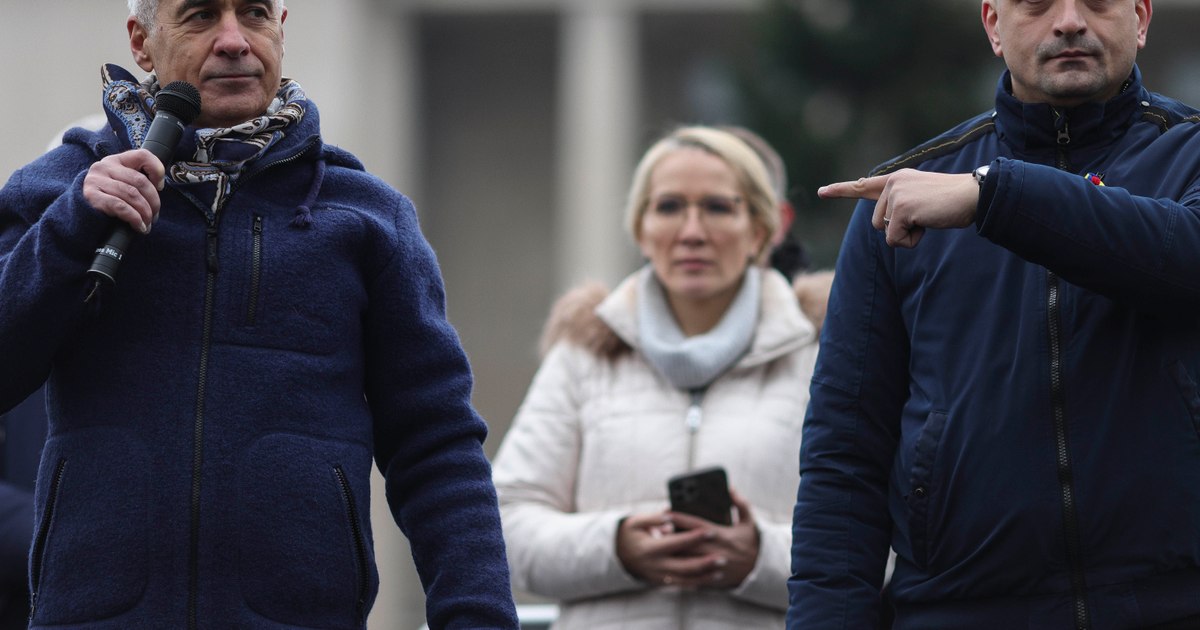
Although the presidential elections have passed and Romania has a new democratically elected president, the danger represented by extremist parties has not dissipated. On the contrary, the polls show a worrying stabilization of the voting intention for the AUR and the radical formations, while the political class in power is wasting precious time in internal squabbles. We analyzed the phenomenon with sociologist Remus Ștefureac, director of INSCOP Research.
The figure that should worry anyone who looks carefully at the Romanian political landscape is only one: approximately 40%. This is what the polls of the last months show when it comes to the cumulative voting intention for the AUR and the parties that gravitate towards the radical zone. It is a stable plateau, which persists after the presidential elections and which accurately mirrors the score obtained by George Simion in the first round, explains Remus Ștefureac.
“Polls show, first of all, a stabilization of this voting intention at a score of around 40%. Of course, with small variations, plus or minus: sometimes 30 or so percent, other times a little over 40%, but there is a stabilization of this score.” explains Remus Ștefureac, director of INSCOP Research.
Georgescu’s electorate: disappeared or just redistributed?
A question that frequently comes up in the public debate is what happened to those who voted for Călin Georgescu. According to the sociologist, they redistributed themselves calculatedly to the formations that take their message and cultivate their frustrations.
“Călin Georgescu’s electorate is there. He went to the areas that resonate with what he considered to be an attractive political message. It is no coincidence that in the communication strategy of AUR and the leaders of this party we see a continuity of messages like “The second round back” and other themes that have the role of attracting Călin Georgescu’s electorate. Not necessarily and Mr. Georgescu, but that is another matter. The electorate is there and finds itself in this said basin”, shows Ștefureac.
Georgescu: orchestrated construction, not organic return
Sent to court for complicity in an attempted coup d’état and legionary propaganda, Călin Georgescu takes a public bath every Tuesday, when he has to sign for the judicial review, or when he has to appear before the judges. Each time the former presidential candidate is surrounded by hundreds of supporters, who stage a real skit.
“First of all, there’s an amplified background noise to every little appearance, with direction and obvious resources invested there. It’s not out of the blue that some people express their views. There’s a certain kind of direction, a certain prop, precisely to amplify the visibility of each appearance. It’s an obvious construction. We’ll see, as the investigation progresses and concrete elements emerge, whether the public, including his supporters, will tire at some point, in the context of the exposure of other information from investigation, which we also do not know at this time. The situation is quite volatile and evolving.” explained Remus Stefureac.
As for its future relevance, the INSCOP director is cautious.
“It is very difficult to predict to what extent it will still have political relevance or not. The fact is that at least one of the parties that gravitate in this electoral area still appeals to a type of memory or landmarks that link them to the image of Mr. Georgescu. This still requires a certain type of relevance. As these political movements will become more autonomous and find sources of legitimation beyond the themes associated with Mr. Georgescu, the political relevance of his reign will diminish.” said Remus Stefureac.
Who are these voters and what unites them?
Beyond political labels, the sociological picture of this electorate is one that essentially speaks of the forgotten Romania or, more precisely, of the Romania that felt it was left behind.
“There are, on the one hand, a number of objective factors. If we look at the socio-demographic structure of the public that resonates more intensely with this message and this type of identity, we are generally talking about people with lower incomes, with secondary or primary education. Not exclusively these people, but in higher proportions compared to other electoral basins. We are talking about people who, unfortunately, benefited less from the advantages of joining the European Union, compared to other categories. There are people who they live mainly in rural areas, in small and medium-sized cities, where the incomes are less. On the other hand, there are also objective psychological frustrations. That is why the vote or sympathies are found in small and medium-sized cities, where most of the wave came from. migration from Romania to the diaspora, where there is, in turn, a high level of support and frustration. Beyond the objective factors, there are also subjective factors, such as vulnerability to misinformation and hybrid war, partly fueled by the political opportunism of some internal leaders and partly by the hostile power in the East. It is more than a campaign, a true information war, based on manipulation and false information, which shapes some public perceptions in a sense unrelated to reality and fuels these frustrations”, elaborates the sociologist.
Where do the votes actually come from?
There is a convenient theory circulating in the public space: that AUR grew exclusively due to a massive transfer from the PSD electorate. The reality is more complicated and, in Ștefureac’s opinion, this simplification makes it difficult to really understand the phenomenon. Votes are coming from many directions, including areas of the electorate that, not long ago, considered themselves on the other side of the political fence.
“Part of the PSD electorate, which no longer resonates with this party, has moved to the AUR, but only a part. There is also a part of the USR electorate that is now with the AUR, I mean the anti-system electorate of the USR, that 15-20% party. Part of the pool of this party is in the AUR area at the moment. It would be an oversimplification to focus only on the transfer from the PSD. For example, part of the electorate from the environment rural areas moved towards AUR, but on the other hand, the traditional cores remained in the Social Democratic Party area. I repeat, I would not simplify things. The votes come from several areas, and the criteria are more related to frustrations of this type, than strictly partisan ones.” explained Remus Ștefureac.
