
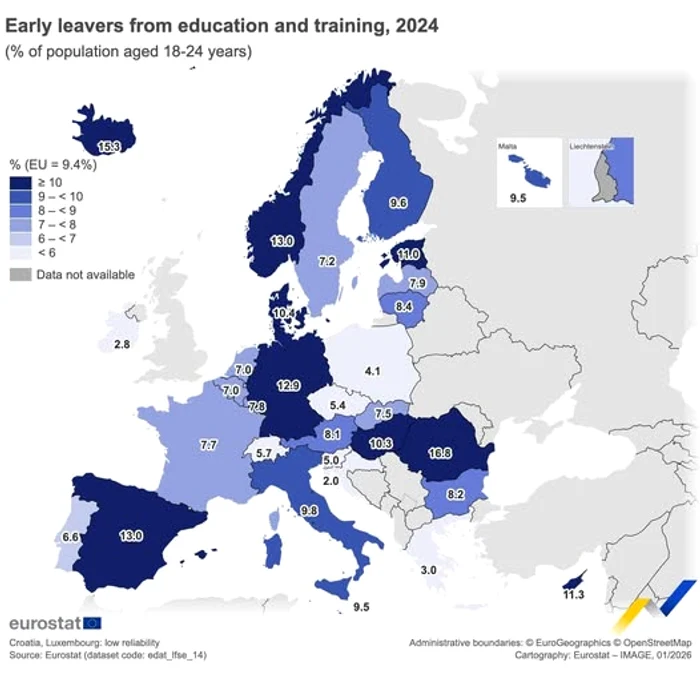
Romania leads a not very honorable ranking in Europe. It is in first place in the number of young people between 18 and 24 years of age who have completed at most lower secondary education (gymnasium), with a percentage of 16.8%, almost double the European average of 9.4%, according to a Eurostat report. “It is the result of two decades of incoherent policies and a refusal to treat abandonment as a national security issue.”draws the attention of education expert Gabi Bartic.
European map of those who have given up education
According to the Eurostat report, which analyzes data from 2024, the ranking of the countries with the most young people between the ages of 18 and 24 who stopped their education after secondary school looks like this:
- Romania (16.8%)
- Spain (13.0%)
- Germany (12.9%)
At the opposite pole, the states that have a very small percentage are:
- Croatia (2.0%)
- Ireland (2.8%)
- Greece (3.0%)
And the Bulgarian neighbors are doing much better than us, with a percentage of 8.2%.
Education specialist Gabi Bartic points to the reasons that led to this position in the ranking:
“Romania loses children from school, especially where the state is weakest: rural areas, vulnerable communities, families with a low level of education. We are not just talking about poverty, but the absence of real support for learning: isolated teachers, non-existent counseling services, late interventions. In short: it wasn’t the children who abandoned the school – the school abandoned the children first.”
50% of young people in this situation do not want a job
The Eurostat report also highlights a worrying aspect: 50% of young Romanians who dropped out of education early do not want a job. Only 20% of them are employed, while 30% are looking for a job.
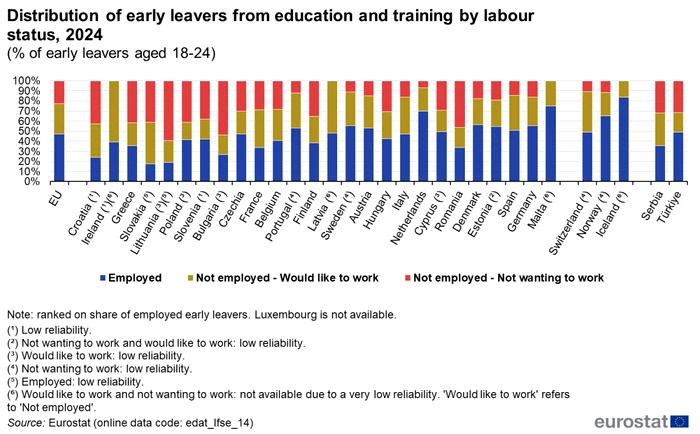
“This is the most worrying indicator. We are not only talking about dropping out of school, but about social disconnection. When a young person is neither in education, nor in work, nor looking for a job, we are talking about: loss of human capital, long-term social dependence, increased risk of marginalization.
It is, in fact, a wake-up call for the whole society. Because every generation lost in education becomes a generation that is difficult to recover economically and civically”, attracts Gabi Bartic’s attention.
Why vocational education is not an option for school leavers
I asked the specialist why she thinks that more of those who decide they don’t want to go to high school don’t go to vocational education, which can provide them with a job.
Gabi Bartic explains: “Because, for a long time, it was treated as the route of those who “can’t”, not as a valuable option. In the countries where the professional works: it has social prestige, leads to well-paid jobs, allows the continuation of studies. In Romania, the default message was the opposite: <
What can Romania do?
Our country was in first place in this Eurostat ranking for the fourth consecutive year. What policies could lead to lower rates and fewer young people dropping out of school? The education expert says that the first step is to abandon general strategies:
“We need simple, consistently applied measures: early identification of the risk of abandonment, based on real data, not impressions; individualized educational support – tutoring, remediation, counseling – provided before the student leaves the system; financial incentives conditional on school attendance, especially in vulnerable communities; a modern professional education, really connected to the labor market and which allows the continuation of studies; integrated services around the school: psychologist, mediator, social support, community workers“.
She also says that a difficult but necessary discussion is also needed regarding the rural school.
“We cannot claim quality education in units with 10, 20 or 30 students, where a few teachers cover almost all subjects and support services are completely lacking. There we do not save the community – we only maintain the illusion that the school exists. The solution is not to abandon the village, but to strengthen strong rural schools, capable of becoming real support centers for children and families: places where education meets social services, counseling, learning support and guidance We are not talking about closing schools, but about pooling resources so that every child in the countryside has access to a school that can actually function. Because, in the end, the right question is not how many schools we keep open, but how many children we manage to keep in real education.“, concludes Gabi Bartic.
