
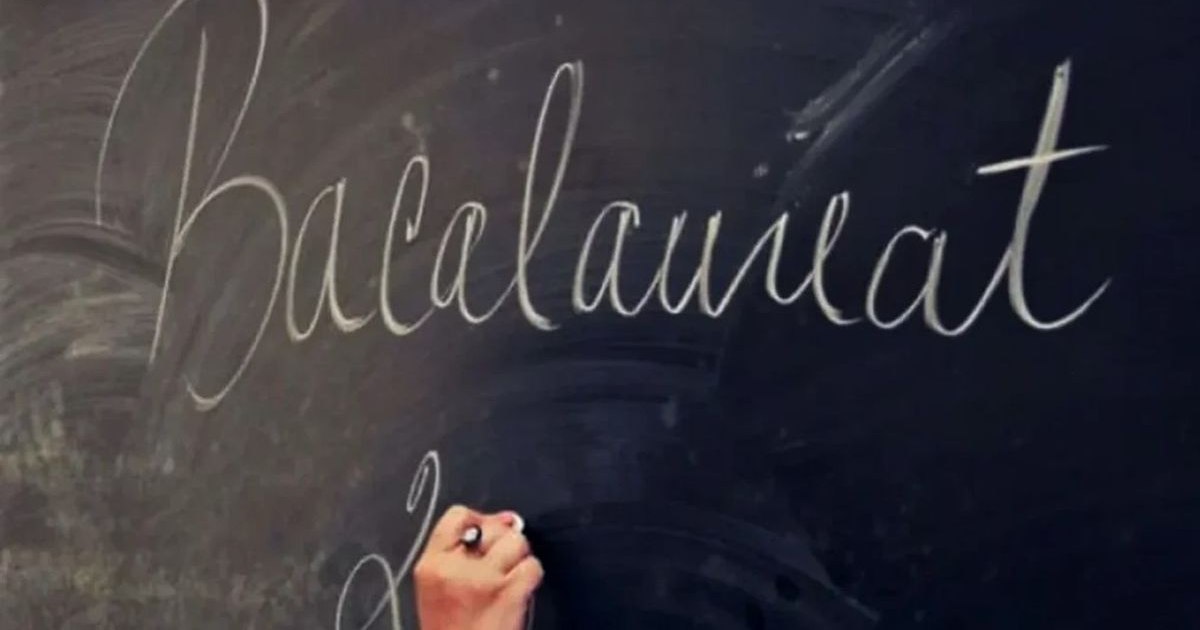
The national exams that will take place next year could undergo changes for the first time. The baccalaureate will start in the winter, with the competency tests, and the written exams – including the National Assessment – will be held in June. It is a proposal of the Ministry of Education, under public debate, agreed by both students and parents with a few exceptions.
The 2025 baccalaureate is undergoing unprecedented changes. Photo source: archive
The proposal of the Ministry of Education comes under the pressure of the parents, but also of the students who, year after year, took the national exams in the middle of the summer, in the heat, in the context where many schools in Romania are not equipped with air conditioning devices or air conditioning systems.
“The skills test doesn’t really matter anyway”
Specifically, the ministry proposes that the assessment of Romanian language skills take place between January 27-29, the digital skills assessment take place between February 3-5, and the oral foreign language exam be held between February 5 and 7.
Bianca Ivan, president of the Romanian Student Council, told “Adevărul” that the students welcome this decision. “We agree with this proposal because it practically makes the entire exam more efficient, it makes everything that happens in the summer easier. And, as we know, skills, unfortunately, are not that relevant for students in Romania. Or to go to college or get a job. And I’m telling you this because I did a consultation of the students on the subject of the baccalaureate, if there is a need for an elimination or a reform. Almost 9,000 of them answered that they see the point of skills tests. Therefore, the fact that they are scheduled in January does not really matter”, stated the student representative.
And the parents’ representatives are of the same opinion, Iuliana Constantinescu, the president of the Parents’ Federation in Sector 2 of the Capital, told “Adevărul” that year after year, from one summer to the next, it’s getting hotter and hotter, and thermal discomfort is a stress in addition for children “Since the beginning of the month, we have had extreme temperatures, and the infrastructure of educational institutions is not prepared to face exams in such periods. In winter, we would have a much more favorable climatic period for the students, a less crowded period and less stress”.
But will the students be well enough prepared in the winter? Parents believe that students should be able to cope with these oral exams, even if they are held earlier. “Any 12th grader should pass these proficiency tests with flying colors. There are some tests that evaluate an average preparation of students in terms of how children can read and understand a text, as well as in digital skills.. I think that any graduate should be able to pass even in the winter these evidences”.
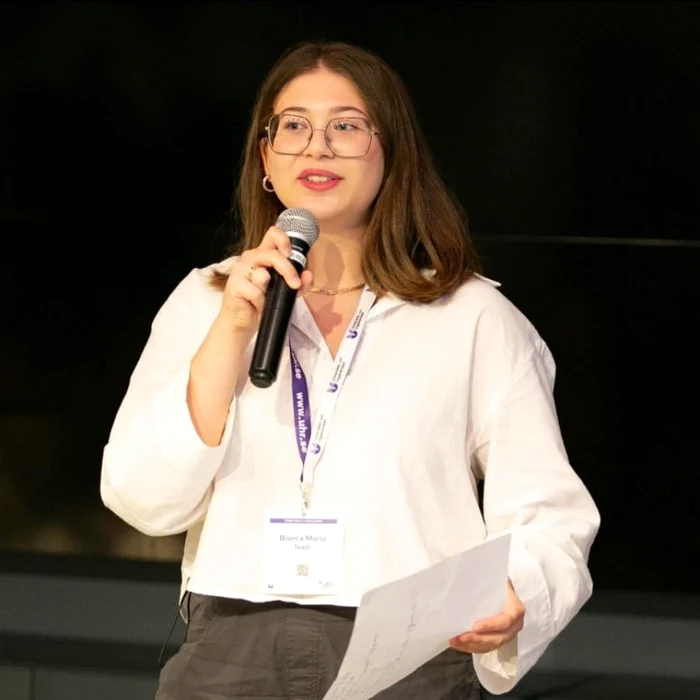
Bianca Ivan, the student representative, asks for a day off between the Baccalaureate written tests. Archive
“We ask for a one-day break between written tests”
Immediately after the 12th and 13th grade students finish their courses, the written exams will take place, the Ministry’s proposals continue. Concretely, they will start on June 10, just four days away from the end of the school year for the final grades, with the Romanian language test. “We think it’s too early.. there should be at least a week and a half from the end of the year to the first test. You’re not even happy that you’ve finished school, that the emotions, the stress, the fatigue are starting. Then, you don’t have so much time left to repeat… And let’s think about the teachers. And they need time to prepare for these exams, to plan the organization, to set up the classrooms”, is Bianca Ivan’s opinion.
And one more aspect, this draws attention: the Baccalaureate exam would take place while the students in the lower classes are still learning, still having classes. “It must be decided how the hours will be recovered for these students who have not yet finished the courses”. Iuliana Constantinescu, the president of the Parents’ Federation from Sector 2 of the Capital comes with clarifications: “These educational units, during the national exams, are closed. Only candidates and teachers have access. The baccalaureate cannot be taken in certain classes, and classes can be taken in others, as usual. The system is not ready for an exam of such a large scale during the school year”.
The following day, on June 11, the students will take an exam in mathematics or history (the mandatory profile test), and on June 12 they will take the test of their choice. The last exam is scheduled, according to the proposals of the Ministry of Education, on June 13, for Mother Language and Literature. However, the proposed calendar is not agreed. Both students and parents ask for a day off between tests for both the Baccalaureate and the National Assessment. “We will propose a day off between exams. It’s too tiring,” they say in unison. And we should think about one more aspect: students with CES, continues Iuliana Constantinescu’s idea. “These children with CES have the right to sit for the exam two hours more than those without CES. Well, after four, five hours of exam one day..then another four, five hours the next day and so on..what performance do these students still give? What claims do you still have?” Parents believe that three consecutive exam days come with excessive fatigue, children no longer have time to catch their breath. “So much accumulated emotion, so much stress..it’s too much, these kids can’t take that much”.
“We will contest the works in due course”
Between June 18 and 20 inclusive, the results of the written tests, the viewing of the written works and the submission of appeals take place. This year, students will have the right to view their work and then, depending on that, decide whether or not to appeal. “It is a decision that makes us happy. We will know exactly what the chances are of getting a higher grade. We no longer make “blind” decisions, at risk…and this is for the benefit of all students”, Bianca Ivan also said.
Parents believe that the proposals presented by the Ministry of Education are very good, they have been expected for a long time, but they must be able to be applied. Because, here, there are some aspects that need to be adjusted, rethought. “Since we are talking about a project put up for debate, I think that our opinion, as well as that of the students, will count in making the final decision.” Iuliana Constantinescu also declared.
Education expert: “Just dust in the eyes. The real problem is elsewhere”
Marian Staș, expert in education, told us that the project proposed by the ministry is “just dust in the air”: “Too much form, too little substance. I can swallow that climate change dumpling, but actually the story is thin from the point of view of the background, and the background is the inability of people to transform the framework plans, to change the curriculum model. The fact that he moves those skills in January, those are friction on the wooden leg. No one looks at them anyway, no one falls, so the story is as if it exists. This is so, so to speak, that we do things. And the fact that they move the Baccalaureate a month earlier, I have two objections: one, that the students will have one month less preparation. And the second thing, the heat wave. Let’s be serious. It’s been like this for decades and no one has died from it. The most sinful, the most treacherous and the most unforgivable story is the ferocious resistance and strategies – almost ridiculous, if they were not sad – of the system, of the minister, of everyone, to evade the transformation of framework plans. For years and years they have not been able and they do not want to break the cat”.
Marian Staș believes that the essential problem at this moment is “the continuation of blocking this system in an outdated, syndicalist curricular model, designed for the norms and teachers’ salaries, without any connection with the good of the children”.
How is the Baccalaureate supported in other European countries
In France, the Baccalaureate is of three kinds: general, technological and professional. 40% of the final mark will be obtained from a continuous assessment, and 60% will come from five exams: one in French, written and oral, taken at the end of the first year and four others, taken in the last year. They consist of: two written tests in specialized courses, a written test in philosophy and an oral test based on the presentation of a project prepared by the student.
In Germany, the Baccalaureate exam is called Abitur. It is given in the last year of school, in four or five subjects, depending on the basic and advanced courses taken. Advanced courses are chosen in the last two years of high school and are two or three in number, to be done intensively for five hours a week. In the last year, students choose two more subjects, one for writing and one for speaking.
In Italy, the Baccalaureate is called Maturità and is composed of two written and one oral tests. The first test is in Italian, and students have a choice of seven different topics with three tasks: text analysis, an argumentative text and a current topic. This test lasts six hours. The second test is given according to the branch of each high school. The interview is the last phase of the Maturità exam. It lasts 20 minutes, during which the committee will present the student with a project, an image or a text, and he will have to start a discussion that will highlight the knowledge he has acquired that year.
In Spain, the Baccalaureate lasts two years. We are talking about a sequence of tests in the last two years of high school. This exam has a weight of only 40% of the final mark, what matters more are the results of the two years of high school – 60%. The compulsory exams are in mathematics, Spanish, English and Spanish history, and with these you can get the maximum mark, 10. But, if they want, the students don’t stop there. They can get grade 14, if they take additional exams based on the studied profile. Some universities require this grade.
In Finland, the Baccalaureate is given in at least 5 subjects, and if you did not manage to get a passing grade in one of them, you can take it three more times. The compulsory subject at baccalaureate in Finland is the mother tongue and literature, i.e. Finnish or Swedish, both national languages. In addition to this subject, students must take the exam in mathematics, the second national language, a modern language and one more subject from the real world. In addition, the candidate can choose to take one or more exams, if the university they want to attend after high school requires it.
