
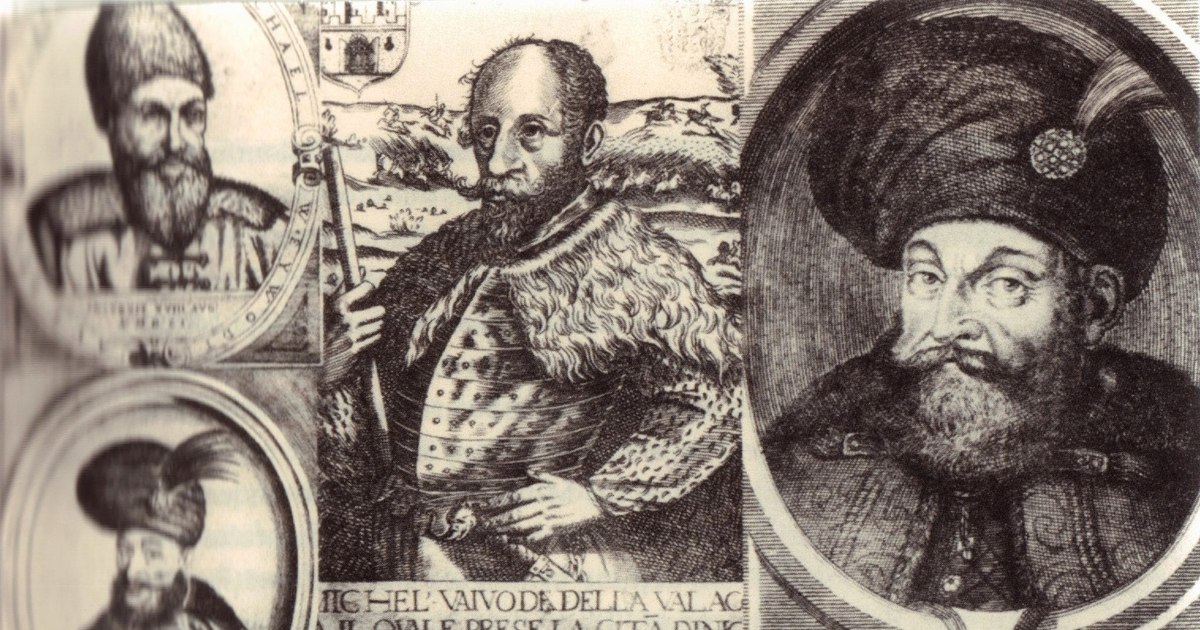
In all of Romanian medieval history, few rulers achieved the stature and mythology that Michael the Brave acquired. Of all the sources attesting to his deeds, the book “Brevis et Vera Descriptio Rervm“, written by Balthasar Walther in 1599, remains one of the rarest and most important documentary relics, being the only chronicle published during the voivode’s lifetime.
“Brevis et Vera Descriptio Rervm”, written by Balthasar Walther in 1599
It is about a work almost unknown in Romania (not being present in public libraries) which, for any historian truly passionate about the subject, represents a treasure that offers an authentic perspective on Mihai’s reign, but also on European political and military relations at the end the 16th century.
The uniqueness of Walther’s chronicle
Balthasar Walther’s book is not just a simple chronicle, but a first-hand testimony, written by a direct witness of the events, the work representing a huge source of knowledge and a relic that deserves to be rediscovered and re-evaluated.
The author, a scholar from Silesia, was part of the delegation led by Stanislav Golski, the Polish ambassador who visited the court of Michael the Brave in the summer of 1597.
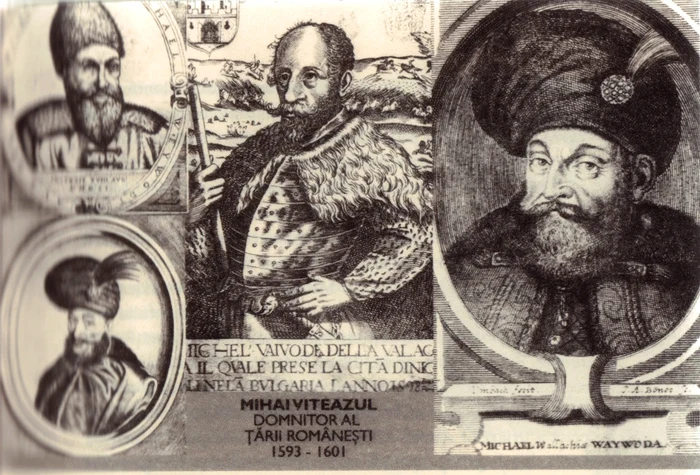
Michael the Brave, portrait. PHOTO Archive
Being at the princely court in Târgoviște, Balthasar Walther had access to the lord’s political and military life, but also to the official chronicle written by the speechwriter Teodosie Rudeanu, which allowed him to compose a remarkable work.
It should be noted that this chronicle was written on the basis of an official version of the gentleman’s deeds, approved by Mihai himself.
In the book’s introduction, Walther mentions that he received a “brief description of Michael’s heroic deeds” directly from the voivode’s court, written in Romanian and later translated into Polish by Andrei Taranowski, a Polish diplomat who admired the ruler.
The resulting description was then translated by Walther into Latin, which underlines the importance of the text not only as a primary source, but also as a bridge between different languages and cultures of the time.
The fact that this initial text would have been drafted in “walachico sermons”, i.e. in the Romanian language, it reinforces the hypothesis that the Romanian language was widely used in the official documents of the court.
Walther’s work thus becomes a document not only historical, but also linguistic, reflecting the early use of the Romanian language in chronicles.
A complex geopolitical context
The publication of the work in Görlitz, a city within the Habsburg Empire’s sphere of influence, is no coincidence. At a time when the Ottoman threat was strongly felt throughout Europe, the victories of Michael the Brave were seen as an example of Christian resistance against an overwhelming force. Michael was not only a defender of Wallachia, but also a symbol of the defense of Christendom against Islamic expansion. Thus, Walther’s chronicle, although originally written as a direct testimony of the master’s deeds, also served as a propaganda tool for the Habsburg Court, which used Michael’s successes to inspire other European nations to join him in the anti-Ottoman struggle.
The publication of the book in this context suggests that Michael the Brave was not just a simple voivode from the Balkans, but a figure of European relevance, a leader who attracted the attention of the great powers of the time. In the eyes of his contemporaries, Michael was not only a defender of Wallachia, but a potential leader of a crusade against the Turks, a leader capable of uniting Christian forces in a common struggle.
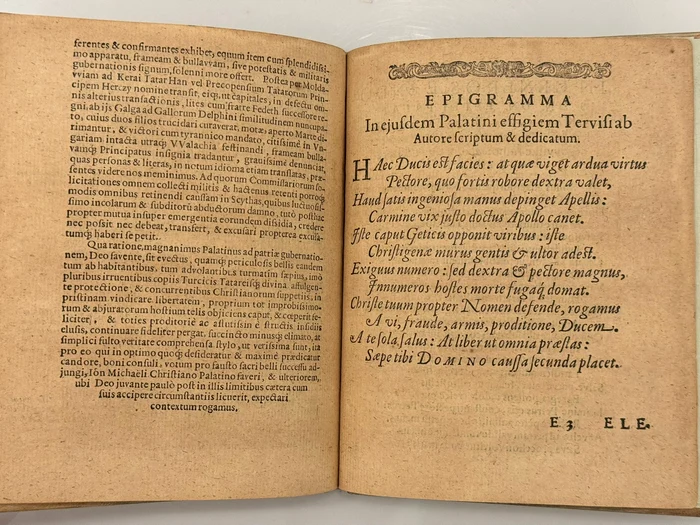
“Brevis et Vera Descriptio Rervm”, written by Balthasar Walther in 1599
The relationship with the Buzești chronicle and valuable details about Mihai
One aspect that makes Walther’s book even more important is its relationship with Mihai’s official chronicle, known as the Buzești Chronicle. This chronicle, written by Teodosie Rudeanu and lost in its original form, served as a source for Walther’s work.
In an era where many of the chronicles documenting the reign of Michael the Brave were written much later, often influenced by political interests or boyar rivalries “Brevis et Vera Descriptio Rervm” stands out for its impartiality.
Compared to the works of Grigore Ureche, for example, which often reflect the prejudices of the boyars towards the ruler, Walther’s chronicle presents an objective and detailed view of the events.
The description of Mihai Viteazul’s return to Târgovişte in 1595, after he managed to defeat the Turks and liberate the city, is a notable example of this.
Balthasar Walther describes how Mihai managed to rebuild the devastated city, calling the inhabitants back from their hiding places and distributing seeds to restore the war-ravaged lands.
The related episode highlights not only his qualities as a military leader, but also those of an administrator concerned with the welfare of his people.
Michael the Brave: Military leader and defender of Christendom
The psychological portrait of Mihai Viteazul, which Walther carefully outlines, is another important aspect of the work “Brevis et Vera Descriptio Rervm.”
Compared to many of the later chronicles, which focus exclusively on the voivode’s military successes, Walther also describes his deeply religious character and devotion to the Christian cause.
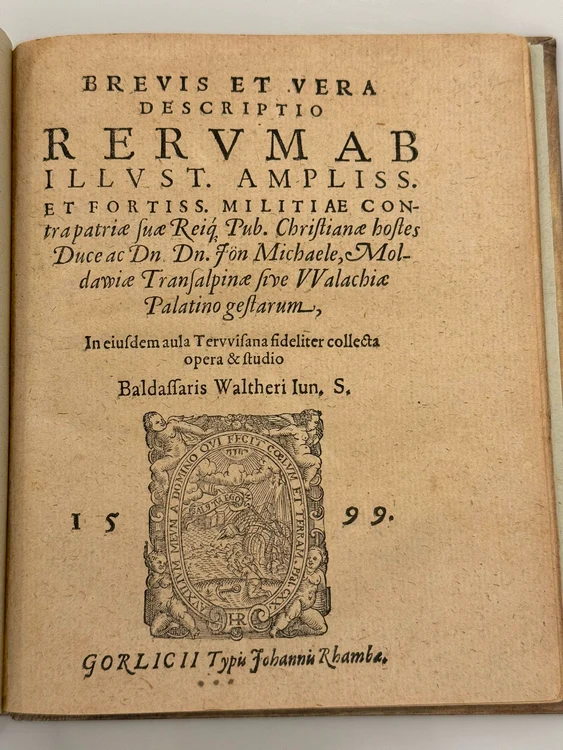
“Brevis et Vera Descriptio Rervm”, written by Balthasar Walther in 1599
In an epigram dedicated to Mihai, Walther names him “the wall of Christendom” and prays that God will protect him from betrayals and dangers, thus recognizing not only his military prowess, but also his spiritual importance in the context of the struggle against the Ottomans.
The way he describes the battles led by Michael, especially the battle of Călugăreni, offers a detailed perspective on the tactics used by the voivode. The work brings up military aspects rarely mentioned in other sources, presenting a leader who, although he had a smaller army, used ingenious strategies to defeat his opponents.
Walther’s descriptions not only complete the military picture of the era, but also emphasize the tactical genius of Michael the Brave.
A rare and valuable but forgotten source
“Brevis et Vera Descriptio Rervm” it is an extremely rare work and, unfortunately, almost unknown in Romania. Even though Papius Hilarian partially reproduced and translated the work in “Treasury of historical monuments” (1862), the original remains difficult to access, and the lack of access to one of the most important sources about Mihai Viteazul is a huge loss for Romanian historical research, according to specialists.
.
