
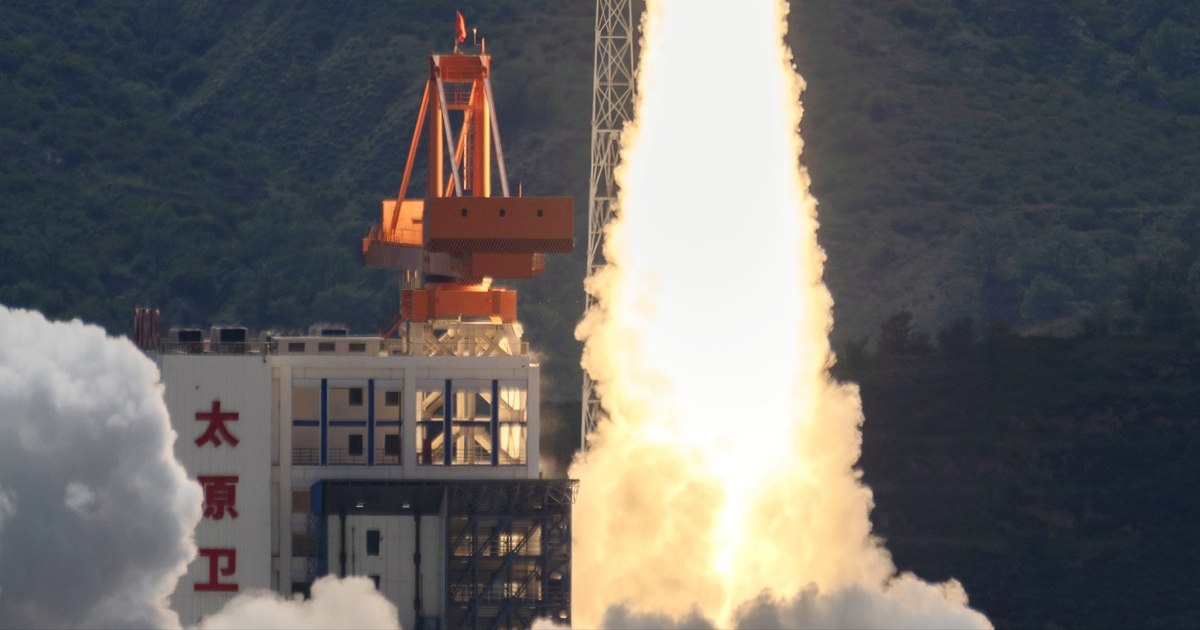
Monday’s launch of Internet satellites is an attempt to be a Chinese response to US entrepreneur Elon Musk’s SpaceX. Monday’s launch of Internet satellites is an attempt to be a Chinese bid at American entrepreneur Elon Musk’s SpaceX company.
China has launched internet satellites into low Earth orbit PHOTO x/ CGTN Global Watch
The launch took place at the Taiyuan Satellite Launch Center in northern Shanxi Province. A satellite is considered to be in low Earth orbit (LEO) at altitudes of less than 2,000 kilometers above the Earth’s surface, according to NASA, close enough for communication and observation.
The company, Shanghai Spacecom Satellite Technology, touts the network as intended to provide international broadband internet the Thousand Sails constellation, also known as Plan G60 Starlink, was launched last year.
The project, which receives support from the Shanghai city government, could eventually be a rival to Starlink, which currently boasts about 6,200 satellites out of a planned 42,000. Shanghai Spacecom’s goal is to deploy its entire constellation of 15,000 satellites by 2030.
Another fully government-funded satellite constellation, known as Guowang and run by the China Satellite Network Group, is also in the works from 2021, with the aim of eventually establishing a network of 13,000 satellites .
The launch comes as China is establishing itself as a major player in outer space, a new frontier for great power competition. China carried out 67 space launch missions in 2023, second only to the US, and placed 221 spacecraft into orbit. China hopes to grow by 100 launches this year, according to state-run Xinhua.
In 2013, China became the third country to conduct an unmanned mission to the moon’s surface, and six years later, it became the first to put a spacecraft on the dark side of the moon. In June, its last mission, Chang’e-6, brought samples from the far side back to Earth.
Shanghai Spacecom Satellite Technology is one of several Chinese firms that has taken the initiative to establish large-scale satellite networks, part of a broader strategy to build self-sufficient technological capabilities amid global tensions, writes Newsweek.
The competition between the US and China in space extends beyond commercial interests to security, with China’s People’s Liberation Army expressing concerns about Starlink’s military potential earlier this year.
