
“The Chirping Waves”so named for their resemblance to birdsong when converted to audio signals, are disturbances in the Earth’s electromagnetic field capable of accelerating particles to speeds potentially deadly to spacecraft and astronauts.
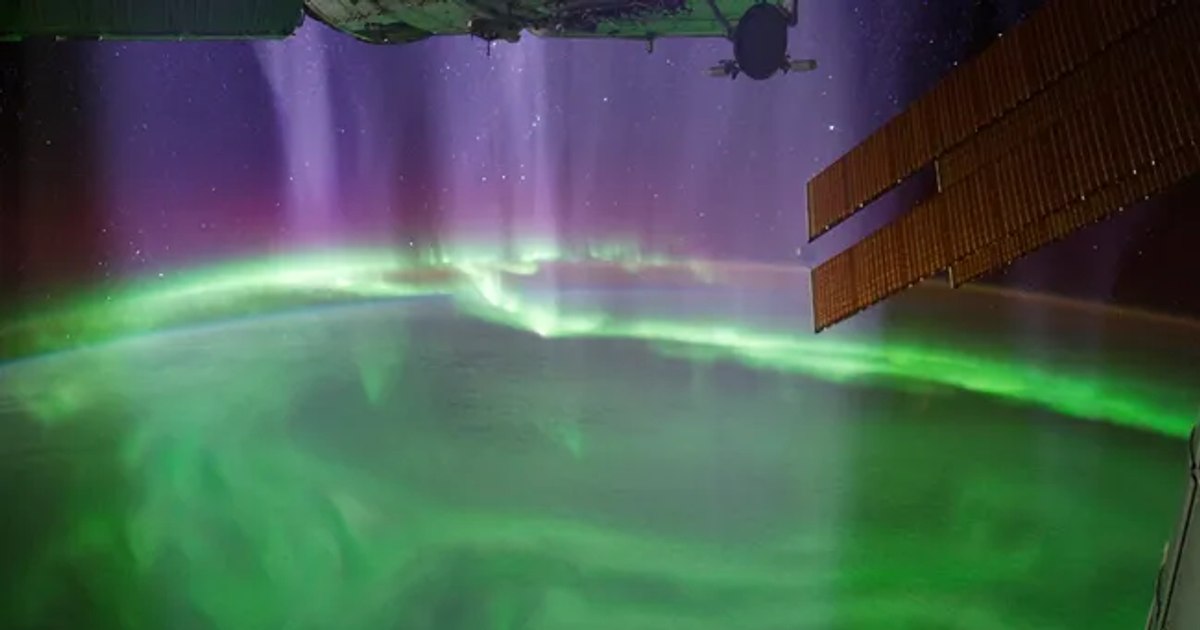
Aurora Borealis seen from the International Space Station PHOTO: NASA
However, although these mysterious waves have been observed coming from Earth and other planets since the 1960s, scientists previously assumed they only occur nearby, according to Live Science.
Now, in a discovery that casts doubt on existing theories, a new team of researchers has spotted the waves 100,000 miles (165,000 kilometers) from Earth, about three times further than previously detected.
The researchers published their findings on January 22 in the journal Nature.
“Chorus waves” are bursts of energy lasting only a few tenths of a second that travel through Earth’s magnetosphere, the magnetic field that surrounds our planet.
The waves were first detected by radio operators in World War I who heard them while listening for enemy signals.
In the decades that followed, chorus waves were picked up by radio receivers as well as NASA’s Van Allen Probe spacecraft, which detected the chirps coming from Earth’s radiation belts.
Waves have also been observed around the planets Mercury, Jupiter, Saturn, Uranus and Neptune (all planets with global magnetic fields), as well as Mars and Venus, which do not have a magnetic field.
Scientists still debate the causes “chorus waves”but the most popular theory is that they are formed by an effect called “plasma instability”.
According to the cited publication, new waves, detected by NASA’s Magnetospheric Multiscale satellites, were found in a relatively flat region of Earth’s magnetosphere, implying that they were produced by frequency changes in the field.
Why experts are worried
To better study the waves and what might be producing them, the researchers suggested better monitoring of the plasma bursts coming from the sun and how they interact with Earth’s magnetosphere.
This could lead to answers that could prove vital to ensuring that future satellites, astronauts and deep space missions to Mars and beyond are not “hit to death by high speed electrons”.
“The discovery does not rule out the existing theory, as the expected magnetic field gradients could still be present, but it means scientists need to look more closely”wrote Richard Horne, head of space meteorology at the British Antarctic Survey.
“It is a surprising result in a surprising region and prompts further investigation of chorus waves in regions where the Earth’s magnetic field deviates substantially from a dipole.”, Richard Horne also said.
