
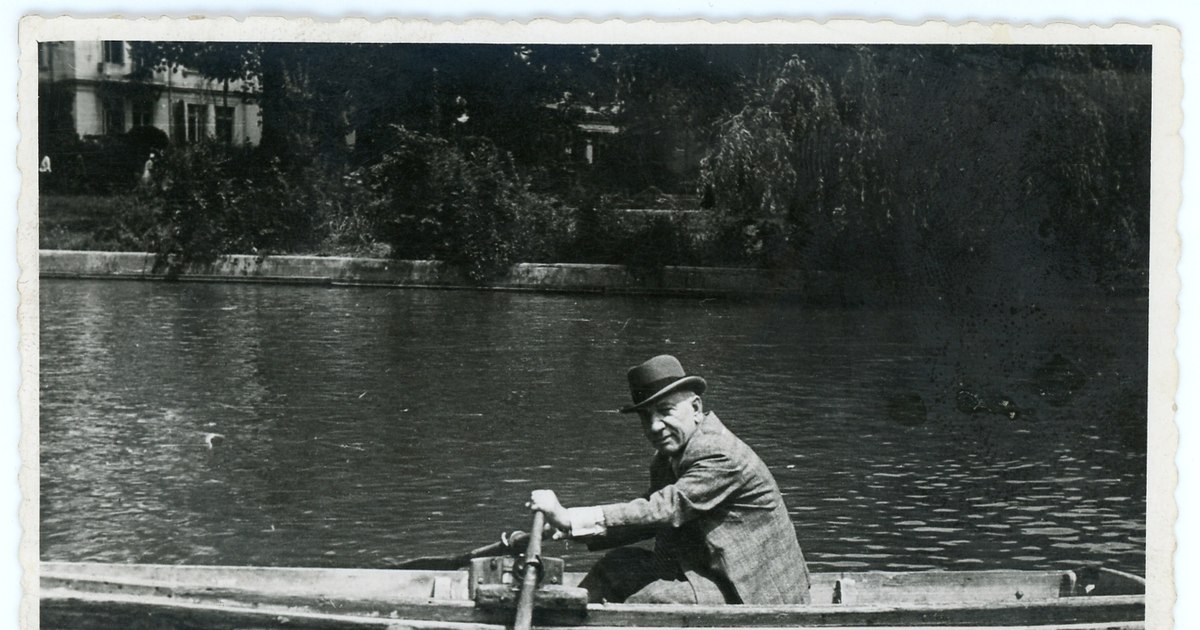
Constantin Tanase made the Romanians find their hope and optimism through its couples, satires and vadevils. He taught us that a little bit of trouble is a form of survival, and even a form of protest-and they did not prevent the war, nor the censorship to say this all his life.
Constantin Tanase’s last picture before he died, in August 1945. Photo Constantin Tanase Theater
The war had passed with all its evil. Constantin Tanase knew that now is the time of new beginnings, when dreams had to come to life. Said and done. As he already had the experience of setting up theater troops, he said that this time he had to put a foundation to the dream; Thus, in March 1919, he won at a tender the renting of the place on Academiei Street, where they had played the scores of the summer theaters “friends” and “ambassador”. The job was serious: immediately the Romanian architect of Dutch origin Edmond Van Saanen Algi was immediately hired, under whose signature, among others, the Palace of Phones and the Palace of the Academy of Economic Studies. However, the work was complicated, because the theater had to be inaugurated for about in a month, and the land did not help them at all: more long than wide. The architect began to visualize and put on paper. During the creation, Tanase stops him: “Did you draw a beetle. What would we say” beetle “?”. And so the name left.
The new summer theater, worshiped in particular to the magazine, would be the most in Bucharest. He was designed according to Tanase’s desire: “But, I pray you, so to see and hear everyone, not to swear that he gave the money to see nothing.” Van Saanen punctuated them all, including quality: because at that time there were no methods of amplifying the voice, he designed the scene with the appearance of an Egyptian frieze. Here, the bitch was the lucky amulet.
“The mirage was dismaying”
After no four months, the Cărăbuș Summer Theater was inaugurated with fast. It was July 2, 1919, and the yard was tickled. And how would it be different, when everything promised to be at high standards: architecture, decoration, 25 people’s ballet, 20 musicians orchestra, the chorus of 40 singers. The opening show was the magazine “Cat on rice”, whose texts had been written by Mircea Rădulescu and Constantin Solomonescu. Năsăilă had the couple “Cotoiul is on the cabbage, the cat on the rice”-and with this, the academy area exploded. Of course, this was just the beginning, because the season would be sprinkled with the public’s favorites: the political satires.
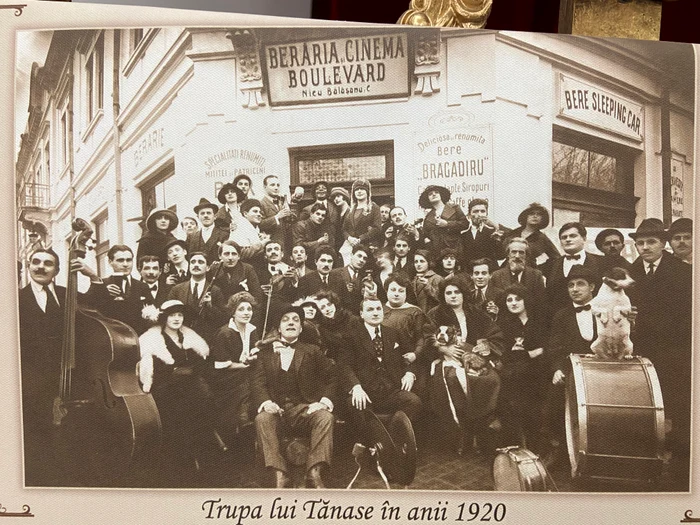
The director Mihai Zirra remembered the moment of the inauguration: “In the summer of 1919 I first entered the Cărăbuş Arena on Academiei street and I saw for the first time as a garden with 2,000 places where no chair was. Elegant, then forty beautiful pulps, then another 20 fractions, then two elegant toilets, then others and a gentleman with a huge nose and a thunder of applause.
The “beetle” was stationed in the capital during the summer, and in winter he went around the country. The rooms were full-eyes, especially because of Tanase-people had not forgotten his funny face with their eyes and big nose, which was in the beating of bullets and disease. The shows were impressive: sophisticated decorations, dozens of artists, costumes that stole your eyes, but especially the political accuracy – no event escaped from Tanase’s reflectors, being taken for small money … with humor, of course.
“The most sensational woman” in Bucharest
Tanase wanted more and more – so it was all her life. But not for him, not for fame or for money, but for art – always be more, always be better. And here’s how, during the interwar period, he was three times over his head and brought stars of the moment in the West. In 1924, one of the most vogue artists of the time, Charles Prince, French star of the silent film, known as Rigadin, arrived in the Capital. Dozens of people waited for the platform with admiration, curiosity, but also for fun: the Frenchman was tall and his nose, and Tanase was … as we know him. The subject was not escaped and the two came on stage to joke one at the expense of the other. Rigadin played on the stage “Cărăbușului”, but not through a couple or magazine he remained in our history, but through the film. He filmed the short film “The adventures of Rigadin’s journey from Paris to Bucharest”, which represented the introduction of the scene that the two played together. The film, unfortunately, was lost.
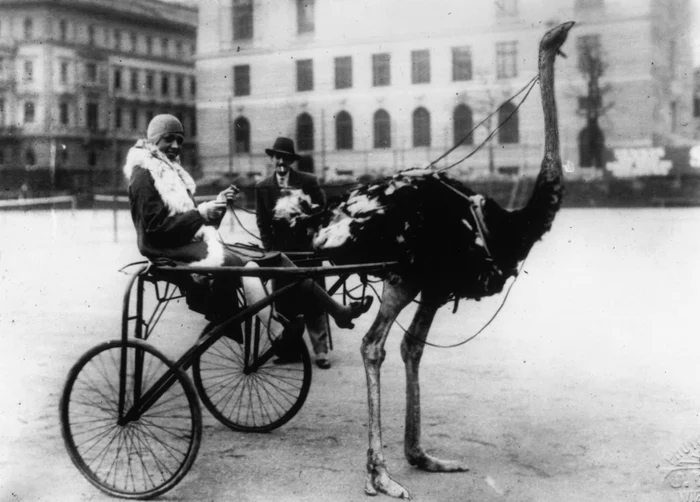
Josephine Baker and the famous ostrich -drawn carriage. Photo: Getty Images
Năsăilă also brought Josephine Baker to Romania, the American Music-Hall artist, the pampering of Europeans that Ernest Hemingway called “the most sensational woman anyone has ever seen.” The fee? 100,000 lei, the largest ever offered by a Romanian theater director. The representation? As the money, both on the stage and on the street: Baker came to Bucharest with the luxurious Orient Express and walked on the central streets in a string drawn by an ostrich. Here’s how the scene describes the actor Mircea Constantinescu: “Suddenly, by the right of the trash, I go to the eyes) a young black man wearing pants. Come on! The front of the ostrich a handful of peeled peanuts and steps in Capşa and drinks a masan in a society in a hundred virile, and fluttering, and waves, and slides before the chloroformized eyes of customers and passers-by who forget to spend. “
We must emphasize that Tanase did not just summarize the theater, he also put his nose in those of the cinema: he brought to Bucharest “the shadows highlighted”. For the moments when a movie was playing at the theater, the spectators received at the entrance a pair of glasses provided with a green and red bottle. Thus, the overturned projected images were seen by glasses in a way that we know today as 3D technology-the objects seemed to be thrown to the public.
Tanase “penetrates the heart of humanity and extracts the picturesque and definitive essential”
The 1930s we can now look at them in our own pocket: Economic crisis in flower. Large prices and small leafs also affected the theater industry, especially in Tanase’s yard: they were independent artists, so without subsidy from the state. But the Romanian, from where he did not have, removed some lei and gave the “beetle” to drown his bitter bitter and make his burden easier. “Năsăilă and his own did not escape any topic: the electoral promises, the difficulties thrown on the shoulders of the population, the irregularities and the illegalities. It is this bastard, as it enters the scene, as it opens a creation that fixes in tragedy features a type document from the gallery of the Romanian society. And it extracts the picturesque and definitive essentials, ”wrote Alexandru Kirițescu.
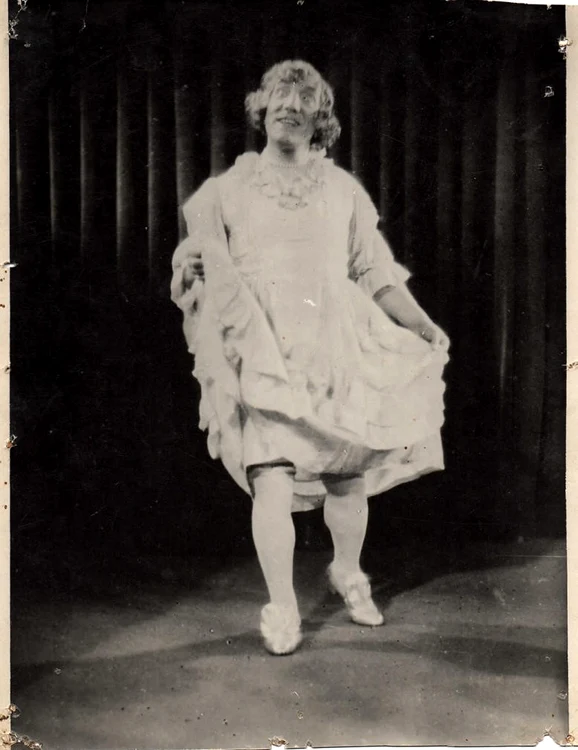
Sequence from “Dream of Tanase” (1932). Photo: Constantin Tanase Theater
Things tended to rot more and more and the misfortunes to start to gather, both at the level of society and in the “Cărbușului” yard. On December 22, 1937, at the premiere of the show “Good appetite in Tanase”, the scene of the “Eforie” Theater caught fire even during Tanase’s replies. Row, balcony with balcony, everything was burning. The world went out of the room quickly and, at the peak, took refuge in a place near the theater, hoping that the show would continue. The whole Bucharest Vuia: “Burn in Tanase!”. Firefighters could not save anything, and people with money considered that the theater was no longer worth restoring. With Chiu, alas, Tanase and his shows found a place at “Savoy”, but nothing was the same-the censorship of totalitarianism had begun to show their corners.
Censorship, lethal weapon
During the Second World War, his couplings not only disturbed, but were censored, forbidden-not even a more Fistichie mustache was allowed. Moreover, due to anti -Semitic legislation, many of the theater name had to be removed from the poster. During the war, the “beetle” celebrated a quarter of a century of existence. As a form of survival, as every man hats in troubled times, Tanase returned to the glorious past and celebrated properly: he recreated, inside, the atmosphere of the missing summer theater on the Bucharest map. The decor, made with a migal, was the facade on Academiei street. And Tanase appeared as the first time, when he interpreted the coupler written by his good friend Belcot, “skirt, skirt, skirt with the baby”: the gray suit with carnation at the buttonhole.
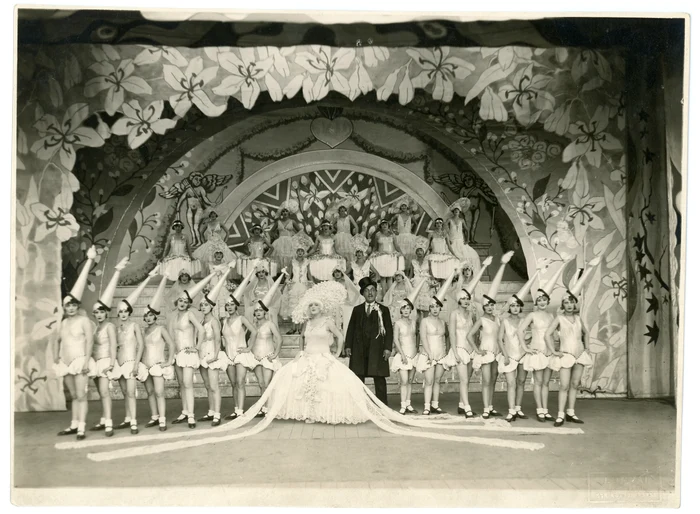
Fast anniversary of the “beer”. Photo: Constantin Tanase Theater
The bombing of April 1944 took Constantin Tanase about everything that had more expensive in the world: art and friends. The capital, once lively, was now under the heavy cloud of death. Theaters, cinemas were closed, some being destroyed. And the actor and his friend, Vasilache, died, following the explosion of a bomb that had landed in his balcony. Thus, Tanase took his luggage and left for Săftica, where he had a small roof over his head and did not return from there until he heard on the radio that Romania returned the weapons, on August 23, 1944.
“Na, the devil’s devil” …
In the spring of 1945, when the peace began to sit, Tanase and his own resumed-first at the Paladium Circus, from the end of the current Regina Elisabeta boulevard, then, in the newly renovated “Savoy”. The rooms were full again and it seemed that things were recovering to the past. It was the middle of August and a hot summer. On the way home, Tanase stopped in Cișmigiu to cool with beer at the dump. In the evening he notices that he did tonsillitis and realizes what. He confesses to his sister-in-law: “I did a fool who I think will cost my life. Only not to hear Virginia.”
His health is getting worse, seeing with his eyes: a general infectious state is installed and begins to be seen by one foot. Not to shave can no longer be: “Na, the devil’s devil, I do Harakiri.” He stayed in bed for 20 days, the state of health was worse-he had made a kidney block-but the optimism had not lost him: “You do not take care of me, work on, start the rehearsals, that I arrive.” On August 28, the composer Ion Vasilescu visits, but the artist was visibly weakened, as if the haze was no longer. In the evening, Tanase preiminated his end; He tells the doctor who visited him regularly: “Doctor, to know that this is Mihai Viteazul’s last night!”. At the dawn of August 29, Năsăilă, at the age of 65, left the scene, and after three days of mourning in Bucharest and thousands of people who said goodbye to him, at the Romanian Athenaeum, was buried at the Bellu Cemetery, thus closing the summer season.
