
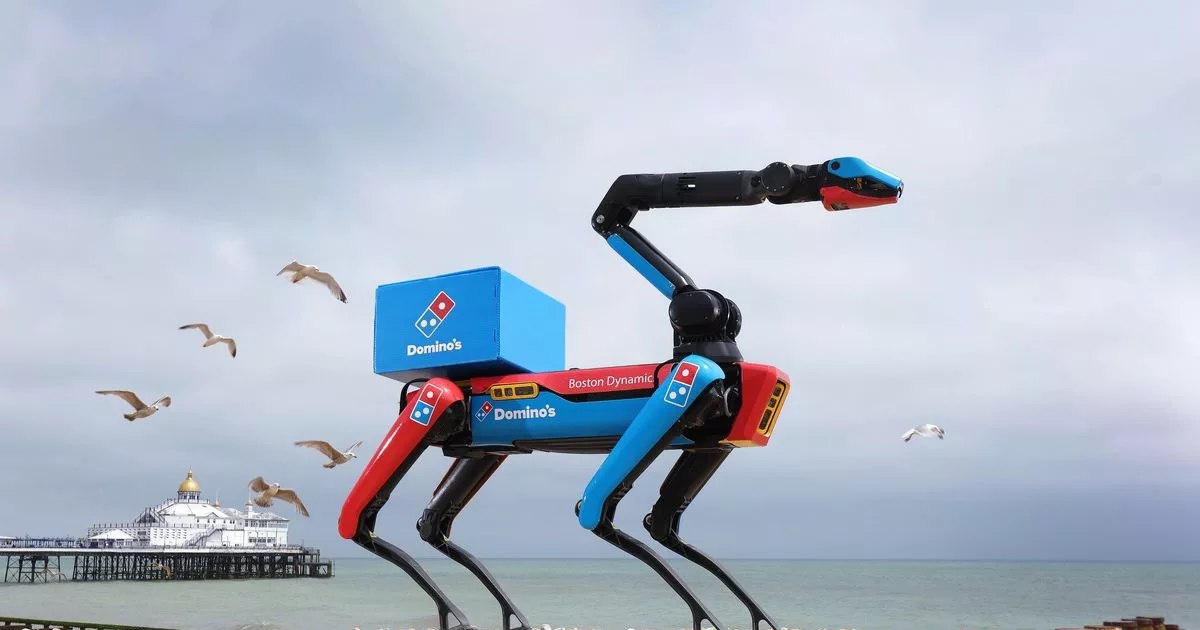
The British summer season received a high-tech ally: Domidog, the dog-shaped, autonomous robot, created by Domino’s to deliver pizza to the beach and defend the orders of bold seagulls.
Photo source: Image: Pinpep
The Domino’s pizzeria chain added a new “employee” in the team: Domidog, a robot dog created to deliver pizza to the beach visitors. Although it does not replace human couriers, the prototype is tested this summer with a clear purpose: to keep the aggressive fishermen who give in the eating of tourists on the coast.
The device was launched as a result of several studies that the seagulls are among the largest sources of discomfort for the British when they go to sea. Among their dissatisfaction are: uncoated toilets (40%), excessive agglomeration (37%) and dogs left free on the beach (17%), according to a survey on 1,500 visitors.
One in three respondents acknowledged that it was “stolen” the food of seagulls, and most say they would like a simple way to protect their snacks.
“The seagulls took over the countless snacks on the coast, it was time to do something about it”, says Izzy Gardener, Domino’s representative. “We constantly explore innovative methods to deliver pizza as hot and fresher. That’s why we test domidog this summer, a technological solution for a classic beach problem,” she adds.
Performance robot, with Boston Dynamics pedigree
Domidog uses the advanced technology developed by Boston Dynamics, the same robotic platform that has been previously used in search and rescue missions, pyrotechnic interventions and research on human -robot interaction.
Equipped with state -of -the -art sensors, stereo rooms and sophisticated location systems, the robot can navigate autonomously around obstacles and make deliveries in crowded environments. Due to the room with a panoramic view, the robot is oriented without problems in crowded spaces or on difficult land.
“It’s the future”
According to Dan Popescu, director of engineering @scopefusion, the use of robots in deliveries is not a novelty. “There have been experiments in the past: drones, Amazon robots or ziplines. It is an inevitable process that, in the medium and long term, will replace human couriers if it is proven to be profitable. And the data seem to indicate that it is.” he says, for the truth.
However, in this case, Dan Popescu believes that Domidog is rather a marketing movement than an optimal technological solution:
“The use of Boston Dynamics robots for pizza delivery seems like a spectacular choice, but not necessarily. There are already cheaper and efficient technologies for deliveries.”explains the specialist.
However, he remains open to the idea that the seagulls have even become a serious problem on the British coast. “Perhaps Dominos has decided that it is worth the investment – maybe the seagulls are a real danger. After all, it is the future. The human courier is no longer justified in terms of costs. The robotic one, yes.”
Autonomous deliveries: investments, efficiency and depreciation
Moreover, the automation of deliveries is not only a matter of innovation, but also of economic efficiency. “For a comfortable rololout in a city, ie 20-30 drones or robots, a company could pay between 500,000 and $ 2.6 million, depending on the equipment capabilities,” Dan Popescu continues.
Although the initial investment is significant, the advantages become obvious in the medium term: “In the courier job, about 60% of the costs come from the human resources. Automation makes sense and will continue. Usually, the depreciation comes in 3-5 years, but with the technological evolution and the simplification of the processes, the period could become even shorter.”he estimates.
In fact, in Los Angeles, delivery robots that seem out of a pixar movie are already part of the urban landscape. Autonomous deliveries become more and more visible, but behind this high-tech progress is a more complex reality: robots are not (yet) fully autonomous.
Real robots, real problems: between tiktok and vandalism
The journalists from The Verge spent a day with the robots of Serva Robotics, who collaborate with Uber Eats to deliver food to the Californian metropolis. The devices, the size of a shopping trolley, circulate on the sidewalk with “eyes” LED type that blink friendly and bear the name written on the housing.
On Tiktok, clips with ridiculous, pushed or vandalized robots make thousands of views. In Hollywood, these robots became secondary characters in their own reality show.
Intelligent robots, drones and scales
According to an analysis published in The Wall Street Journal (WSJ), US restaurants receive over 4 billion orders annually, and technology companies have invested over $ 3.5 billion in 2019 to make this process more efficient. Autonomous robots such as Serva Robotics or Coco deliver food in cities like Chicago, Los Angeles and Miami, using Lidar, rooms and AI for precise navigation, without interacting with drivers or couriers.
An example quoted by WSJ is the Harold’s Chicken Shack chain in Chicago, where robots take orders directly from the restaurant and transport them to customers, faster and warmer than a classic courier. Customers are watching delivery in the app and unlock the robot to pick up their food. The devices have internal rooms, alarm systems and human monitoring for safety.
Technologies do not stop upon delivery. The company ACECECEC has introduced into the restaurants fast-food smart scales that check the total weight of an order, including napkins and cutlery, to prevent shortcomings. The first tests show that about 8% of the orders had mistakes, corrected before shipping.
The company Zipline delivers pizza, soups or drinks with drones that fly at 45-90 meters, descends the order with a cable and leaves. In Texas, drones distribute Jet’s Pizza orders, and in North Carolina, Wing (supported by Alphabet/Google) deliver food from Panera and Wendy’s in less than five minutes, directly in front of the house.
According to the WSJ, the drones are ready to fly in the rain, they do not ask for a tip, and the customers pay between $ 7 and 10 for this service, the packaging being water resistant.
Romania, still without robots on the sidewalk
Although the technology is widely tested in the US and Western Europe, there are still no active robots in the public space. Automation can only be found in restaurants and warehouses, and deliveries are still made by human couriers. The lack of infrastructure, the legal framework and the initial investments break the adoption.
Even though Domidog seems, at first glance, a nice marketing experiment, it is part of a global phenomenon: delivery automation.
