
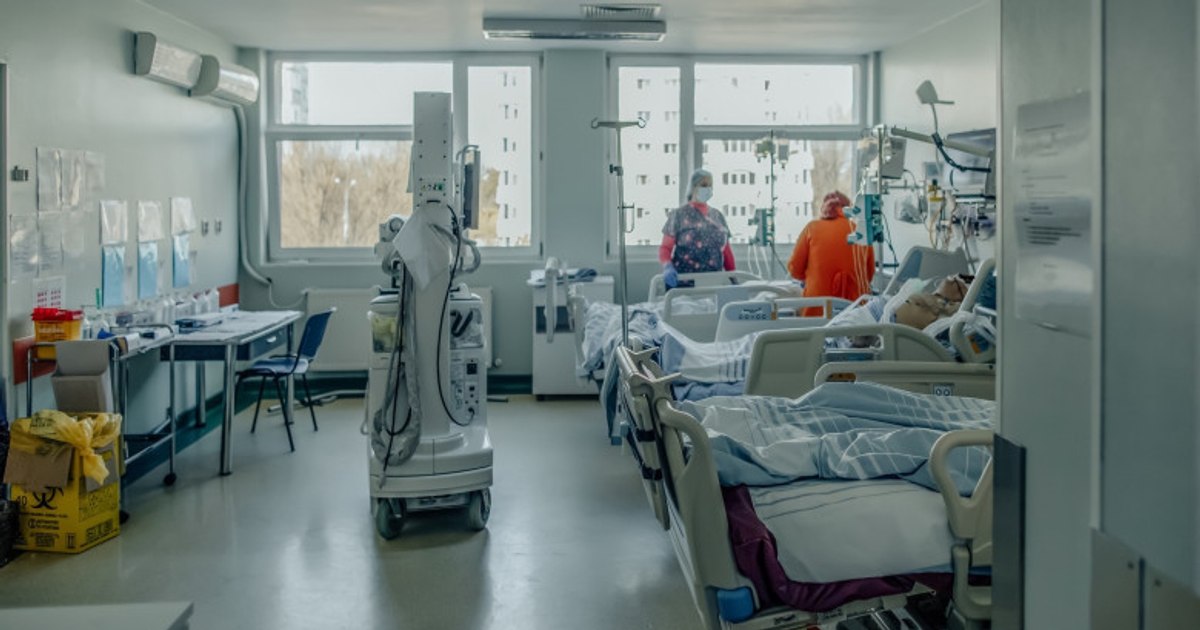
A group of over 80 Romanian doctors working in French hospitals came to the defense of the two female doctors arrested following the scandal at the Saint Pantelimon Hospital, accused of qualified murder.
Ward of the Pantelimon Hospital. PHOTO Archive
In an open letter, the Romanian doctors emphasize the complexity of the decisions made in the intensive care units and claim that the situation faced by their colleagues was one with no way out.
Medical staff give the example of French legislation, which sanctions doctors when “insist” to administer treatment to a person who no longer has a chance of survival.
“They intervene in the public space, unfortunately, people who do not seem to have that minimum of professional training in terms of understanding the operation of an Intensive Care Unit and the particularities of this service, the characteristic pathologies and who nevertheless pronounce on the competences and decisions taken by these doctors, our colleagues…Unfortunately, death in resuscitation (intensive care) is part of our daily life as doctors. Every day, ATI doctors are faced with life and death decisions, in a world where material, physical and human resources are limited, and where the tendency is to be as invasive and aggressive as possible in the treatments proposed to patients” reads the open letter.
“The situation that our colleagues faced was one with no way out”
The Romanian doctors in France believe that the situation we are talking about is a complex one, and the doctors from Pantelimon could not get out of it.
“The key to understanding what happened at Saint Pantelimon Hospital not found in noradrenaline dose. The key to understanding lies in the realization that the situation our colleagues faced was one with no way out, that they were in a therapeutic impasse. It is a kind of “checkmate” in medicine, when no matter what you do there is no good solution. For those unfamiliar with medical terms, the state of “refractory shock” means a state of profound and prolonged hypotension that no longer responds to increasing doses of norepinephrine. There is no solution to this situation and the inevitable outcome is death, whatever the dose of noradrenaline, high or low“, they say.
Specialists show that in France in particular and in Europe in general, unlike Romania, this situation related to the end of life in resuscitation wards is rigorously regulated and is part of the concept of “therapeutic limitation”. This practice applies to terminally ill patients who are considered to have no prospects of survival.
“In France, for example, the insistence on administering a treatment when there is no chance of survival is called “therapeutic obstinacy” (“obstination déraisonnable” or “acharnement thérapeutique”, the Leonetti law of 2005) and is sanctioned by law as a medical practice not adapted to the situation, which harms the dignity of the respective patient“.
In France, the legal framework of practices limiting medical care aims at both the patient’s rights and the legal protection of the medical team faced with this situation.
“The medical team has a duty to act strictly in the patient’s best interest, even if this may sometimes mean limiting medical care to patients who are considered terminally ill, without a reasonable therapeutic plan. These laws began to be developed in France as early as 20 years ago and continue to evolve. Without this legal framework in Romania, exaggerations and excesses in both directions are possible. Patients must also be protected, but medical teams also need legal protection in the face of these difficult cases“, the letter also states.
In the opinion of Romanian doctors in France, the legislative vacuum made the tragedy at St. Pantelimon Hospital possible.
“And when we say tragedy, we also understand the pain of the families who were left with the impression that everything possible was not done for their loved ones, but also that of the doctors involved, who, although they had the feeling that they were doing the right thing and that they acted in the interests of the patients, now they are ostracized and treated like common criminals. As ATI doctors, we express our hope that this case of the doctors at St. Pantelimon Hospital will be entrusted to experts, who can judge impartially what really happened there. We also hope that it will be the starting point for defining a legal framework in Romania that will establish the rules of operation in such situations”the doctors say.
Situations that require limiting or stopping treatments in an Intensive Care Unit in France
– Patient in the situation of therapeutic failure, despite a well-managed strategy and an optimal treatment. In this situation, the decision to limit or stop one (or more) treatment(s) is aimed at not needlessly prolonging the agony by continuing to replace a certain organ function.
– The patient whose evolution is unfavorable in terms of survival and/or quality of life and for whom the continuation or intensification of organ replacement treatments would be unreasonable or disproportionate to the therapeutic objective and the real situation (e.g. terminal cancer).
– The patient who directly or indirectly expresses his refusal to the introduction or intensification of organ replacement treatments (e.g. invasive ventilation, dialysis, etc.)
The Pantelimon case
We remind you that two female doctors from the ATI Department of St. Pantelimon Hospital were detained preventively for 30 days for attempted murder and qualified murder, and a nurse was placed under judicial control for perjury.
The judge ordered the preventive arrest of the two female doctors, accusing them of acting intentionally to cause the death of the 54-year-old patient by suddenly decreasing the dose of noradrenaline. It is believed that these actions were intentional and not negligent, and that the defendants attempted to conceal evidence. As a result of the search, evidence was found that the female doctors tried to delete evidence and complicate the investigation. The injectomat was stopped for 10 hours, and INML specialists confirmed that the sudden drop in noradrenaline was directly related to the patient’s death.
