

The Organization for Economic Cooperation and Development (OECD) has published the 2025 edition of the “Brief Education” report, which includes detailed data on Romania. The document shows that, although the rate of completion of university studies is above the average of the analyzed states, our country is facing serious challenges: reduced investments in education, school absenteeism and a high rate of university dropout.
Over 20% of young Romanian people are neither at work nor at school Photo archive
UPDATE Daniel David: When you are in a fiscal-budgetary crisis, you can not always implement the best OECD practices
In reply, the Minister of Education said that when you are in a fiscal-budgetary crisis, you can no longer implement the best OECD practices.
“You see we are in a situation of fiscal-budgetary crisis, when you are in a fiscal-budgetary crisis you can always implement the best OECD practices, but it is very important if you are a responsible minister or you are a responsible decision maker that the measures you take to find between the OECD or the European landmarks, Anchored in these institutions, to be able to communicate, to change data, to change ideas, to change practices with other countries in these organizations“Said Daniel David.
Education level and graduates
Romania is making modest progress in terms of the level of education of young adults. The weight of those without higher average studies decreased from 26% in 2019 to 24% in 2024.
Instead, our country is part of the six OECD and partner states in which the proportion of young people with university studies decreased in the same period, from 26% to 23%. Comparatively, the OECD average shows that 42% of adults hold a tertiary diploma, while in Romania only 19%.
However, the level of higher education guarantees good employment prospects: 92% of adults with higher education in Romania are employed, compared to 87% on average in the OECD.
Employment and income
The occupancy rate of adults with higher education is high, but their salary advantage is lower than the OECD average.
In Romania, those with higher education earn 41% more than high school graduates, compared to 54% on average in OECD.
In contrast, the wage difference between those without secondary studies and high school graduates (higher average studies) is only 9%, well below the OECD average of 17%, which suggests a more equal distribution, but also lower education.
Young Neet and school participation
The report draws attention to young people who are neither at work, school or training programs (NEET).
In Romania, 22% of young people aged 18-24 are NEET, compared to 14% OECD average. Which means that 1 in 5 young people neither work nor study.
The risk of unemployment or inactivity is higher among 25-34 years with lower average studies: 18% are unemployed and 45% are not in the workforce.
School participation in early ages is also reduced: 16% of children aged 6-14 and 32% of adolescents aged 15-19 are not enrolled in school, compared to 2% and 16% OECD average.
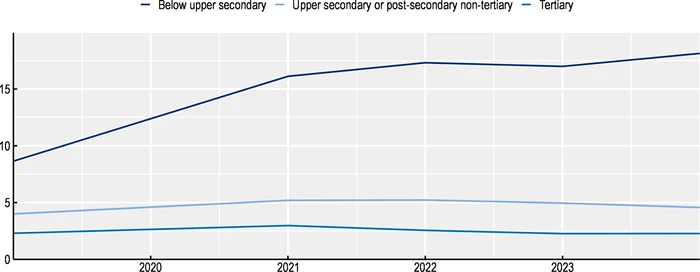
Trends of unemployment rates at 25-34 years in Romania, depending on the level of studies
University studies, completed or abandoned
Romania is doing well in terms of completing the university studies.
62% of students starting a bachelor’s degree obtain their diploma, over the OECD average of 43%.
After three additional years, the completion rate reaches 66%, slightly below the 70%OECD average.
However, 21% of students abandon the first year, compared to 13% in the OECD, which indicates a persistent retention problem in tertiary education.
Study fields and foreign students
Romania is highlighted by an increased interest for the Stem areas (science, technology, engineering, mathematics), which represents 31% of graduates, compared to 23% OECD average. Other popular fields are business, administration and law (29%) and arts, humanistic sciences, social sciences and journalism (19%).
The international mobility of students is increasing: the proportion of foreign students ascended from 5.4% in 2018 to 6.7% in 2023. The taxes for foreign students at the master level are $ 8.150 (~ 40,350 RON), compared to USD 2,098 (~ 10,380 RON) for Romanian students.
Expenses for education
Romania spends $ 6.069 per student (≈30.040 RON) for primary education to non-country post-secondary, well below the OECD average of over $ 13,000. At the tertiary level, the investment is $ 10,329 (≈51.120 RON), compared to $ 15,102 OECD media (≈74,800 RON).
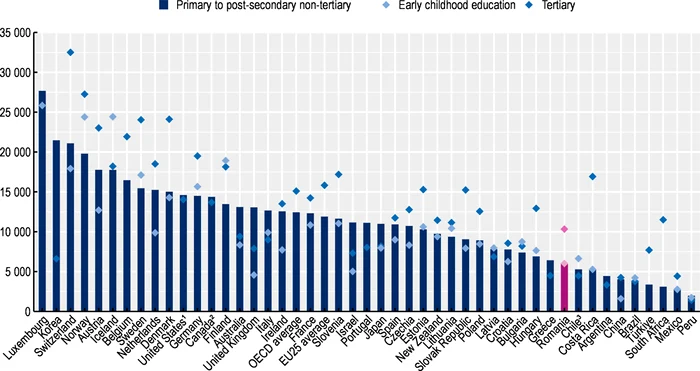
Government expenses according to the level of studies
As a percentage of GDP, education represents 2.5%, the lowest level in the OECD, compared to the average of 4.7%. The share of expenses for education in the public budget decreased slightly between 2015 and 2022, from 6.6% to 6.3%. At the pre -prime minister, government expenses increased by 36.7%, even though the number of children registered decreased by 2.9%.
Teachers and pay
The salaries of the teachers in Romania are competitive at international level: the primary teachers earn 14% more than other workers with higher education, compared to -17% OECD average.
The share of vacancies is reduced (1.9%), and only 2% of teachers are not qualified. In addition, teachers can receive compensations for overtime, mentoring, teaching in disadvantaged areas or with students with special needs.
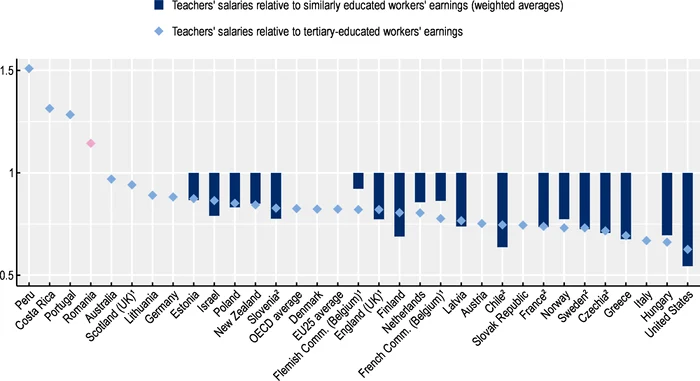
Effective salaries of primary teachers in relation to workers with higher education
Hours of school and holidays
The students from Romania receive 6,000 mandatory hours between the mayor and the gymnasium, with 1,600 hours less than the OECD average. In the mayor, a student has 540 hours annually (compared to 804 OECD average), and at the gymnasium 834 hours (compared to 909).
School holidays are among the longest in OECD: 16.6 weeks annually in the mayor, compared to 13.5 weeks OECD average.
