
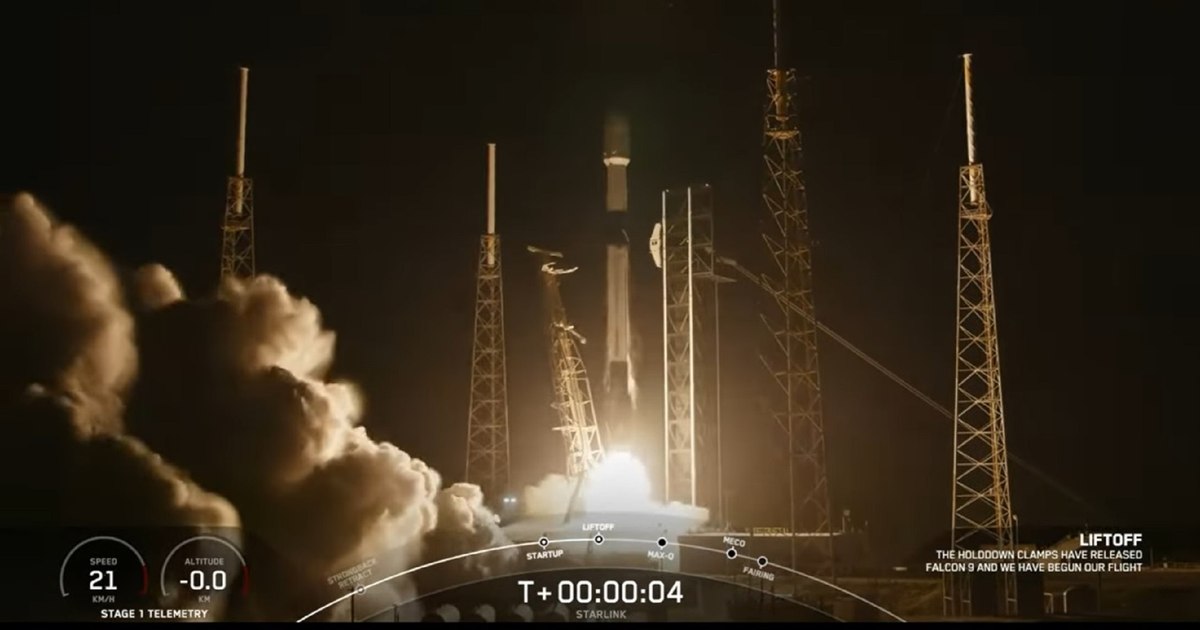
Radio waves from Elon Musk’s growing network of satellites are blocking scientists’ ability to peer into the universe, according to researchers in the Netherlands.
Starlink satellites PHOTO: Archive
They say the new generation of Starlink satellites, which provide high-speed internet around the world, interfere more with radio telescopes than previous versions.
The thousands of orbiting satellites “blind” radio telescopes and could hinder astronomical research, according to the Netherlands Institute for Radio Astronomy (ASTRON).
Satellites provide broadband internet around the world, often in remote places, including difficult environments like Ukraine and Yemen, according to bbc.com.
They are also used to connect isolated areas of the UK to fast internet. In 2022, tests showed Starlink could deliver internet speeds four times faster than average, according to the Department for Digital, Culture, Media and Sport.
But astronomers say this comes at a cost.
“Each time more of these are launched with these kinds of emission levels, we see less and less of the sky,” Professor Jessica Dempsey, director of ASTRON, told BBC News.
“We’re trying to look at things like jets, which are emitted by black holes at the center of galaxies. We’re also looking at some of the earliest galaxies, millions and millions of light-years away, as well as exoplanets.” she said, pointing out the areas that satellite radiation affects.
ASTRON found that the interference produced by the second generation of satellites, or V2, is 32 times stronger than that produced by the first generation.
The amount of radiation emitted exceeds regulations set by industry body the International Telecommunications Union, Professor Dempsey added.
One estimate suggests that there are 6,402 Starlink satellites currently in orbit about 550 km above Earth, making it by far the largest provider.
The satellites are relatively large – with 3m flat panels and an 8m solar array for power.
SpaceX’s main competitor, OneWeb, has fewer than 1,000 satellites. But this is a growing field of activity. Amazon is developing its own network and hopes to roll out at least 3,000 in the next few years.
By 2030, the number of satellites in orbit should exceed 100,000.
The study was carried out using the LOFAR radio telescope in the Netherlands in a single day in July earlier this year.
Many objects in space, including distant galaxies and planets, emit light in the electromagnetic spectrum.
This radiation travels in the form of waves, and radio telescopes can pick up these waves, allowing us to picture things that we cannot see with our eyes.
But these waves are disturbed by satellites.
Scientists have detected unintended electromagnetic radiation from almost all observed V2 Starlink satellites.
they were about 10 million times brighter than those from the faintest light sources identified, they say.
Lead author Cees Bassa said it was like comparing “the faintest stars visible to the naked eye and the brightness of the full Moon.”
“As SpaceX launches about 40 second-generation Starlink satellites every week, this problem is only getting worse.” he added.
Robert Massey, deputy chief executive of Britain’s Royal Astronomical Society, said “it’s very clear that if we have something this bright this much a major radio observatory, then we have to do something, and we have to do it fast.”
Asked about the value of astronomical research, he said: “it is wrong to say that there is a science that you can simply dismiss. The applications may be decades or even more in the future, but they can be very fundamental and very important.”
Scientists are also concerned about light pollution from satellites and fear that it also interferes with optical telescopes.
Astronomers say they spoke to SpaceX about radiation from the first generation of satellites, and the company listened to their concerns.
But ASTRON now say that the V2s have proven to be even more powerful.
Turning LOFAR back on and seeing these strong signals from this new generation of V2 Mini SpaceX satellites was a bit of a shock,” says Prof Dempsey.
“This actually threatens all of terrestrial astronomy at every wavelength and in different ways. If it continues, without some kind of mitigation to make these satellites silent, then it will become an existential threat to the kinds of astronomy we do.” Professor Dempsey added.
The researchers stress that greater regulation of space and the way satellites operate is needed to avoid compromising scientific activity.
They said that as the largest supplier of satellites, SpaceX could set a standard for limiting pollution.
Professor Dempsey said simple actions such as shielding the battery on the satellite could make a big difference and reduce the radiation emitted.
Some interference comes from faulty electronics, so this could prevent this.
But if action is not taken, “very soon the only constellations we will see will be man-made,” she added.
