
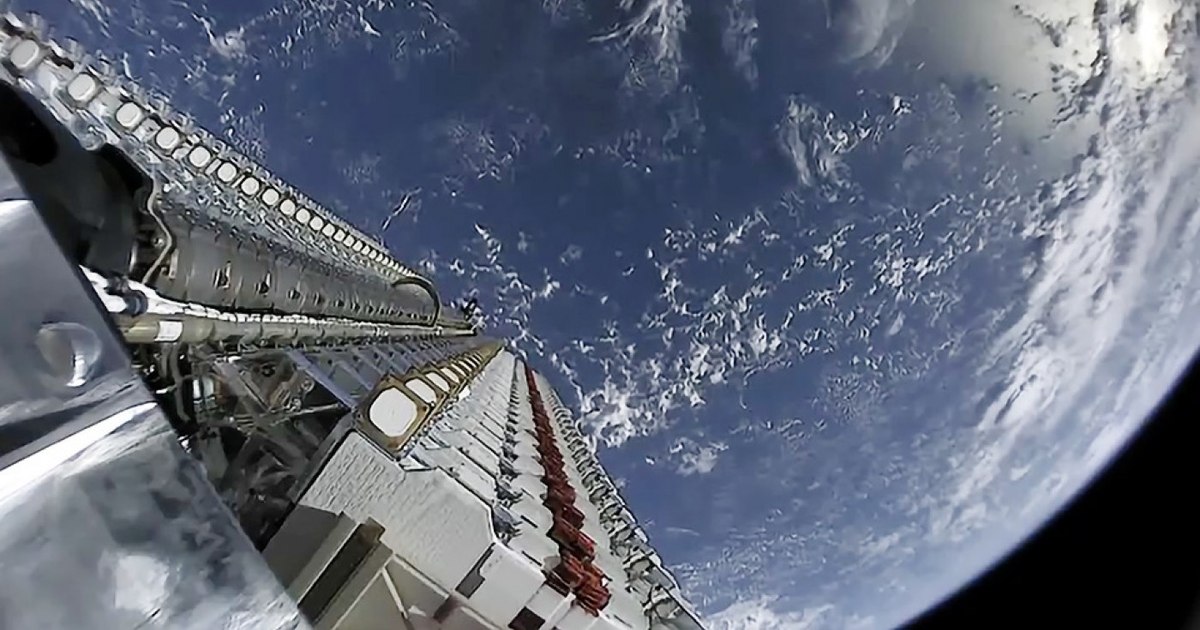
A former NASA physicist has told DailyMail.com that space junk could affect the Earth's atmosphere, leading to an “unplanned geoengineering experiment”. Satellites like Elon Musk's Starlink could disrupt Earth's magnetosphere, exposing all life to deadly cosmic rays.
Starlink satellite in orbit PHOTO Archive
The new study is by researcher Sierra Solter-Hunt and is based on new estimates that Musk's SpaceX burns more than 1.3 tonnes of wireless internet satellite debris into Earth's atmosphere every hour – creating a metallic layer of “particles conductors” in orbit.
“I was very surprised”Solter-Hunt told DailyMail.com. “No one has done much research on metal dust accumulations in the space industry.”
There are 5,504 Starlink satellites now in orbit, according to astronomers' last estimate in March, of which 5,442 are operational. But tens of thousands more are planned.
Particles from these satellites, at the end of their life cycles, could “distort or trap the magnetic field” that prevents escape into the Earth's atmosphere, the physicist said, “with all the metal garbage”.
Although she notes that it is a “extreme case”such a layer of charged metal dust could lead to
“atmospheric stripping”similar to the ancient destinies of Mars and Mercury.
After working on the Stardust spacecraft research team (NASA), the researcher spent three years at the US Air Force Research Laboratory.
There, she studied the electromagnetic behavior of plasma jets in low Earth orbit (LEO), the region of the upper atmosphere where the Starlink orbital network is located. He now consults on the impact of space weather on the aerospace industry.
The atmosphere, the “trash bin” of the space industry
“We're about 10,000 satellites (in orbit) right now, but in 10 to 15 years there will probably be 100,000.”said Dr. Solter-Hunt, per the source cited.
“By the time we get to 100,000, I think it might be too late.”she said, “regarding this unplanned geoengineering experiment that will take place.”
The reason for her concern is that this fine-particle metal debris already far outweighs the magnetically charged particles that shield Earth from cosmic radiation.
The heaviest known portion of Earth's magnetosphere are large loops of particles called the Van Allen Belts—two donut-shaped regions of small particles energized by cosmic radiation from the Sun. The belts fall from the Earth's magnetically charged North and South Poles.
The weight of this vital region is impossibly small compared to the metallic debris that might separate it from Earth—the Van Allen Belts have a total mass of about 0.00018 kilograms.
“Masses of other parts of the magnetosphere (ring current, plasmasphere, etc.)
not widely estimated, but less dense than the Van Allen Belts”she notes, in the new work.
This light weight and low mass of the magnetosphere, in other words, means that a large volume of heavy satellite debris could have a dramatic, unprecedented impact.
“I think we need to stop
immediate let's use the ionosphere and the atmosphere as space industry trash can”,
warned the researcher.
In recent years, both academic astronomers and SpaceX's satellite company competitors have issued formal complaints to the US Federal Communications Commission (FCC) about Starlink's ambitions. In particular, astronomers fear that the company's space junk could permanently interfere with ground-based observatories, halting the study of space.
“The addition of nearly 30,000 Starlink satellites will disrupt the entire field of astronomical research”as the FCC summarized the researchers' complaints in their November 29, 2022 ruling on SpaceX's Gen2 satellite plans.
Criticism of new hypotheses
However, some astrophysicists and scientists have expressed skepticism about the new paper's hypothetical scenario.
Researcher Fionagh Thompson of Durham University in the UK told Live Science that Solter-Hunt's estimates of the number of future satellites “seem exaggerated” because companies' ambitious launch schedules tend to be overstated.
The paper is an “interesting thought experiment,” she noted, but added that it “shouldn't be taken as an indisputable truth about what's going to happen.
A magnetosphere expert and planetary scientist at the University of Rochester in New York, Dr. John Tarduno, specifically criticized the new paper's hypothesis that the density of metallic debris could become so thick as to separate Earth from its Van belts Allen.
On the other hand, Dr. Solter-Hunt told DailyMail.com that none of her critics had been able to undermine her basic premise, even when she personally called for deeper constructive criticism.
“I contacted (some of) them to further elaborate on how I could improve the research and they just didn't know how
or were not available“,
she said.
Dr. Lawler, the astronomer at the University of Regina in Canada who inspired the investigations, called the new study
“a really important first step” which draws much-needed attention to the “terrifying” amount of spacecraft dust accumulating in Earth's atmosphere.
“The consequences (ieLinden
pollutepri
via satellite)”said Dr. Lawler, “it might also be on a totally different scale than we're used to thinking about.”
