
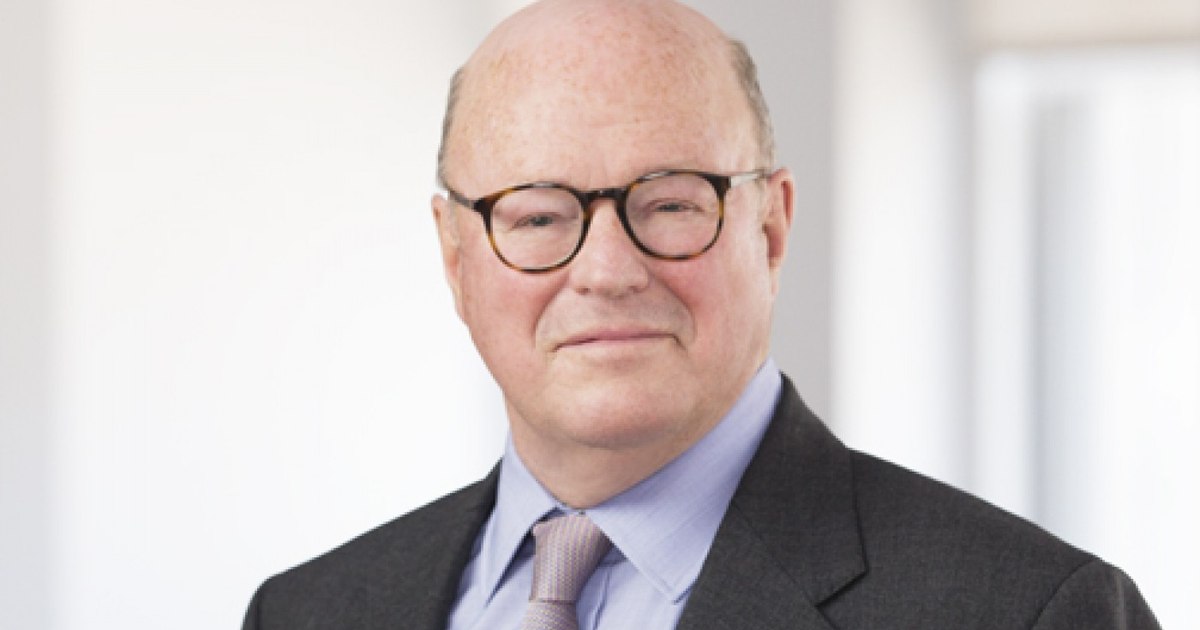
Frank G. Wisner II, former US Secretary of State, with a career of several decades in major positions in the US State Department, gave an exclusive interview to “Adevărul” about Romania’s situation following the cancellation of the presidential elections.
Frank G. Wisner. PHOTO personal archive
In the interview with The Truth, former US Secretary of State Frank G. Wisner Jr. talks about how the decision of the CCR to cancel the first round of the presidential elections is perceived and about the effects that the decision will have on the external level. He also shows that the CCR approach is not at all to the Kremlin’s liking.
The truth: Is the decision of the Constitutional Court of Romania a major blow against Russia?
Frank G. Wisner: I am not an expert in Romanian legislation, but I respect the decision of the Constitutional Court of Romania and the step it took to cancel the first round of the presidential elections. It is an extremely important one and I think it is a good thing for Romania and certainly a good thing for the United States of America. I was very disheartened by the result of the first round of the election and I think this is the general view in the US as well. The man who won the elections is certainly not a friend of this country and is not a supporter of Romania’s participation in NATO and Western institutions. So I am pleased with the Court’s decision. I imagine it was a tough decision, but an important one, and I don’t think it went down well with the Kremlin.
The Truth: How do you think Russia will react to the cancellation of the first round of the presidential election?
Frank G. Wisner: In my opinion, Russia will not make a sound. He will not want to appear that he manipulated the first round of the elections or that he had a partisan attitude. And now, after things have been decided by the CCR, Russia will be silent.
The Truth: Is Hybrid Warfare Russia’s New Key Weapon? How could Eastern European countries counter Russia in this hybrid war?
Frank G. Wisner: As long as we are talking about hybrid warfare, Russia’s pressure on Eastern Europe, and indeed all of Europe, is for Europe to kneel before the Russians. But it is something Europe cannot do. She must stand. Politically, to give nothing to Russia, to support Ukraine and to strengthen its European defensive structures. Much needs to be done to signal to Russia that Europe will not back down and that it will accept Russia’s ambitions.
The truth: How do you see these pressures in recent weeks, first from Georgia, now from Romania. Could they be part of a larger plan to destabilize Eastern Europe?
Frank G. Wisner: Russia shows influence. Of course, every case is different. Georgia is not in the same situation as Romania, Moldova is not in the same situation as Georgia. So, we have to be careful before putting them in the same plane. Russia aims to make it clear to European countries that it is a political factor to be reckoned with, and if Europe does not take this into account, it will continue to face destabilization, political pressure and even military pressure from Russia. It is time for Europe to be united, to stand up and show Russia that Europeans have no time for its maneuvers.
The truth: Is Romania in danger, taking into account the fact that Russia tried to influence the presidential elections?
Frank G. Wisner: Romania is always in danger from Russia. Romania lives in danger, being in the vicinity of Russia, being invaded by Russia in the past, living under the communist regime in the past. So there is nothing new here. It must show that it can stand up to this, show that it is fulfilling its commitments to NATO, that it continues to build up its forces and show solidarity with its European friends and neighbours.
The truth: This month will be the 35th anniversary of the December 1989 Revolution and the collapse of the Ceaușescu regime. How close would the scenario of the fall of Ceaușescu be in the case of Vladimir Putin?
Frank G. Wisner: You mean being kicked out of power and being tried and convicted? I do not see Vladimir Putin in such danger. But of course I don’t know. I remember what Marx said when he was asked when he thought the revolution would begin. And he answered: you can tell when the water starts to get colder, but you can’t predict when it will turn to ice.
The Truth: How do you estimate the risk of a peace plan in Ukraine favorable to Russia?
Frank G. Wisner: The war in Ukraine is a tragedy and has a bitter cost to Ukraine. He can be stopped by political settlement, but it must be one that Ukrainians can live with, can support, and be supported by Europe and the United States of America.
Who is Frank G. Wisner Jr.
Frank G. Wisner Jr. he had an impressive career at the top of the US administration, working with eight US presidents and having extensive experience in diplomacy. Born on July 2, 1938 in New York, a graduate of Princeton, he had a distinguished career in diplomacy, working for the United States Department of State for 36 years. He was Acting Secretary of State in 1993, Under Secretary for International Security between 1992 and 1993, under President George HW Bush, and Under Secretary of the Department of Defense during the Bill Clinton administration, between 1993 and 1994.
Frank G. Wisner Jr. he was also deputy executive secretary in the State Department in 1976 under President James Carter, later serving as US ambassador to Zambia, Egypt, the Philippines, and India, among others. The renowned expert is still very active at almost 86 years old, being an international relations advisor at the Squire Patton Boggs company in New York.
His father, Frank Gardiner Wisner (1909-1965), was one of the pioneers of the establishment of the Central Intelligence Agency (CIA) and a legend of American espionage. He stayed in Romania from August 1944 until January 1945, as head of the OSS station (Office of Strategic Services – the US espionage service) in Romania. During his time in Romania, the father of Frank G. Wisner Jr. he developed a close relationship with both King Michael I and the Royal Family. Frank Wisner met King Michael in Bucharest, in the fall of 1944, and the friendship between the two was maintained afterwards.
