

In an exclusive interview given to a Romanian publication, the protagonists of the phenomenon series “Squid Game” talk to us about the challenges of the new season, but especially about the message of the Netflix production: the problems of vulnerable people and the abuse of power.
Lee Jung-jae, who plays the protagonist Seong Gi-hun PHOTO: Netflix
“Squid Game”, released in 2021, is the most watched series on the Netflix platform, with 142 million people and amassing 1.65 billion hours of viewing in the first four weeks of its release. Now director Hwang Dong-hyuk, who made history at the 74th Primetime Emmy Awards by becoming the first Asian to win the award for Outstanding Direction of a Drama Series, is back at the helm of the series , for a new season, as director, screenwriter and producer.
Lee Jung-jae (who plays the protagonist Seong Gi-hun, player 456) and Wi Ha-joon (policeman Hwang Jun-ho) spoke exclusively to “Weekend Truth” about the challenges of the new season, but especially about the message on which the Netflix series, but also South Korean culture, take to the whole world: the problems of vulnerable people, with vices, who belong to the lower class; the abuse of power by those who rule (from the shadows); how much a life costs (both the organ trafficking situation and the extreme decisions people make for a better future). The new season is available on the online streaming platform Netflix.
“Weekend Adevărul”: What are the key elements that will keep people glued to the screens for the new season?
Lee Jung-jae: I think it will be the new games. The first season featured various Korean games that I played as a child, and also the second season will feature such games that are popular among kids but that everyone will remember playing, so , it will be a season for all the followers.
How has the success of the series changed your life? Have you had pleasant experiences because of him in Korea or abroad?
Wi Ha-joon: It is an honor for me to participate in this series. Thanks to him I got roles in other productions and now I can enjoy them with all the fans. I treasure all these moments immensely. It was like living in my own dream. For a Korean production to become a global phenomenon was a matter of pride for me and I am honored to have been a part of it. As an actor, I think I have evolved a lot because of the series – now the whole Globe is watching the series and I want to reach the highest standards in the acting game and I hope that everyone will resonate with the feelings and experiences of my character. Success made me work harder.
The avalanche of feelings, part II
your character he went through a lot in the first season. What surprises is he preparing for us now?
Lee Jung-jae: This season, Seong Gi-hun is determined to put an end to the game – we can see that he’s dedicated three years to finding the mysterious man in the suit so he can get back into the game. Also, in season two he meets a lot of other characters that help him in his personal development in the end.
How difficult was it to get back into the shoes of the character?
Lee Jung-jae: When I was offered to play the role of Gi-hun again, I had a lot of feelings. I remember when I first set foot in the game arena, for the second season, it was a moment of horror. I remembered all the games the character played in the first season and felt Gi-hun’s trauma – all those feelings came back like huge waves. I thought that there are some emotions that I will never have again in this life.
In the first season, your character, just like the rest, agrees to enter the game out of desperation. Now, however, Gi-hun actually wants revenge. When you first got the script, how did you feel: that you were playing a completely different character or that it was a natural evolution of him?
Lee Jung-jae: I think it’s a normal evolution of the character from season to season. Due to the fact that 456 people died, he was able to get that huge amount of money, but his conscience does not let him use the money – although in the end he followed the rules of the game. Gi-hun decides to use the money to stop the game. I think this desire of his does nothing but revert him back to his original, childish and naive personality from the beginning of season one. This shows us that he has a good heart though.
Hope springing from history
“Squid Game”, “Parasite” and this year the Nobel Prize was won by the writer Han Kang. Why do you think South Korean culture has become a global phenomenon?
Lee Jung-jae: I think this has to do with Korea’s modern history, which provides depth and many layers to the cultural and entertainment content we make. We have, indeed, a tragic history, but in it we find a source of hope, of hope to live in harmony. I think all of these have shaped us in such a way that through what we do we express Korean culture in a special way, and those who know our history can understand it even better. Everything that is expressed in our content, in this series was and is a part of Koreans’ lives, but to the rest of the world it seems something unique, it seems different, and that’s exactly why I think Korean culture is so appreciated. But in the end, that’s just my perspective; I’m sure everyone has their own way of appreciating, judging Korean productions.
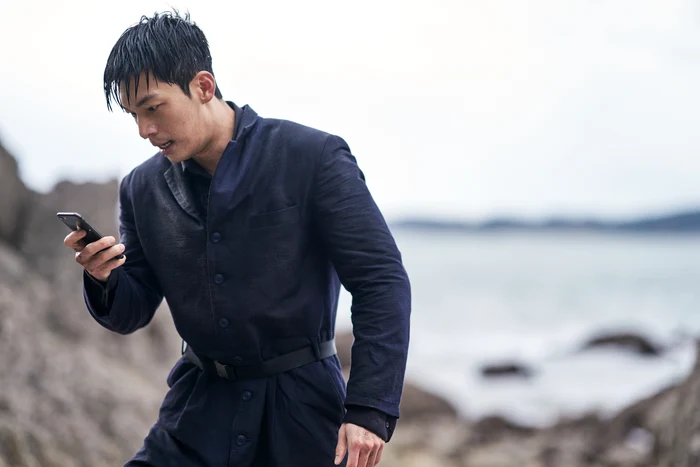
Wi Ha-joon (Policeman Hwang Jun-ho). PHOTO Netflix
“Squid Game” is classified as a violent series. However, what role does this violence play, what can we see beyond it?
Lee Jung-jae: I think that the violence in “Squid Game” is not for entertainment or to make the series more challenging, but to emphasize the tragic situation of the people who are basically thrown into this violence. We can say that violence is a medium through which we show the despair of the characters, their tragic stories that are really painful. Through violence we learn what is going on in the minds of the characters, it maximizes the emotional arc of the characters.
There have been many reported cases of children and teenagers, especially at school, trying to replicate the actions of the “Squid Game”, including extreme bullying. Are you surprised by these consequences that the series has had?
Lee Jung-jae: The message the series wanted to convey was the very opposite of using violence and promoting the fact that the strongest and the most vulnerable can live together. So, I would advise those kids to watch the show again and figure out its true meaning.
Socio-emotional balance
You stated that you have a lot in common with Hwang Jun-ho in the first season. Now that filming for the second one is over, do you still think you’re that similar to the character?
Wi Ha-joon: I don’t think it was just me who resonated with Hwang Jun-ho, but many other people as well. He is a man who sees a lot of bad things happen to his family and it was a shock to him to see that his own brother is behind the game. And he feels that it is his duty as a policeman to expose the operation, but he feels desperate, alone, going through a very difficult time. So, in season two, those who watch the series will surely want him to succeed, to surpass.
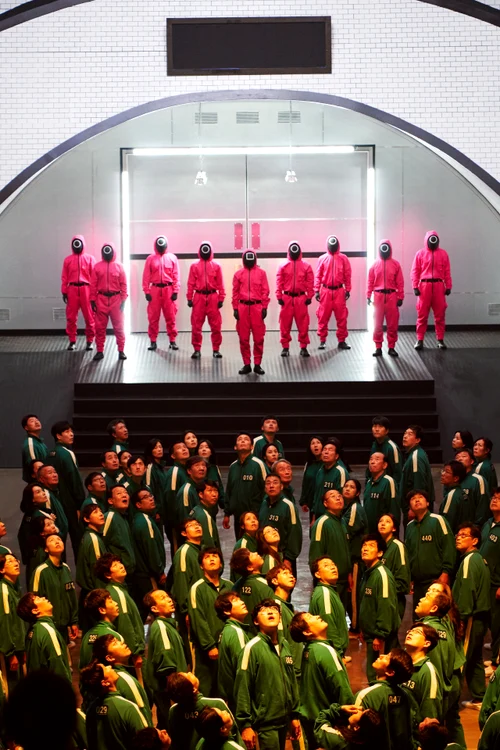
The power of many, one of the themes of the new season. PHOTO: Netflix
Considering the fact that what happens on the island in “Squid Game” is a reality within a reality and that the characters sometimes have a hard time distinguishing between the world there and the one they left, can you tell us if for this season has Artificial Intelligence been used and how much do you think it will be used in cinematography in the future?
Lee Jung-jae: As far as I know, no AI was used in the production of “Squid Game”. But I know that this field is evolving very quickly and there will come a time when the professionals will show us, in cinematography, how far they have come. But now I think AI can help improve visual effects.
The first season of the series is a very dark one. How “dark” will the second one be?
Lee Jung-jae: I think at times we go down some darker roads, but we have more entertaining elements, so I can say it’s a balance between the lighter stuff and the social messages.
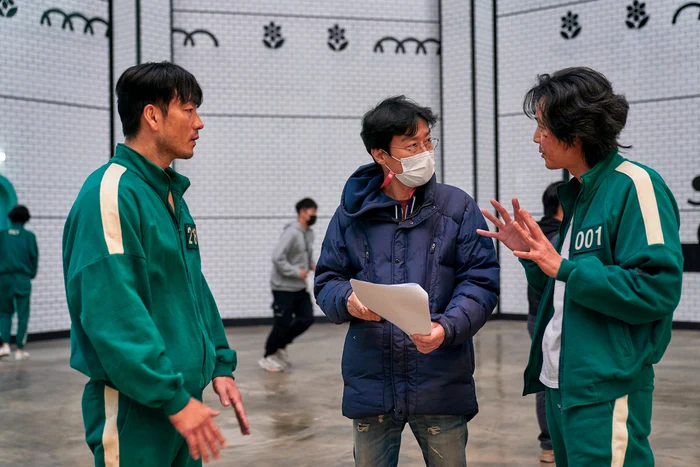
Behind the scenes of the phenomenon series. PHOTO: Netflix
Considering it’s such a high-impact, shocking series, was there anything this time around that surprised you so much, something you didn’t expect? What was the most difficult thing you encountered?
Wi Ha-joon: From the first season, I think the moment that had the most impact was when he found out that the head of the operation was really his brother. It was downright shocking. That scene was very difficult for me. It was difficult for me in both seasons to play Hwang Jun-ho because he is not a very expressive, very charismatic character, instead, he hides some very complex emotions – anger, especially towards those who agree to enter the game. So it was quite difficult for me to outline Hwang Jun-ho, but with the help of director Hwang Dong-hyuk, I was able to bring him to life the way I wanted.
