
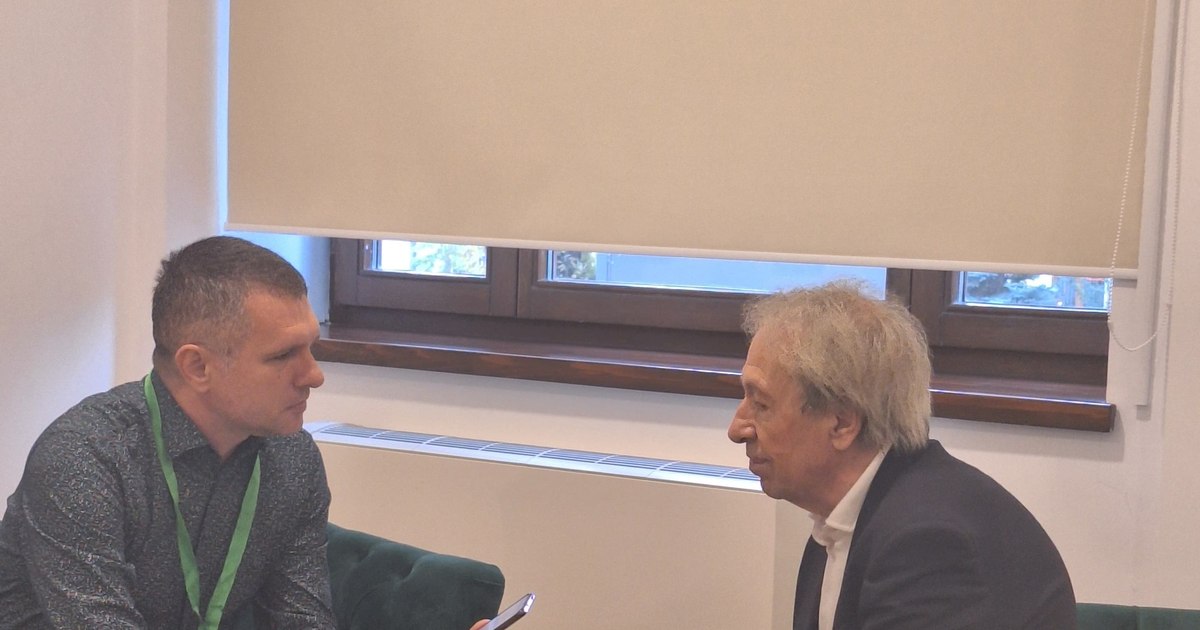
In an exclusive interview for “Weekend Adevărul”, the French writer Pascal Bruckner spoke about Romania, to which he is very attached, also talking about the fact that we live in a society dominated by fear, always in the shadow of past and future wars.
Pascal Bruckner (right), in dialogue with journalist Denis Grigorescu
French novelist, essayist and philosopher, Pascal Bruckner (76 years old) has written numerous books sold in millions around the globe. The Frenchman began to stand out in the mid-70s in the circle of new philosophers, alongside Bernard-Henri Levy. Among others, he is the author of the novels “Luni de fiere” (1981), adapted for the big screen by Roman Polanski, “Beauty Thieves” (1997), for which he won the Renaudot Prize, “Anonymous Monsters” (1998) and “Love towards the neighbor” (2005).
Pascal Bruckner, one of the best-selling and most appreciated French writers of the last half century, was one of the special guests of the Iasi International Literature and Translation Festival (FILIT) in the fall. There, in the capital of Moldova, he gave an exclusive interview for “Weekend Adevărul” in which he spoke about war and peace, about Romania in the 90s and Romania now, about the challenge of writing theater and the challenge of fulfilling a dream. He also talked about his latest book, I Suffer, Therefore I Am. The portrait of the victim as a hero”, the translation of which was published by Trei Publishing House.
“Weekend Truth“: Why has the culture of victimization invaded our societies?
Pascal Bruckner: Because it rests on a Judeo-Christian foundation and has its direct origin in the figure of Jesus, who was crucified as a slave. As a result, this image, this reference is very present in Western culture. And other cultures use victim culture to commit crimes or attack us.
In your opinion “neo-feminism and anti-racism have made the white man responsible for all the evils of the world”. Whence this propensity for “The scapegoat ofb“?
It is a fairly old ideology originating in the USA, founded on the antagonism between African Americans and Protestants. This ideology came later to France. It is about to fade in the United States, as Kamala Harris officially repudiated this ideology at the Democratic Convention in August 2024. This ideology is somehow also based on the concept that everything bad in the world is because of the West, storms, global warming global, poverty, diseases, because it is a very comfortable position. And in my latest book, I have a quote from Nietzsche: “I suffer, so someone must be the cause of the suffering.” And that’s true in everyday life, but it’s even truer in public life. For example, for a writer, when his book sells well, it’s because of him, and when the book does poorly, it’s his publisher’s fault (zboth).
With the war in the house
How can we combat the narcissism of domestic unhappiness?
It is very difficult, almost impossible. In everyday life we must try to stop complaining and blaming others. But with discussions, with dialogue, we manage step by step to separate what is true from what is false. We tend to always blame someone else for our own misfortunes.
In the volume “I suffer, therefore I exist. The portrait of the victim as a hero” denounce a culture that makes excuses for fear and fragility. What is the reason why fear is very popular with the current generation?
This popularity of fear has many sources, many reasons – I mean climate change, wars. We have the feeling that we are disarmed in terms of the adversities that arise and that we will not be able to overcome them. Our generations were brought up with the idea that peace is eternal, but peace lasted 20 or 30 years in Europe. The wars are back. And fear dominates because there is no overall plan to give direction to our societies. Europe lives in fear of war.
Duty to tell the truth
What would be the solution so that happiness is not forgotten in a world where the competition of suffering and misery has become the norm?
Happiness is like water: it seeps everywhere. We can be very happy and in a moment of sadness. But if suffering dominates the discourse, it is hard to find happiness. All these negative forces accumulate to try to make people unhappy.
How can we fortify this generation that is very sensitive to the slightest annoyance?
We can strengthen it through education, by teaching history, teaching the young people of this generation how their grandparents and great-grandparents behaved. We don’t have to hide the problems. We must define the enemy, the problem, and then determine the means of combating it. But children should not be lied to, neither about death, sexuality, nor about the rest. We owe it to our children and the younger generation to tell the historical truth.
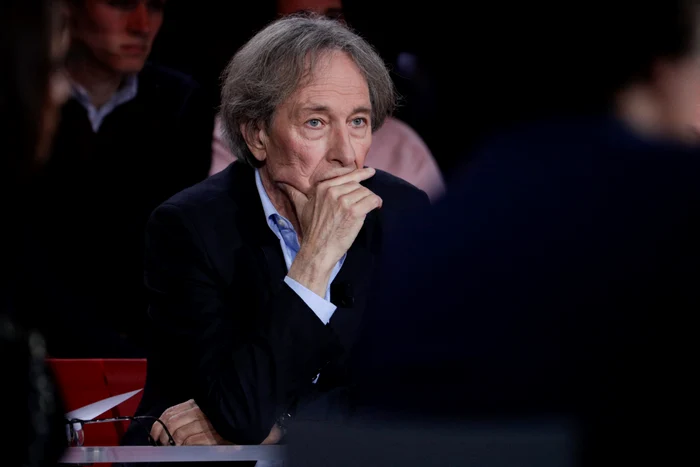
Pascal Bruckner, one of the greatest French writers PHOTO AFP
Is love an endangered species?
No, not at all. Love is reborn with each person, it’s a very complex feeling. Love will never disappear, not even in the midst of ruins. Love has an infinite power of rebirth. And this is actually the great message of Christianity.
The welcoming house of the Latins
You first came to Romania at the beginning of 1990. What is the strongest image you have from those days?
There are two images that marked me then. The first would be the poverty in Bucharest, people had fear in their eyes, they were afraid of a return of the communist regime. I also remember the old Trabant cars with the cardboard roof. And the second image from 1990 is related to the warmth of the Romanians, to their kindness, to the happiness due to the fact that they had overthrown Ceaușescu’s regime. And I prefer to keep this second image, of a smiling and very warm and open people. I come to Romania generally once every two years. And I still have this image of warm and open Romanians. It’s not like France, where people aren’t spontaneously warm. It is this Latin side of Romanians that I love a lot.
How did your impressions of Romania change after 1990?
Romania is doing a thousand times better compared to 1990. It is an immeasurable difference. In the countryside there are still traces of the past, such as horse-drawn carts, all the traditions and a certain degree of poverty. But Romania knows an explosion of inventiveness and creativity. There are many talented people in Romania. What is hard is the demographic decline; Romanians are having fewer and fewer children. And there are many Romanians who went to America, to France, to Germany. There are many very well trained Romanian doctors in France. And these Romanians should return. Romania must not lose its young people, it must do something so that they are tempted to stay, that is the big challenge.
A dream and a theater
A
writer and director Romanianuh
Chris Simeon,
led you to write plays as well. How has this change of register been for you in terms of writing?
It was extremely interesting. Thanks to Chris Simion I also wrote theater. I just finished a new play, it took me three years, because I wanted to improve it. It is a beautiful experience to write a play. And Chris Simion is a very dynamic and enthusiastic woman. Writing plays was a renewal of inspiration for me.
Bucharest will have the first private theater in Romania from scratch, also thanks to Chris Simion. How do you see this project and the fight them
to make this dream come true?
The Grivița 53 theater is still not ready, it must be completed by December according to the clauses of the European funding contract. What Chris Simion is doing is an act of courage all the more commendable coming from someone who is not a millionaire. And Chris Simion will make it, I think, because she’s fighting so hard.
