
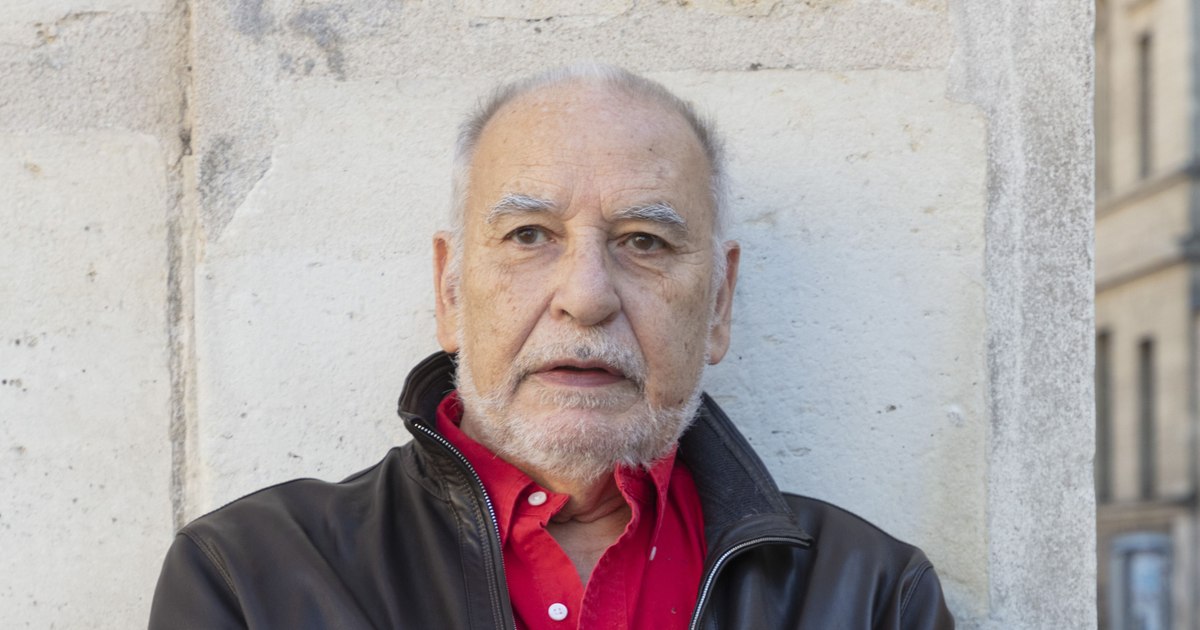
Tahar Ben Jelloun, one of the most famous French-language writers in the world, gave an exclusive interview to “Weekend Adevărul”. It is the first interview that the famous writer gives to a Romanian publication.
Writer Tahar Ben Jelloun PHOTO Publisher Gallimard/Francesca Mantovani
Passionate about philosophy, but also painting, Tahar Ben Jelloun (79 years old) still remains dedicated to writing – either novels, specialized works focused on racism and discrimination against women, or articles for various famous publications. About all this, the writer spoke for “Weekend Adevărul”, the first publication in Romania to which he gave an interview. Starting from his foundation, both Moroccan and French, and reaching his latest novel, “The Honey and the Bitter”, the translation of which appeared at Nemira Publishing House, the writer reveals to us the layers of his world, but also his fears, especially not to betray his passion for writing.
And the exclusive interview given by Tahar Ben Jelloun for “Weekend Adevărul” was a real treat full of dense and intense lines.
“Weekend Truth“: Between Morocco and France, you have known 1,001 lives: philosopher, poet, teacher, political opponent, journalist, psychotherapist, writer, literary juror – an impressive career. Which of these lives do you love the most?
Tahar Ben Jelloun:
I didn’t have many lives, but I can say that from the beginning curiosity helped me enormously to go beyond literature. At first I did journalism to have a source of income. Then I got a lot of taste for the media and constantly collaborated with different newspapers and websites. At the moment I have a column that appears every Monday on the Moroccan website 360.ma, I write two or three times a month in the Italian publication “La Repubblica” since 1989, and in France I write for the newspaper “Le Point”. The rest of my activities just came naturally. And I love all of these areas that you referenced in your question. Nowadays painting has become my professional activity which is as important as literature to me.
Between East and West
You were born in Fès, grew up in Morocco and moved to France. How have the two cultures influenced your writing?
To live with two cultures, two languages, two imaginary worlds is a wealth that I wish for any creator. It’s great to switch from one to the other and even mix them up. Which is why I feel happy and very good in my own skin.
How did work shape your multicultural journey?
My work has been strongly influenced by both worlds. When I write – and I only do it in French – Arabic words come out and I can’t find their French counterpart. Things are arranged the next day. I am Cartesian and Oriental at the same time. I go from Cartesian rigor to the surrealism of certain behaviors we have in Morocco.
Beyond the face
“The writer is not someone who isolates himself and closes the doors and windows.
(…) He is someone who lives in reality. I am a citizen, a writer and a citizen” you declared at one point. How would you describe your relationship with reality?
My relationship with reality is that of a discerning and curious observer. A writer is a witness of his era. The writer listens and is attentive to everything that happens, to everything that surrounds him. Obviously, in recent months I have been very concerned about what happened in Israel and then in Gaza. We analyzed how the horrors of 7 October – which we denounced without hesitation – were followed by disproportionate reprisals, war crimes and crimes against humanity, massacres against innocent people under the pretext of finding those responsible for the 7 October attacks. More than 40,000 dead, approximately 12,000 of whom were children, was not enough for the Israeli prime minister to quench his thirst for revenge. And a writer cannot remain indifferent to this catastrophe. The writer bears witness – writes, speaks, screams. I published in Italy a small volume entitled “L’Urlo” (trans. – “The Scream”) where I express my horror at everything that happened.
When you started the adventure of writing, you made it a profession of faith and said to yourself: “I write to have no face”. What interests you is the work, not your image. How have you managed to avoid narcissism in your books?
When I wrote that phrase I was about 20 years old, and until then I had only written a few small poems of no importance. But I assume this profession of faith: what is important is not the face, but what hides the face, it is not the image, but the work. At that time I had just discovered Guy Debord’s book “La société de spectacle” (trans. – “The Society of Spectacle”), and then the works of Roland Barthes and Beckett. Then there was that memorable meeting with Jean Genet in 1974, thanks to which I learned how to be humble, demanding and work rigorously.
In the book “The sacred night” is a phrase I like very much: “We can forget a face, but we cannot at all erase from our memory the warmth of an emotion, the sweetness of a gesture, the sound of a tender voice”. What is the strongest emotion in your memory?
Strongest emotion? There have been many strong emotions in my life so far. I would mention the meeting with Jean Genet in 1974, the Prize Goncourt won in 1987, as well as many other emotions related to readings – “Don Quixote”, “1001 nights”, “Pedro Paramo” by Juan Rulfo – or films – “Voyage à Tokyo” -, the discovery of Matisse and Giacometti, etc.
The classics, always in fashion
“I realize that every book, short or long, novel or essay, is a stone that is placed on top of other stones until,
at a given time,
it forms a house of words and doubts”, you wrote in the introduction to your works at the Quarto Publishing House. What does your house look like with words and doubts?
I hate people who have certainties. I have doubts and criticisms. I’m never satisfied with what I do. I’m afraid of not living up to it, I’m afraid of disappointing. I’m afraid of somehow betraying my passion for writing and friendship. I consider my books as so many stones that, I hope, will come to represent at some point a house just good to live in and dream of.
How do you view literature now versus how you used to a
look at the beginning of the literary career?
I always admired the classics. For me, there is nothing more modern than Cervantes’ Don Quixote. I had the chance not to fall into the trap of the “new novel”, an epiphenomenon that no one reads anymore. I have always looked at literature with curiosity. And this approach has not changed even now. Since I have been a member of the Académie Goncourt (2008), I have been reading a lot of novels. I see and follow the evolution of French and Francophone literature. And my interest is the same towards literature and I am very careful about Latin American writers.
“In Morocco, sexuality is practiced as long as you are discreet”
“Mierea si amarul”, your latest novel, published in Romania at the Nemira Publishing Houseis both gorgeous and earth-shattering. A novel that sheds light on the fact that sexuality continues to be a taboo subject in Moroccan society, as are extramarital relationships. Why in the 21st century maand
are there enough countries where sexuality is still a taboo subject? What is there to do?
I wrote “Honey and Bitter” because I witnessed the drama of a family I knew. A pedophile criminal attacked a 15-year-old girl. Trauma, silence, shame, guilt and then suicide. Today, the word has been released, but there will always be victims who will die with their secret, who will remain silent after being rape victims. In Morocco, sexuality is more or less taboo, as in most Muslim countries. In reality, sexuality is practiced as long as you are discreet. It must be said that the novel and the positions taken by intellectuals in the mass media, especially by women in civil society, make morals evolve, but not legislation. Two articles of the law prohibit premarital sex and homosexuality. They are anachronistic articles of law that do not correspond to reality. And activists are constantly calling for the repeal of these two articles.
Samia’s drama,
the main character in the novel,
it is the drama of all young girls crushed by sexual assaults, but also by silence and by the conventions of a society that does not at all recognize the individual as an integral part. Why are there still quite a few countries in the Middle Ages in mentality regarding women’s rights?
Morocco is preparing a new Moudawana, a new family code. This new code will be especially dedicated to the condition of women and their rights. And the Islamists, being aware of what is being prepared, constantly show their disagreement with the rights granted to women. Islamists are angry and true to their conservative and retrograde characteristic. Things change and mindsets try to follow the evolution of society. Not everything is perfect, but King Mohammed VI has contributed enormously to this change that restores women’s rights and dignity. Samia’s drama is not an isolated one, but associations for women’s rights and respect continue to fight against aggressions and crimes. Sometimes justice is responsive, sometimes justice is lax. Morocco is on its way to becoming a country where these crimes and sexual assaults against women will be punished.
Resume
Doctor in social psychiatry
Name:
Tahar Ben Jelloun
Date
and place of birth:
December 1, 1944, Fez, Morocco
Studies and career:
He studied Philosophy at the “Mohammed V” University in Rabat, where he wrote his first poems. Then he was a professor of Philosophy.
In 1971 he went to France, where he studied Psychology. Four years later, he obtained a doctorate in social psychiatry.
In 1972 he started publishing for “Le Monde”.
In 1985 he published the novel “L’Enfant de sable” (“The child of sand”) which made him famous.
Two years later he receives the prestigious Goncourt prize for “La Nuit sacrée” (“The Sacred Night”), becoming the first Maghreb writer to be awarded this distinction.
He has written several pedagogical works, such as “Racism explained to my daughter” and “Islam explained to children”, and is regularly requested for interventions in Moroccan and European schools and universities.
He founded La nave di Teseo Publishing House in Milan, together with Umberto Eco.
livesis in:
Paris, France
