

“Would you have the courage to leave yourself in the hands of a professional who went through college the way you are?” – is the question raised by the Law and Public Administration Students’ Club, in a video clip posted on Facebook, made to draw attention to the responsibility that those who choose such a field have. And not just lawyers or magistrates, but also lawyers or civil servants. In an interview for “Adevărul”, Mario Claudiu Chirica, the student who started the clip, talked about exam fraud and the long-term impact.
The clip-manifest posted on the networks
“Honest question: Would you have the courage to leave yourself in the hands of a professional who went through college like you? If the answer is hesitant, you need to admit that you have a problem. But if you’re in Law or Public Administration, we all have a problem. That’s because lawyers are the architects of modern society. (…) If a jurist makes a mistake, the whole society suffers. That is why cheating on exams is unacceptable. Our preparation directly dictates the quality of the society in which we live” – said Mario Claudiu Chirica, the president of the Club of Law and Public Administration Students, in the clip posted on the association’s page.
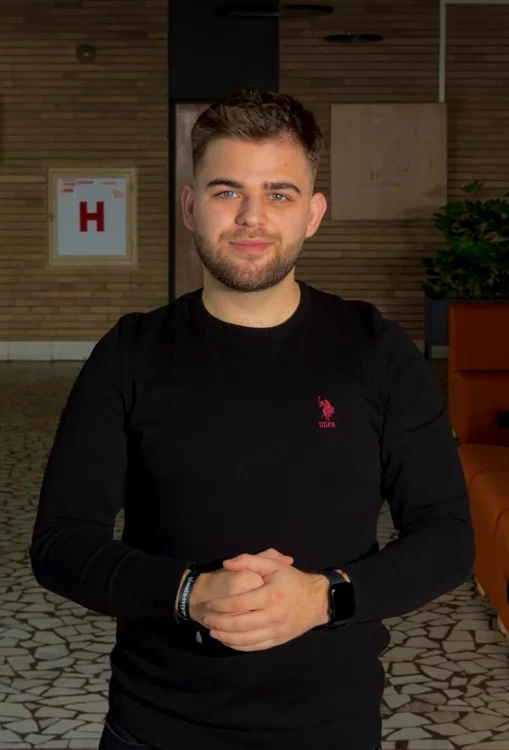
The young man is a third-year law student at the “Lower Danube” University in Galati, and he dreams of a Romania where professionals do their work with integrity, in the service of the citizen.
“The foundation of integrity is poured into the session”
The truth: How did you decide, within the student organization, to approach the subject of exam cheating?
Mario Claudiu Chirica: We decided to address the topic of exam cheating when we designed the campaign to promote students’ rights and obligations. While thinking about future campaign posts, I realized that sometimes in our work to represent students in our college, we end up putting a lot of emphasis on rights, while obligations are left as a footnote in most such campaigns from various university centers. I specifically chose the topic of cheating in exams because it is the student’s fundamental obligation. If we skip the learning stage, we hijack the very idea of training future professionals.
I wanted to remind the students of “Dănărea de Jos” University in Galati and my colleagues that a society cannot be repaired only with good laws, but with trained and honest people who apply them. The foundation of integrity is now being poured into the session.
Is copying still a phenomenon?
I believe there are enough mentions of this “shortcut” culture online that I believe the phenomenon still exists, and I believe it’s not an isolated one, but a national one. This is especially exacerbated by the emergence of various artificial intelligence models, which can provide answers in real time, unlike the classic “kids” that required time and effort to prepare, and even there there were chances to remember something at the end.
“The world is becoming desensitized to fraud situations and they see them as a normal part of the course of society”
What happens when we are not talking about exams, but about undergraduate papers?
In the case of undergraduate theses, as far as I know from my colleagues from older years, the process is very carefully monitored, starting from the choice of the topic and ending with the presentation, being multiple intermediate steps and checks to ensure the coordinating professors that the papers will be ready on time and that they comply with the requirements. We know of the existence of those services that offer to write undergraduate theses, but the timetable imposed by professors means that sneaking in an unoriginal paper involves more effort than if you were to write on your own and with the help of teachers.
Do you think that the example of politicians/people from the university environment who are found to have plagiarized in their doctoral theses causes young people not to resort to such methods or, on the contrary, they are shown that it is also possible?
I believe that with the volume of such cases that have been shown to us recently, the world is desensitized to fraud situations and they see them as a normal part of the course of society. Thus, the efforts may end up in the area of ”how do I hide better” rather than putting in the work required to write these PhD papers.
In the clip, you were talking about the strategic importance of Law professionals in society. Do you think young people realize the huge responsibility when they choose such a field? What is your advice for those who want to attend law school?
I think that the majority of students who decide to study Law are not aware, at the time of their choice, of the responsibility that this field entails, a situation in which I found myself at the beginning of the journey, too. From what I have observed, there are many who choose this major with the financial side in mind as a priority, being encouraged by the amount of money that can be earned following a legal profession. My advice to those who want to go to law school is to look for ways to get as close to the field as possible, either through volunteering or through people who are already in the profession or who are students in college, so that they can see for themselves if it is something they could do for a lifetime. Including us, through the Law and Public Administration Students’ Club, we are considering organizing a campaign to promote our faculty’s specializations not from the perspective of attracting as many students as possible, but to present them with what it entails, with good and bad, so that when they choose their faculty they can make an informed decision.
“If lawyers and civil servants did their job as per the book, Romania would become, first of all, a predictable country for citizens”
Public Administration can be perceived as an area where after college you get a well-paid and secure job in the state. How harmful is this mindset and how should the field actually be viewed?
I believe that financial security and working conditions within state institutions are some of the main attractions for anyone aiming for a career in public administration, and that is not necessarily a wrong thing. The problem is that it is not far from the perspective in which some believe that, once they have reached a position in an institution, there is nothing that can affect their job, while their performance and their adaptability to the trends of society should be constantly measured. Moreover, the preparation of Public Administration students is at least as important, given the risk that lack of preparation creates institutional bottlenecks, which is associated with wasted time and money.
How could Romania look like if the majority of professionals in Law and Public Administration did their work by the book?
If lawyers and civil servants did their job as per the book, Romania would become, first of all, a predictable country for citizens. They would know that the law is the law, and the files do not end up gathering dust in the halls of the courts. Even if the change does not come overnight, a solid body of integrity professionals in Law and Public Administration would restore the most important thing that we lack today: the citizen’s trust in the state. This would be the foundation stone for a modern Romania.
