
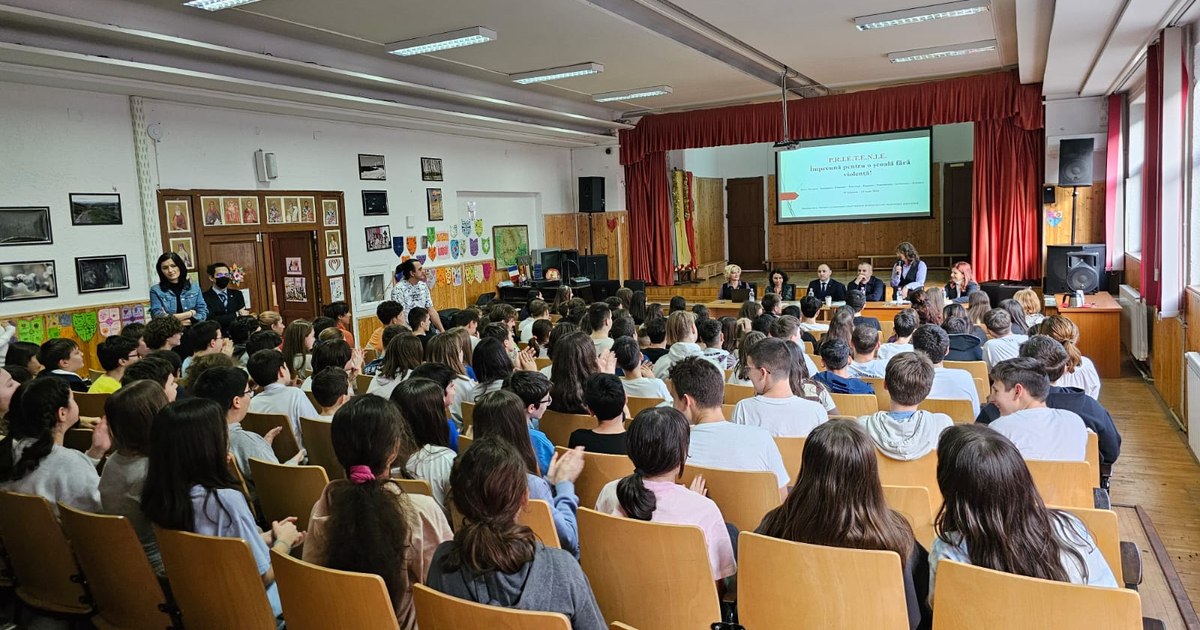
The bad relationship with the teachers, but also the dissatisfaction with the living conditions in Romania and the bullying causes the students to go to study abroad. 55.1% of children want to attend school abroad. These are the data obtained following a study carried out this fall by the Save the Children Organization.
Romanian students want to study abroad. Photo source: Archive
Alexandra Bădescu, general director of Integrare Edu, one of the most important educational consultants in Romania, stated for “Adevărul” that, indeed, in recent years she has noticed an increasingly pronounced trend not only among students, but and among high school students to study abroad.
One out of three Romanian students would like to study abroad, because they no longer trust that the school in Romania prepares them for the future, we learn from the “Save the Children” report. The reason? Students find that the school schedule is too busy and leaves them no time to relax and develop their passions. For this reason, school has become a real chore for many, a place where they come bored, bored, uninterested and without any calling. Many of them go to school out of obligation, not pleasure, and show up to class to say they went somewhere and came back from somewhere.
School, like a nail in the sole
But what are they left with after finishing their studies? With nothing else! And this for Romanian students, says the Save the Children Organization, they are extremely unhappy at school. The conclusion comes from a survey conducted on a sample of 4,500 middle school and high school children. According to the data obtained, it seems that as children get older, their happiness at school decreases, while indifference and tension increase. Thus, if 82% of primary school students declared themselves happy at school, the percentage fell below 70% in the case of high school students. Strain increased from 6% in grades I-IV to 16% among teenagers.
Bullying and the relationship between students and teachers were also mentioned as major problems in the Save the Children survey. Thus, 5% of students said that they are beaten by teachers, 22% that they are offended and 76% that they are scolded when they make a mistake. The problem of bullying in schools in Romania was reported by almost 82% of students, who say they witnessed bullying situations, while 28% frequently witnessed such episodes.
This is the context in which Romanian students want to leave the Romanian education system and study in schools abroad. And, it seems, they are not few at all. “There are two big categories of children who go to study abroad: those whose family moves temporarily or permanently to another country and those who enter a boarding school education system. Access, specifically, those boarding schools,” explained for “Adevărul” “Alexandra Bădescu, general director of Integrare Edu. “The schools in Great Britain that Romanian high school students go to are international schools, whose students come 100% from abroad, but also mixed, where both British students and students from other countries study. We recommend that children who ask us for advice go to mixed education units so that the integration happens more smoothly, more easily”, continues the specialist.
The COVID pandemic, a springboard to “outside” education
The desire of Romanian students to study abroad is a phenomenon that developed slowly, with small but determined steps, since 2008. However, this trend would explode with the COVID pandemic. “The isolation in which we lived during that period contributed to making some radical decisions in the heart of many families. Parents and children then realized that the Romanian school moved online could be successfully replaced with a boarding school education”. Thus, the child was withdrawn from mainstream Romanian education and enrolled in a boarding college abroad that offered at least two great advantages: a safe environment for health, but also a more selective education. “Students enrolled in boarding schools all learn and live on that campus in a very safe environment, and the teachers are also there with them. During the pandemic, they were isolated as in a huge glass globe, a small closed city where they ate book on bread”, continues the expert. But even after the COVID period, the number of Romanian students remained high. With the mention that the destinations have diversified. “BREXIT has contributed to widening the search horizon, and now schools from Spain, Ireland and America are also attractive”, Alexandra Bădescu also specified.
The high school students who go to study abroad come either from among the students entering the 9th grade or from the 11th grade. “They will take the Baccalaureate in the respective countries, and the exam will be equivalent in Romania. However, this matriculation exam completed there opens a lot of doors for them. Because children’s education does not stop here. They enroll in college there, in the country where they attended college. This is also the purpose of studying abroad: to have easier access to the biggest universities in the world”.
Romanian education, stuck in outdated paradigms
Why do high school students want to leave? Because, says Alexandra Bădescu, education in America, Great Britain or other countries of the world offers them what Romania has not been able to do so far. “The educational part matters a lot. Then the environment in which they learn, the extracurricular activities offered by those education systems. Because many skills cannot be acquired in school. And then we need an addition, a surplus that on the one hand facilitates the exploration of fields of study, on the other hand encourages the vocation. The educational system there helps you a lot to develop and deal with the new situations you encounter in life”. In schools abroad there is no concept of “dumb”, memorizing information, there this information is delivered through practical methods. The child learns by actually doing something with his hand. Among the Romanian students who drop out of the Romanian education system are many Olympians and athletes. “Many of them receive scholarships from the colleges they are attending or receive certain tuition discounts. Some are given academic scholarships, others sports or artistic scholarships”.
How much does it cost to study abroad?
However, this opportunity is not within everyone’s reach and pocket because tuition costs a lot, “But no more than a private school in Romania”, explains Alexandra Bădescu. “We are really talking about powerful families from a financial point of view and about students who come mainly from the big cities of the country: Bucharest, Iasi, Constanța, Timișoara, Cluj”.
Regarding tuition fees for colleges in the UK, for example, they start at 12,000 pounds per year, but in total the sums of money required are much higher. “ITto this money are added the expenses for accommodation, food, health insurance, etc. We’re talking about an extra £10,000. But, although it seems like a large amount, private high schools in Romania are even more expensive”, says Alexandra Bădescu.
But not only money matters, but also the level of training of the children. “Places are limited, competition is very high. That is why we prepare the children from all points of view. We test them to find out what each one’s level is, and then, based on the results, tell them where they should push in the preparation process. We help them make their portfolio, if they are asked, but also the entire admission file, we teach them how to present themselves at the interview, because they will go through the selection process and through an interview. We also offer them certain scholarships, in partnership with the colleges where they want to enroll”, Alexandra Bădescu explains the procedure.
The director of Integrare Edu told us that many of these children, after finishing college and university abroad, choose to return to the country and look for a job here. “We have, for example, a former student who attended courses at Oxford University, and then returned to Romania and now works in Fundeni hospital“, the specialist also told us. These young people choose, practically, to return in the middle of a system that has done nothing for them for years.
