
A businessman as fond of silver as he is pious, always attending the Holy Liturgy on Sundays, Gigi Becali, 66, the patron of the FCSB football team, is thinking about the Hereafter from now on.
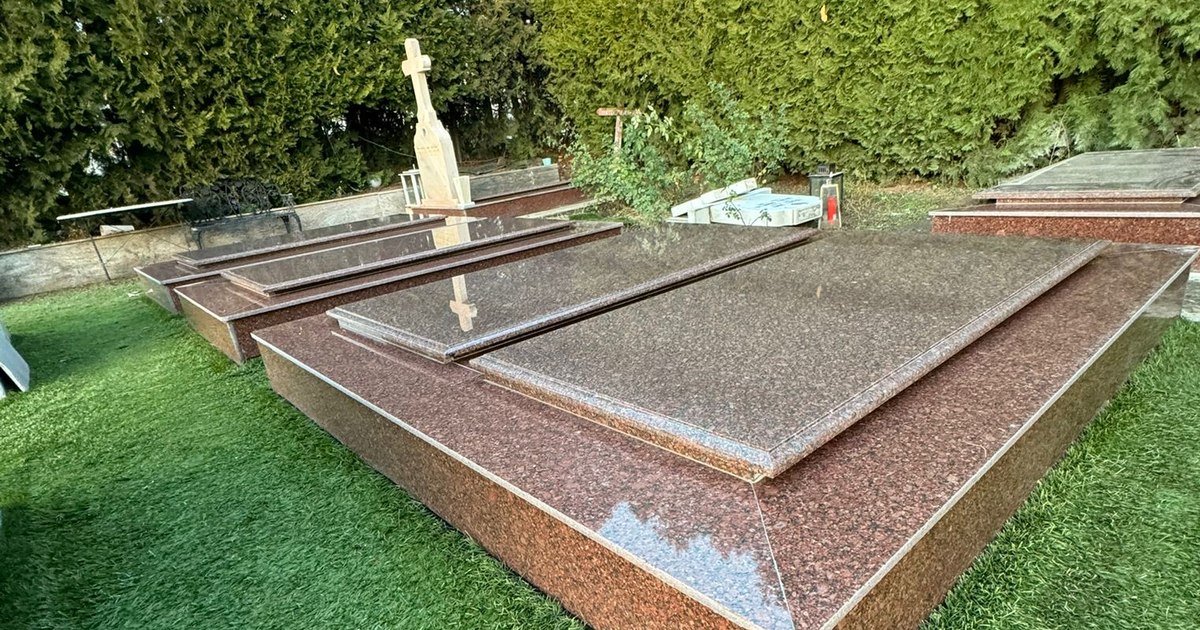
The grounds of the Gigi Becali family have artificial turf among them PHOTO Adevărul
He also wants to have eternal rest in Pipera, the place where his family settled after the great deportation to Bărăgan (the recent Pentecost marked 73 years since that mega-displacement).
The football world recently passed through the Sfântu Ilie Cemetery in Voluntari, at the grave of Didi Prodan, from whose disappearance 8 years have passed on Saturday.
Two huge crosses
The road to the place where “Tătuca” is buried passes by a plot of land belonging to the Becali family. Two huge crosses “guard” 6 crypts.
The area looks like a mausoleum, with the mention that it is not erected in memory of any illustrious personage, but has significance exclusively for the Becali family.
One cross is dedicated to the memory of the parents (mother Alexandra is alive, and his father, Anastase, died in 1989), and on the other the other dead from the Becali family are crossed.
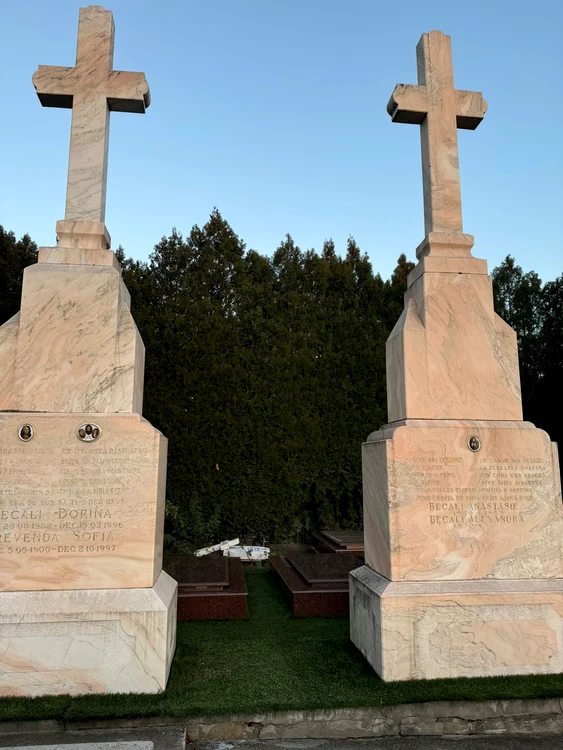
The huge crosses at the entrance PHOTO The truth
New graves appeared on the burial places of the Becali family, and the old crosses were taken down. The novelty is the artificial turf installed between the cables.
While at other graves pebbles are used to stop the growth of weeds, Becali chose to lay artificial turf brought from the training base in Berceni.
The gesture can be interpreted as a sign of the covenant he made with football since his lifetime.
How the Becali family got to the outskirts of Bucharest
In 1952, the name Becali was mixed among the 12,971 families, equivalent to 40,320 people aged up to 90, living in 258 localities located near the border with Yugoslavia.
By order of the state leadership at that time, they were all taken upstairs and made to endure the drama of deportation to the Bărăganu plain.
It was a mass action of the communist regime, which consisted in the relocation of the population from the border with Yugoslavia, Timiș, Caraș-Severin and Mehedinți counties, as a result of the conflict that broke out between Joseph Stalin and the communist leader from Belgrade, Iosp Broz Tito.
This was followed by the sentencing to hard labor of citizens considered by the regime to be “enemies”.
73 years ago, on the day of Pentecost, people were loaded into freight wagons intended for cattle and taken by force to the heat of Bărăganu.
18 villages were born, after they were given a patch of land, two doors and two windows each. People built adobe houses, basically thatched huts, and were forced to work on farms. The Becali family, Gigi’s parents, lived there.
The tragedies of deportation
The shock of displacement was strong. In the period 1951-1956, as long as the forced residence in Bărăgan lasted, more than 1,700 people died, including 174 children.
In the memoirs of a survivor, Maria Anghel Ciungulescu, stories about the Becali family appear.
“Macedonians were great lovers of animals, especially horses. They knew many horse owners, but they had made friends with people from Olten, as neighbors on the street, with whom they went on various daring actions in the fight for survival, on the GAS Brateș grounds.
On the 7th street (no – the streets had no names, only numbers) the Becali family, coming from Săcălaz, stood out.
Gigi’s son, who became famous after 1990, in memory of those times, sponsored the modernization of the “Holy Great Martyr George and Dormition of the Virgin Mary” church in Frumușița, re-consecrated on September 2, 20212“, reveals the unpublished memories of Maria Anghel Ciungulescu.
“After a new resistance in the period 1958-1962, those from Dâlga are allowed to move to the villages of Tunari, Pipera and Pantelimon, near Bucharest. The settlement of Macedonian sheep near the Capital was of great importance, because they provided food resources of meat and dairy products for the people of Bucharest“, writes Maria, currently settled in Giurgiu.
After the release from the camp, before arriving in Pipera, the Becali family moved to Zagna Vădeni, where Gigi Becali was born on June 25, 1958.
