
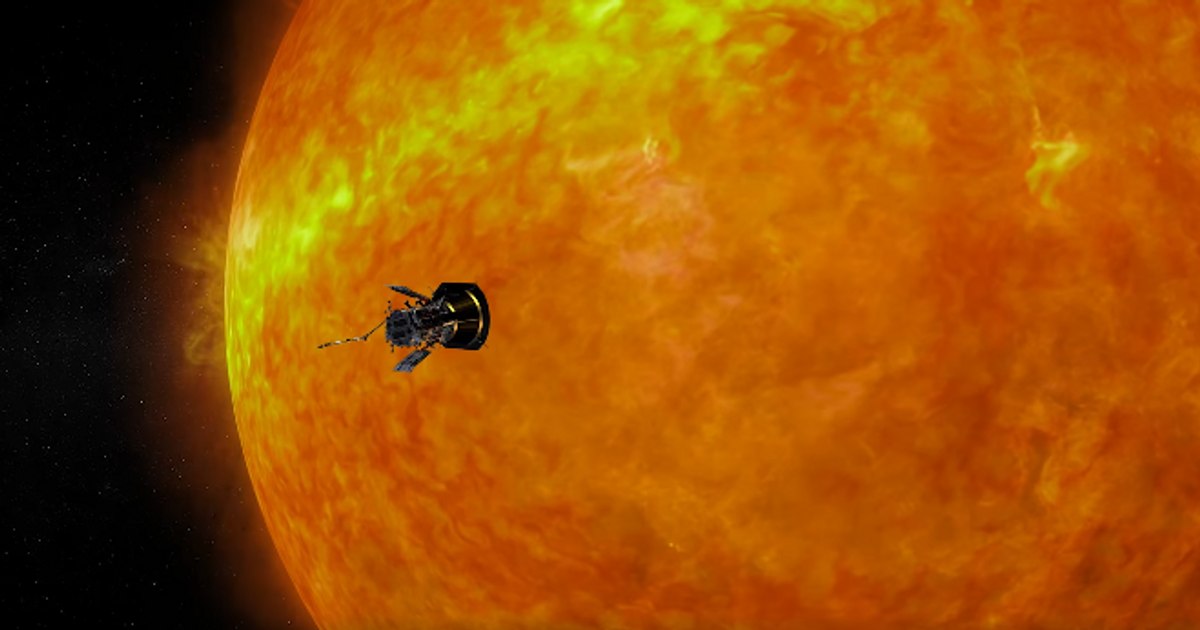
NASA’s Parker probe has reported that it is safe and functioning normally after marking a historic moment by reaching the closest distance to the Sun ever reached by a spacecraft.
The closest approach to the sun record was achieved on December 24, and the message from the Parker probe was received on Earth during the night of December 26-27.
“Parker Solar Probe called home! After passing just 3.8 million miles from the Sun’s surface on December 24 – the closest solar flyby in history – we received the signal from the Parker Solar Probe confirming that the spacecraft was safe“, announced on Facebook, NASA Sun Science.
Following its record approach to the Sun, NASA’s Parker Solar Probe sent a signal to Earth indicating that “she is healthy and functioning normally”.
“The mission operations team at the Johns Hopkins Applied Physics Laboratory (APL) in Laurel, Maryland received the signal shortly before midnight EST on the night of December 26. The team was not in contact with the spacecraft during its closest approach (closest to the Sun), which occurred on December 24, with the Parker Solar Probe traveling just 3.8 million miles from the Sun’s surface, with a speed of about 430,000 miles per hour,” notes blogs.nasa.gov.
Scientists want to understand how it gets to millions of degrees and trace the origin of the solar wind
The Parker Solar Probe was developed as part of NASA’s Living With a Star program to explore aspects of the Sun-Earth system that directly affect life and society.
NASA’s Parker probe has reached its closest distance to the Sun. PHOTO captured by NASA Sun Science
From January 1, the Parker probe is expected to send detailed telemetry data on its status.
“This close-up study of the Sun allows the Parker Solar Probe to make measurements that help scientists better understand how material in this region is heated to millions of degrees, trace the origin of the solar wind (a continuous flow of material escaping from the Sun) and discover how energetic particles are accelerated to near the speed of light. Previous approaches have helped scientists pinpoint the origin of structures in the solar wind and map the outer boundary of the solar atmosphere.” the cited source also shows.
The Living With a Star program is managed by Goddard Space Flight Center in Greenbelt, Maryland, for NASA’s Science Mission Directorate in Washington.
The probe was designed and built by the Applied Physics Laboratory (PLA) which operates it and manages the mission for NASA.
