
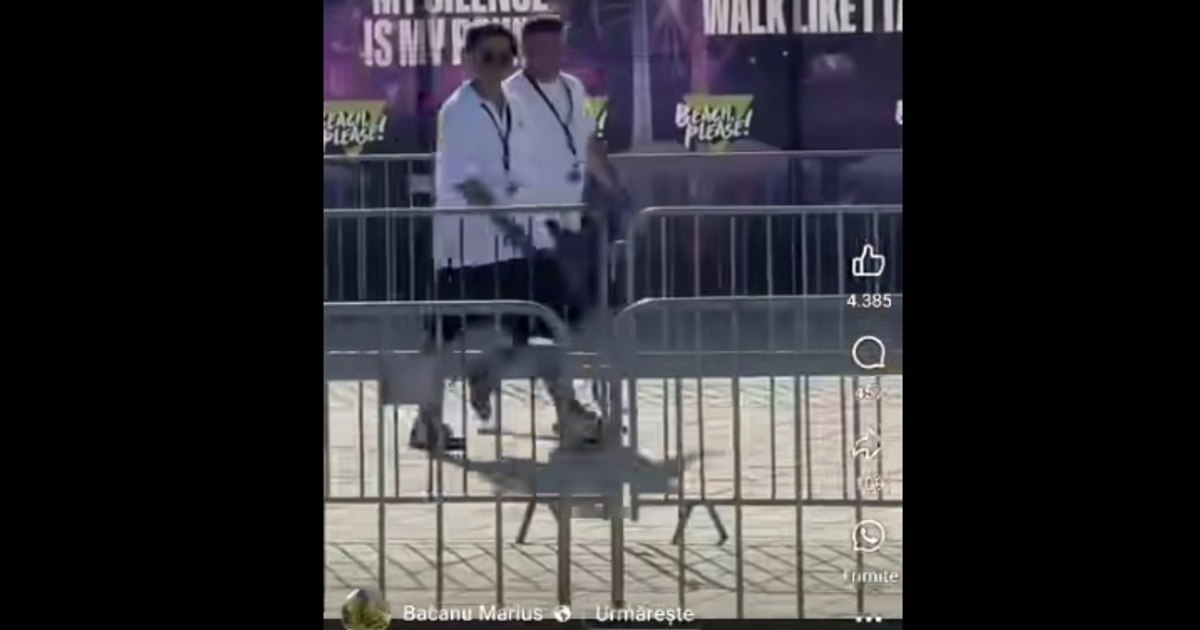
The Pro-Ceausescu scandals at the “Beach, Plese!” Festival! It reflects a dangerous wave of totalitarian nostalgia, even if the organizers invoke a joke, the historian Cosmin Popa draws attention.
A group of young people chanted “Ceausescu, Ceausescu!” At the sight of Selly Photo: ICCMER video capture
The Institute for the Investigation of the Crimes of Communism and the memory of the Romanian exile (IICCMER) reacted, on Sunday, after the appearance of video images in which a group of participants in the festival “Beach!” He chanted “Ceausescu! Ceausescu!” At the sight of Selly (Andrei Şelaru), the organizer of the festival. “It was a joke” could explain the young people, not an act of tribute to the former communist dictator, knowing that Selly is nicknamed the “dictator”, his explanation being that he received this nickname for the efficiency with which he organizes things. The reality is, however, that the Romanian society is facing a wave of totalitarian nostalgia, and on this land the destabilization movements are easy to implement.
“The Ceausist nostalgia spreads directly in proportion to the increase of the degree of ignorance”
The history of communism will be studied, even this fall, in the 12th grade in high school. But is it enough? Can this change this “trend”? I asked this question to the historian Cosmin Popa, a researcher at the “Nicolae Iorga” Institute of History of the Romanian Academy, specialized in the history of the Soviet Union and European Communism
“Sure it will change. But the effects will not be as fast as we would like to have them, because already, the evil has been done. And you know you, as well as me, that this, totalitarian nostalgia spreads directly in proportion to the increase of the degree of historical ignorance and beyond. So, from this point of view, of course it will change the introduction of the history of communism. Many things depend on teachers, they also depend on children as many, if not more, but I think urgent measures must be taken to reduce this wave of totalitarian nostalgia, or for the simple reason that it represents, in fact, an ideal vehicle for destabilizing the democracy in Romania that they undertake various state actors and non-state actors.draws attention to the historian.
The fact that I heard, at such a big festival, chanting the name of a dictator to which decades of suffering are related to Romanians is a symptom, stresses the historian.
“Certainly, those young people who chanted “Ceausescu! Ceausescu!” They will say, and I am not far from the truth, that it was an innocent joke. I think it must be seen to what extent the campaign to promote this festival, and its organizers, has been based on the instrumentalization of this totalitarian nostalgia. Of course it would be unfair to account for the organizers at Beach, please! As for what is happening in Romania. They are also part of what is happening, as are part of what is happening and the Ministry of Education, schools, inspectorates and each of us and the whole society. What happened in Constanța now is just a symptom. It must be identified, it must be marked, but we must understand that things are much more serious than that ”, added the historian.
The approach to introduce in the high school program the discipline “History of communism”, at an age at which the character and beliefs of young people are already formed, cannot solve the problem. It is necessary to involve political decision -makers, academic institutions, artists and those who enjoy influence in society, so that a movement of calming the totalitarian nostalgia that are directly related to the destabilization action, explains the historian.
“They are not accidental. That’s how things happened in Russia. They started with sentimental evocations of the Soviet past, continued with films, books and television shows that showed us how good the communists, the securityists were, and how harmful were the agents of imperialism and of course they ended by establishing a regime. And things will definitely happen in Romania if there are not very clear and very radical measures ””Cosmin Popa believes.
“Nicolae Ceausescu was the one who kept his parents and grandparents in hunger and atrocious shortcomings”
I asked the researcher Cosmin Popa who would respond to a 13-year-old teenager who would like to know who Nicolae Ceausescu was. “I would start by saying that Nicolae Ceausescu was the one who kept his parents and grandparents in hunger and atrocious shortcomings and missing each of the Romanians of minimal freedom. from Romania. the historian replied.
The worst reaction at this time would be to condemn them in corpore And to catalog the young people from “Beach, please!”, Popa added, when in fact it would be to understand why these things happen and what we have to do in the short term and medium term. Consolidating the foundations of democracy among young people and the active population should be emergency.
“We have a general education problem”
“You can make Romania a functional and morally organized state and then some of these problems will disappear by itself ”shows the historian. Cosmin Popa gives the example of educated countries, in which Russian propaganda does not have the expected effect.
“No one asks the question why the totalitarian propaganda, or the propaganda of the Kremlin, are not effective in very educated countries, such as the northern ones, in which the emphasis is placed on media education, on the critical spirit, on the practical skills and so on. So we have on the merits not a problem of reconstruction of the historical memory through false testimonies related to the past, from the Romanian families. We have a general education problem. And on this fund of general precarity in certain social layers it is very easy to promote so current ”, said Cosmin Popa.
The historian emphasizes that after 1990 the Romanian politicians did not discuss very seriously about the communist inheritance in Romania, which made the space of ideas left available to those who express themselves very simply and intelligible to people in general too little interested in history, but also to those who propagate their ideas using the entertainment mask.
“In fact, the problem is a structural one, that Romania has refused to have a communism’s memory policy. And the result is exactly this one we see today ”concluded the historian.
