
Analyst Hari Bucur Marcu analyzes the prospect of organizing a referendum to amend the Constitution to prohibit the CCR from ruling on magistrates’ incomes. He believes there are at least two simple ways to avoid potential abuses of CCR.
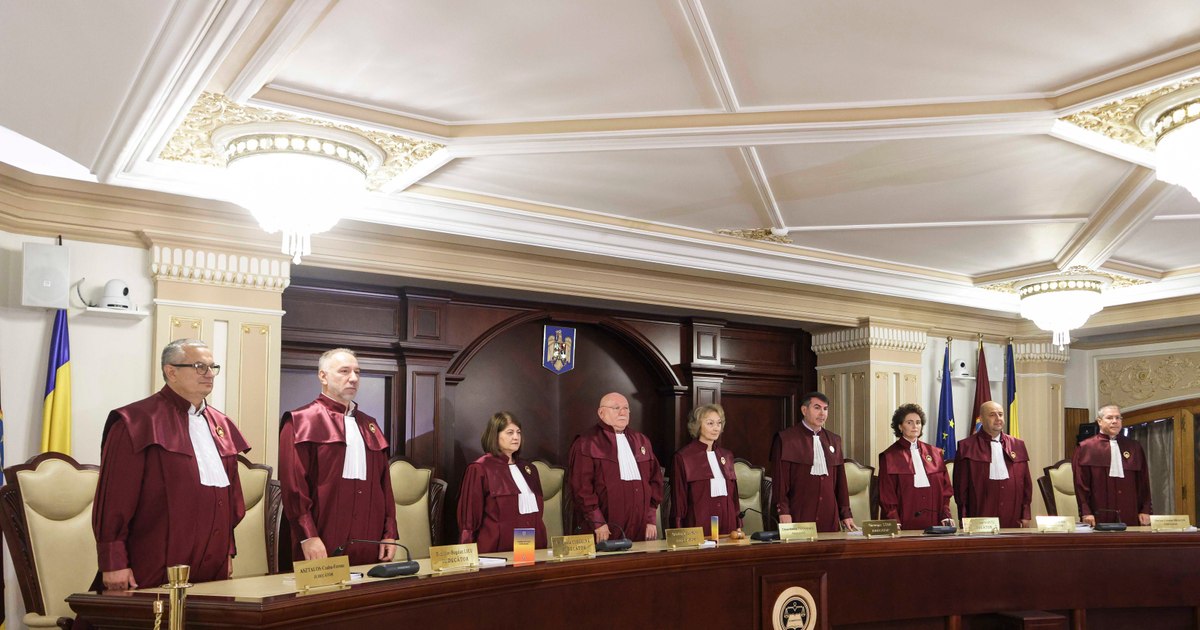
The CCR will rule again on the reform of magistrates’ incomes. PHOTO: Inquam Photos
Hari Bucur-Marcu, expert in defense and security policies, former member of the General Staff of the Army and representative of Romania in NATO structures (decorated with the National Order “For Merit” in recognition of his contribution to Romania’s integration into NATO) claims that there are simpler solutions, which would not cost tens of millions of euros and would put us in front of the unknown, than organizing a referendum to solve CCR problems related to magistrates’ pensions.
“A respectable professor of political science, with European parliamentary experience, insists on a complicated solution, to avoid the Constitutional Court of Romania (CCR) ruling in the future in matters of magistrates’ pensions. His lordship’s proposal would be to amend the Romanian Constitution, which would expressly provide that the CCR does not rule on the incomes of magistrates, be they salaries, allowances or pensions”. Bucur Marcu begins his post.
Such a proposal is complicated, he says, because the revision of the Romanian Constitution can be initiated:
– by the President of Romania at the proposal of the Government,
– of at least one fourth of the number of deputies or senators, as well as
– of at least 500,000 citizens with the right to vote. In this case, the citizens who initiate the revision of the Constitution must come from at least half of the country’s counties, and in each of these counties or in the city of Bucharest, at least 20,000 signatures must be registered in support of this initiative.
A referendum costs tens of millions of euros
“Accordingly, the revision project or proposal must be adopted by the Chamber of Deputies and the Senate, with a majority of at least two-thirds of the number of members of each Chamber, or in a joint session, with the vote of at least three-fourths of the number of senators and deputies. And then the revision must be submitted to the referendum held no later than 30 days from the date of approval. If the President is late in calling the referendum approving the revision of the Constitution, or if The government hesitates to organize the referendum – say, for example, that it does not have money (a referendum costs tens of millions of euros) and thus exceeds the constitutional period of 30 days, the process of revising the Constitution should be restarted from the beginning. This is what the Constitution itself says (Articles 150 and 151), which does not want to be revised too easilye”, explains the analyst.
In addition, there is a need for organizational effort, a political will and an exceptional presidential, parliamentary and executive discipline, but also about an enormous expense, so that in comparison the pensions and incomes of the magistrates in office seem minor expenses. The family referendum organized in 2018 cost, for example, 35 million euros.
“It’s better to spend a few tens of millions on retired magistrates, than several tens of millions on organizing a referendum to amend the Constitution, which we don’t even know what the result would be, as the referendum can be easily invalidated by not showing up to vote“, says Bucur Marcu.
“CCR cannot decide or decide on any matter belonging to the authorities exercising legislative, executive and judicial powers”
The analyst says that it is easy to see that the CCR does not even have specific powers for the holders of state powers (legislative, executive and judicial), so it cannot decide or rule (the CCR law distinguishes between these two types of actions of the Court) in any matter belonging to the authorities exercising these three powers.
“In addition, the law expressly forbids the Constitutional Court to modify at least one comma, in a legal text subject to the guarantee of the supremacy of the Constitution. The same is valid for other acts on which the CCR can rule only in matters of constitutionality. Nor in the matter of law or judicial power can the CCR only rule within its attributions and without intervening in any way to modify the decisions of the courts of justice or the courts of law“, says the specialist.
Moreover, says the analyst, the CCR is not a court of justice, it is not a public authority (the public authorities mentioned in the Constitution are the Parliament, the President, the Government, the Public Administration, the Judiciary and that’s all) and it does not hold any of the state’s powers.
What happens to the CCR decisions taken outside the powers defined by the Constitution?
“From this perspective, all decisions and judgments of the CCR outside of its attributions clearly defined by the Constitution and the reference law are void in law and in fact“, he emphasizes.
But what happens to the abuses of power of the Constitutional Court and the usurpation of official functions committed by the CCR judges, when they pronounce, decide or rule in matters for which the CCR has no powers and consequently cannot even arrogate powers (the only powers of the CCR are those arising from the constitutional and legal powers)?
“In the most severe form, such abuses of power and usurpation of authority should be referred to the High Court of Cassation and Justice, through the General Prosecutor’s Office,” the analyst believesl. This, he admits, will never happen because “CCR courtiers take care to abuse and usurp official qualities of authority in favor of or for the benefit of magistrates in general and especially magistrates (judges and prosecutors) from the ÎCCJ”, explains the analyst.
Two solutions cheaper than a referendum
And then? Two things can happen, much cheaper than a referendum to revise the Constitution, to keep the CCR judges (who are not magistrates) within the Court’s powers, Hari Bucur Marcu opines:
“1. The Government does not publish in the Official Gazette of Romania the judgment or decision of the CCR that it considers to have been taken outside the legal powers and powers of the CCR.
And without publication in the Monitor, those decisions and rulings do not even exist. In fact, if you look at the Official Gazette, you will discover there decisions and rulings of the CCR that are published with a delay of many months, for unclear reasons.
2. Those who are supposed to do something following a decision or ruling of the CCR, which they consider to be outside the constitutional and legal powers and powers of the CCR, simply ignore it, even though it, the decision or the decision is generally binding.
Here we should remind you that there is no criminal or civil sanction for non-compliance and non-execution of the decisions and rulings of the Constitutional Court of Romania. Unlike court decisions, the non-compliance of which is punishable by Article 287 – Non-compliance with court decisions, from the Penal Code, with imprisonment or a criminal fine”.
Bucur Marcu admits that the non-publication in the Official Monitor or the indefinite postponement of compliance with the decisions and rulings of the Constitutional Court does not mean any definitive solution, in any constitutional case. “On the other hand, such an attitude on the part of the public authorities, possessing state powers, can lead to a public debate, from which the illegal and unconstitutional nature of the decision or ruling of the Constitutional Court can result, as well as oblige the competent authorities to self-report the criminal aspects of the acts of the constitutional courts, if necessary”the analyst also pointed out.
The conclusion of Hari Bucur Marwith: “Such a solution by activating a public debate is infinitely cheaper than paying for privileges obtained through abuse of office in the judiciary, to say nothing of the costs of a referendum on the revision of the Constitution, just to tell the constitutional courts what they cannot decide about their “colleagues” magistrates.”
