
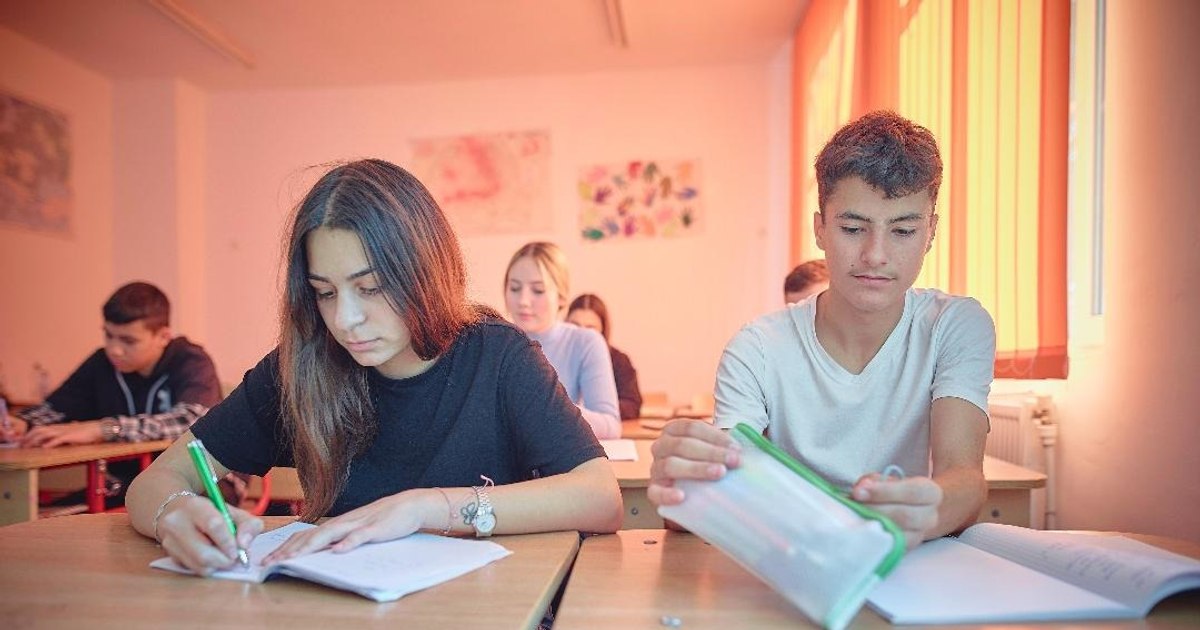
Baccalaureate 2024, autumn session. In the Romanian Language, the students from the real had to write an essay in which they present the particularities of a poetic text. They had to choose between Mihai Eminescu and George Bacovia. “Poetry is not within everyone’s reach,” Romanian language teacher Ruxandra Achim told Adevărul.
The poetry gave the students a hard time at the autumn baccalaureate. Photo source: archive
In general, poetry is not among the students’ preferences. “When it comes to all the preferences that students have for high school girls, poetry ranks last. Instead, they are perfectly suited to subjects based on narrative texts. Poetry is more difficult to approach. It requires additional explanations in the stylistic area, where students are not very receptive. I dislike poetry because it is often abstract” explained the teacher.
“The third subject means the particularities of a studied poetic text belonging to Eminescu or Bacovia. So, they could turn to any of the texts in the syllabus” teacher Ruxandra Achim commented for “Adevărul”. “Luceafărul, Scrisoarea I, Floarea Albastra, Glosă, Ode în Metru Antic, are the texts that are generally studied during the four years of high school, and at George Bacovia canonically they go for Plumb poetry, but they have the freedom to do other texts, i.e. still studying Lakes, still studying Violet Twilight, still studying Decor, i.e. there are more possibilities”the teacher specified.
Eminescu, more accessible than Bacovia. “The students probably preferred the romance”
Ruxandra Achim believes that Mihai Eminescu’s work is much more accessible to students than Bacovia’s symbolism. “I think that many of the students chose Eminescu’s poetry. Texts are easier to tackle, the student can write that 400 word essay without too much trouble. Romanticism comes with a visible nuance of themes, feelings, while symbolism is much more abstract. Students have a hard time understanding this relationship between the symbol that carries a certain state, a certain feeling. In romantics, on the other hand, the feelings are much more obvious, much easier to follow. With the Symbolists, because they are already entering modern poetry, things are much more sophisticated”.
Baccalaureate 2024, autumn session. Traps in the Romanian language
As for the work of George Bacovia, things get more complicated. “His texts are very short, unlike those of Mihai Eminescu. And this makes many students fall into a trap: that of repetition. Children tend to repeat ideas in a different form, to say the same thing in different words.
On the other hand, Eminescu is studying in the 10th and 11th grades. Bacovia is done in the twelfth grade. So it is fresher in the children’s memory. “It isit is possible that some students know the Bacovia style better, that this author is more accessible to them precisely because it was studied in the last year of high school. And the traps can be easily avoided”.
The second subject, the easiest
The purpose of the second subject is to verify the student’s ability to use certain concepts specific to the study of literature on a literary text at first sight. “It is the topic that has the lowest score, only 10 points out of 100 and has a minimum limit of 50 words. That is, here, practically, he does not have to insist on a very nuanced analysis. Presenting the narrative perspective means to identify the subjective or objective nature of the narrative, to provide some examples and to identify two or three particularities also illustrated by the text. So it’s not a subject that requires them very much. Of course, they can be helped by the fact that they have studied Rebreanu and then they are somehow trained in this area of narrative objectivity that Rebreanu uses”, the teacher also commented on the difficulty of the Romanian language subjects.
The bottom line? At this exam session, the poetry might give them some trouble, but Eminescu’s work could be savior for most of the students. We are talking about a vast work, which the students went through during two years of study, a pleasant, accessible author, much easier than Bacovia.
