
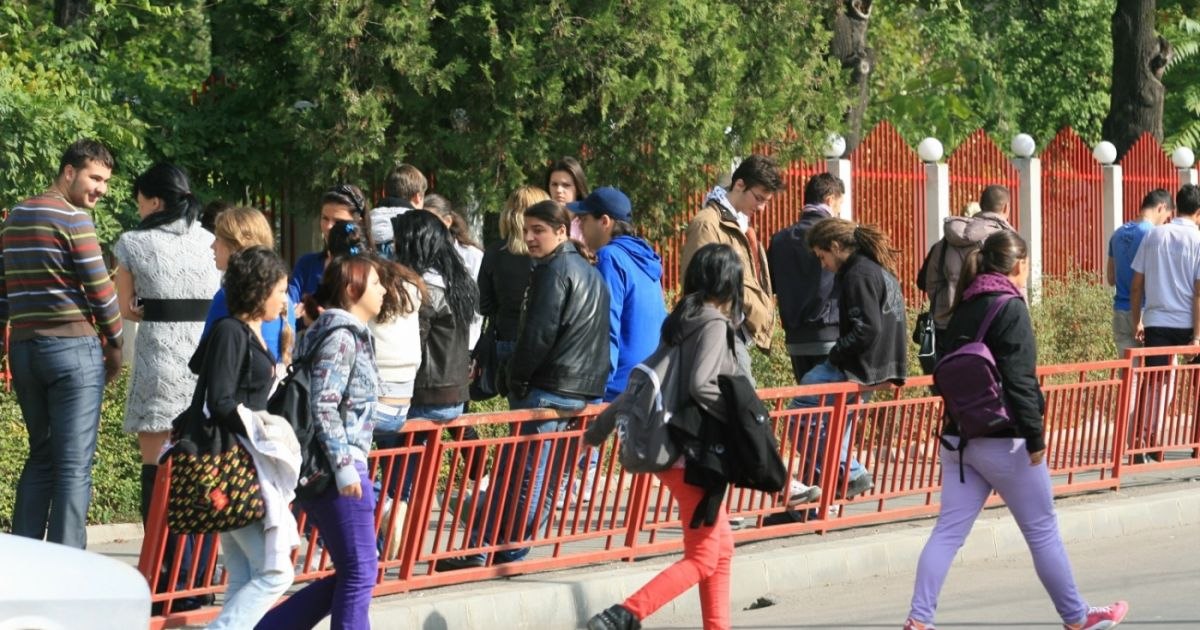
The participation of students over 14 years of age in the “Health Education” lesson should no longer be conditional on parental consent. In other words, high school students have enough discernment to make such a decision on their own: whether or not they want to be informed about some essential aspects of their life and sexuality. It is a proposal made by the “Save the Children” organization in the context in which Romania ranks first in Europe in terms of the number of underage mothers.
But, first of all, there should be such an optional subject in schools. Which doesn't really happen. Although the law allows it, “Health Education” is taught in very few educational institutions, and where there is availability on the part of teachers, it is often absent on the part of parents and students. Or vice versa.
Health education has been taught in schools, at least theoretically, since 2002. However, in reality, only 10% of students have this subject in their timetable. And the context is as alarming as possible: at the age of 15, one out of four Romanian boys (24%) and one out of seven girls (14%) had sexual contact, and one out of four teenagers who have sex do not use methods of protection. At the same time, Romania ranks first in Europe in terms of the number of underage mothers under 15. These are figures published by the “Save the Children” organization, which tries to make society and the authorities responsible for a dramatic phenomenon. It is more than obvious that urgent action must be taken. And it all starts on the school benches. Or it should start, because “Health Education” exists…but is completely lacking. As a comparison, Denmark, the country that introduced this matter the earliest in the world – precisely in 1930 – records one of the lowest rates of births to teenage girls between the ages of 15 and 19. This rate is more than eight times lower than that of teenage girls in Romania.
What would be done? “Health education,” this Cinderella of classroom subjects, would be a good start, experts believe. But you don't want to. And where you want, you can't. Why is this optional viewed with such reluctance? What could be done about it? Who is opposed and why? These are questions to which we tried to find an answer together with Prof. Dana Bobocea, the director of the “Grigore Moisil” National College in Bucharest and Adina Manea, the director of the “Youth for Youth” organization.
Few teachers, many empty chairs
In Romania we have laws, but many of them are not applied. Education is no exception. “Health education” is an optional subject introduced in schools with the consent of parents starting from the 8th grade, but almost no one opts for it. There are many reasons why children do not learn basic hygiene, contraception, prevention or abuse. One of these is the fact that, at the moment, there is hardly anyone to teach this subject in the classroom. “Health education is done under the curricular area of mathematics and science, which also includes biology, physics and chemistry. And there is a situation: some schools say that there is no one to teach this optional. And where there would be qualified, trained teachers, the students' parents don't want them and, obviously, neither do the students”explained Adina Manea, the director of the organization “Tineri pentru tineri”.
Why aren't there enough people trained to teach this elective? Because the Romanian state, the Ministry of Education or the Ministry of Health is not concerned with their training, but, in general, the NGOs, and the necessary funding comes in spades or not at all. “Teacher training for this optional has not been done for many years. The teachers don't have the resources to work with, they don't have the necessary materials“, explained Adina Manea. But even so, it seems that there is a solution. “Between the years 2000-2005 there was a project entitled “Education for health in the Romanian school”, explains the biology teacher Dana Bobocea, director of the “Grigore Moisil” National College”, high school where this subject is taught only in the 11th and 12th grades. “Many teachers were trained during that time. I myself was part of the team of national trainers. Hundreds of teachers were then trained. There is still a lot of material left that, if updated as much as possible, could be of real help“, explained the teacher.
Who are these people qualified to explain to our children how it is with sex education, an important chapter of the Health Education subject? “They are trained people in this sense. Train. Professors, psychologists, educators, people from the system, but also people who come from other fields and who, in turn, attended these courses offered by non-governmental organizations. These are training courses that last 80 hours and span several years“, explains the representative of the “Youth for youth” organization, which deals directly with the training of these people.
An important matter, but which does not take place in the timetable
Another reason why “Education for health” does not really exist in schools in Romania is related to the framework plan, explains the director of the College Grigore Moisil. “Practically, this subject does not take place in the students' timetable. And let me explain why: in the 9th and 10th grades there is only one hour per week dedicated to these electives. What to choose? You choose according to the specialization of the class. For example, we have social studies classes that are English intensive. An English optional was chosen. In the 11th and 12th grades there are four hours a week and here we can still juggle. In our high school, for example, Health Education is taught, but only in these large classes that specialize in Natural Sciences”, said the teacher.
And one more aspect that should be mentioned: children generally choose subjects that really help them prepare for future exams. “We are talking about the desire of the parents for the students to have, as optionals, computer science, foreign languages, subjects that are possibly given at the Baccalaureate. If the school offers an optional to deepen the Romanian language, surely a high school student will choose it at the expense of other subjects less or even not important for the matriculation exam. For the Baccalaureate, the workload is very high, the children have a lot to learn, most of the time there is not enough time in the classroom, so they prefer to do extra”, explains director Dana Bobocea. The teacher believes that this matter is extremely important. Therefore, it should become compulsory from secondary school as well. “Health education, if done properly, should become a compulsory subject. As it became mandatory, starting this school year, in the common trunk, History of the Jews. Just as we need to know the history of our people, the Jewish people or universal history, so should we have fundamental principles of healthy living“, said the teacher.
When the minority decides for all
Obviously, it is also about the resistance of certain parents. “They are few, but vocal. Very vocal. We are talking about prejudiced, ill-informed parents who have got the message totally wrong, who feel that their students will be encouraged to start their sex lives earlier. Most, however, 70-80%, are withdrawn and echoless“, Adina Manea explains the paradox. “There are parents who want sex education right from grade school. Obviously, the information would be distributed by age group in such a way that it would be understood by the children. The opposition, however, includes very vocal, well-organized and funded ultra-conservative groups, which are keeping an eye on any program that could bring about critical thinking among students, especially on topics related to human rights“, says the representative of “Youth for young people”. And besides these parents, there are also many teachers who do not agree either. “Some refuse to be trained because they don't feel comfortable talking to students about these things, dealing with these topics“, continues Adina Manea.
The director of the “Grigore Moisil” high school confessed to us that she does not believe in the resistance of parents, although there have been and will be more cases. “In general, however, it is not about reluctance. If the parent were properly informed, if it were explained concretely what it is about, what the optional consists of, how it is carried out, what the child learns there… I think they would be convinced that no one wants them harm. If the parent invested more trust in the school, the child would have the most to gain. We all know football and politics but let's let the teachers do their job. They know best what to do“, she also said.
Iulian Cristache, the president of the Federation of Parents, told “Adevărul” that “there is no question of ever saying that we don't need sex education in schools. But it is very important that this discipline is taught by professionals, trained people. Let's be very careful about who comes into the school to talk to the kids about this. On the other hand, we also need an age-appropriate program“. Iulian Cristache specified that sexual education should not be an independent subject, but included in a module alongside legal education, traffic education, financial education, etc. In a word, “Education for life”.
The director of the “Grigore Moisil” National College believes that we should judge more carefully and make greater efforts to understand the real needs of our children. “They need to know how to wash their hands, to be polite, to be responsible, we need to know what are the benchmarks that a child must have today. And we can easily find them in school curricula regardless of discipline. There is no discipline that is not necessary.” says the teacher.
